Tim Cook’s Retirement - An Apple Critic’s Perspective
Audio Summary
AI Summary
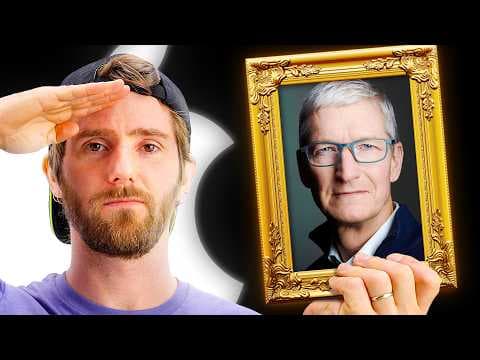
When Tim Cook took over as CEO of Apple in 2011, replacing Steve Jobs, it was a monumental shift. Jobs was a colossal personality in tech, and many questioned how Cook, an awkward supply chain specialist, could possibly fill those shoes. Initially, there was a lot of criticism from both Apple enthusiasts and detractors, who often compared Cook's decisions to the Jobs era, lamenting changes or a perceived lack thereof. The concern was that Cook would be a poor steward of Apple's soul, a company that treated its products as much like art and fashion as like personal electronics.
However, 15 years later, as Tim Cook prepares to step down, it's clear he didn't fill Jobs' shoes in the way many expected; instead, he made his own. While not every move was a success, and some have criticized Apple's design choices, the speaker, focusing more on technology than style, expresses more excitement for Apple's future than ever before. This is largely attributed to Cook's careful stewardship of Steve Jobs' "parting gift": Apple Silicon.
Apple was on an incredible winning streak when Cook took the helm, having revitalized PCs with the iMac, revolutionized personal audio with the iPod and iTunes, and transformed mobile communication with the iPhone. By 2011, Apple's valuation had soared to $300 billion, and in Cook's first year, it became the top smartphone manufacturer globally. While Android devices were emerging, Apple's flagship iPhone, with its premium design and custom-designed A4 processor, was a game-changer. The A4, though not Apple's first custom silicon concept, was the first to reach consumers and enabled advanced features like multitasking on high-resolution displays, video calls, and gyroscope integration, all with impressive battery life.
Apple didn't rest on its laurels. Within 16 months, the A4 was succeeded by the A5, which was twice as fast due to a more advanced architecture, a second CPU core, and superior graphics. This trend of continuous improvement in mobile processors continued under Cook's leadership, with Apple consistently delivering industry-leading performance year after year, even as competitors like Qualcomm and Samsung attempted to catch up.
The mid-2010s, however, presented challenges for the MacBook and Mac, partly due to questionable design choices that limited heat dissipation. A major factor was Intel's struggles. After a long period of success with the Core 2 Duo, Intel began releasing new chips built on old manufacturing processes, failing to advance performance or efficiency. This significantly hampered Apple's ability to innovate, especially as Sir Jony Ive pursued thinner and lighter designs. Additionally, Apple's ongoing feud with Nvidia, stemming from the 2008 "bumpgate" scandal, meant Apple relied on AMD for GPU performance, which wasn't always competitive.
Behind the scenes, Apple's leadership was planning a significant shift. Rumors of ARM-powered Mac prototypes had circulated since 2011, but it wasn't until 2018 that credible reports emerged that Apple deemed its chip performance sufficient to transition away from Intel. The delay was understandable, given the challenges of the PowerPC to x86 Intel transition in 2006, which required developers to recompile and debug applications, costing consumers money and forcing Apple to maintain compatibility tools and parallel OS versions for years. Developing in-house chips is also a substantial undertaking.
Despite these challenges, the Apple Silicon transition was a resounding success, exceeding most expectations. The launch of Apple's M-series silicon was a triumph not just in hardware, but also in software compatibility, with Rosetta 2 and ongoing support for Intel CPUs in macOS providing legacy customers with ample time to upgrade.
Beyond the M-series and AirPods, another Tim Cook success story, the speaker highlights the MacBook Neo as perhaps Cook's most important move. For years, there has been a convergence between the iPad and MacBook, leading many to believe macOS on iPad was inevitable when M-series silicon appeared in the iPad. However, Apple took a different path, putting the A18 Pro, a relatively inexpensive phone chip, into their most affordable MacBook ever.
The $599 MacBook Neo is an outstanding product in its own right, but its significance lies in its potential to revolutionize the education market. Apple had largely abandoned this market by pricing young people and students out of their ecosystem. The Neo's aggressive price point, made possible by the vertical integration and supply chain mastery overseen by Cook, is seen as a "mic drop" moment, akin to Sony's PlayStation launch price. Alongside the Neo, Apple has revamped its education and fleet management tools, creating a powerful alternative to Chromebooks and Windows machines that immediately began to change the industry.
The Neo's success even strained Apple's famously efficient supply chain, a testament to Cook's expertise. Apple's ability to keep products in stock globally, even during disruptions, is nearly unparalleled, a direct result of having a "supply chain guy" at the helm. Under Cook's leadership, Apple's valuation has grown from hundreds of billions to multiple trillions.
While not everything has been perfect, with the Apple Vision Pro being cited as a questionable product that ignores key VR use cases, there's speculation that Apple's VR efforts could evolve, much like the Apple Watch transformed from a luxury item to a health-focused wearable.
As Cook transitions to Executive Chairman, John Turnis, Apple's Senior Vice President for Hardware Engineering and part of the team that introduced the iPad (the first device to use Apple Silicon before the iPhone 4), is taking over as CEO. The speaker expresses enthusiasm for this move, favoring hardware geeks with deep product knowledge reaching top leadership positions. John Suji, who led Apple Silicon design during the A4's development, will replace Turnis as Chief Hardware Officer, further emphasizing Apple's commitment to hardware. This focus on hardware is particularly exciting.