Flawed Victory: The Long Road to a Good Mortal Kombat Movie Sequel
Audio Summary
AI Summary
Mortal Kombat Annihilation, released in 1997, is often viewed as a cautionary tale in video game movie adaptations. However, despite its quality issues, the film demonstrated early instincts for building a cinematic universe, a trait now shared by the recently released Mortal Kombat 2. This analysis explores why Annihilation failed, allowing Mortal Kombat 2 to succeed, by examining the evolution of video game movies in Hollywood.
The 1990s were a period of experimentation for Hollywood in adapting video games. Early attempts like Super Mario Bros. (1993) and Double Dragon (1994) were largely unsuccessful, proving challenging tonally and creatively. Street Fighter (1994), however, achieved a stronger box office performance, suggesting potential for well-reworked game franchises. Mortal Kombat itself was a significant cultural phenomenon by the early 90s, not only for its popularity but also for the controversy surrounding its violence, which led to the creation of the ESRB. This controversy, paradoxically, elevated Mortal Kombat to household name status, making it an attractive property for adaptation.
Lawrence Kasanoff recognized this potential, optioning the franchise in 1993. Paul W.S. Anderson, fresh off his debut, was chosen to direct the first Mortal Kombat film. With creator involvement, a reasonable budget, and a straightforward tournament narrative, the 1995 movie became a global box office hit, reclaiming the title of highest-grossing video game adaptation.
The sequel, Mortal Kombat Annihilation, was intended to build on this success with a "more is more" ethos. While there was ample untapped mythology from the first three games, and audiences responded well to the fantasy elements, a significant factor in Annihilation's downfall was the departure of key creative personnel. Robin Shou and Talisa Soto were the only returning actors. The most critical loss was director Paul W.S. Anderson, who opted to direct Event Horizon instead.
John R. Leonetti, the cinematographer of the first film, took over directing duties. While this seemed like a logical choice given the tight development schedule, it was Leonetti's directorial debut, a significant challenge for any film, especially a martial arts movie heavily reliant on visual effects.
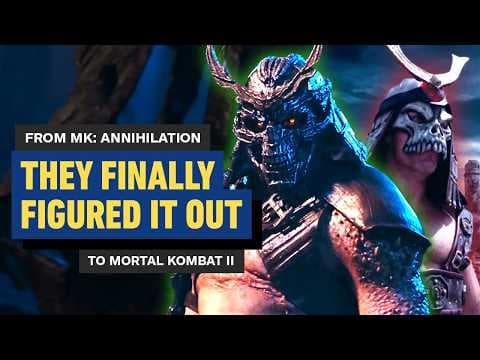
Annihilation picks up immediately after the first film, with Shao Kahn, Emperor of Outworld, invading Earthrealm with characters from Mortal Kombat 3. The film introduces a host of new villains like Motaro, Ermac, Smoke, and Sindel. While these characters hinted at a broader world, their cinematic execution was largely forgettable. The plot involves the heroes preparing for Shao Kahn's invasion, seeking new allies like Jax Briggs and Nightwolf, and exploring concepts like the animality. A notable casting change was James Remar as Raiden, who brought a warmer presence to the role compared to Christopher Lambert's more stoic portrayal. The film also introduces a retcon where Shao Kahn and Raiden are brothers, sons of the Elder God Shinnok, who is secretly manipulating events.
These attempts to expand the mythology were conceptually sound, aiming to represent the games more faithfully. However, the execution suffered due to the limitations of mid-to-late 90s visual effects. The film's reliance on CGI, particularly in the climactic dragon transformations, resulted in a visually jarring experience that failed to capture the magic of the original. The fight choreography and emotional resolution also fell short compared to the satisfying conclusion of the first movie.
Despite its flaws, Mortal Kombat Annihilation can be seen as an important step in the evolution of video game adaptations. It pushed boundaries in world-building and visual ambition, even if the technology couldn't keep pace. Compared to later, equally flawed adaptations like Street Fighter: The Legend of Chun-Li, Annihilation appears less egregious. In hindsight, it represents a necessary trial-and-error phase, paving the way for more successful adaptations like Mortal Kombat 2, which successfully balances spectacle with a deeper respect for the source material.