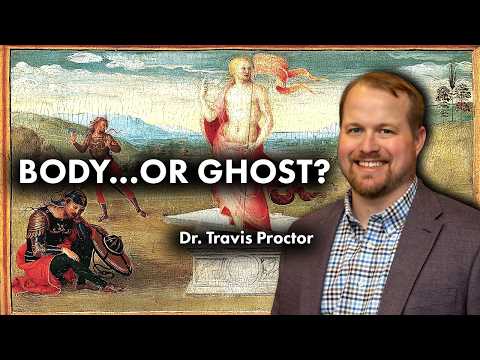
Did Early Christians Think Jesus Was a Ghost? | ft. Travis Proctor
AI Summary
When most modern Christians consider the resurrection of Jesus, the physical nature of his body is rarely a point of contention, generally assuming a bodily resurrection. However, early Christian texts reveal significant anxiety regarding the physical nature of Jesus's resurrected body. The question was whether he was raised in a tangible flesh-and-blood body or something more ethereal, like a spirit or ghost. Some passages depict the resurrected Jesus eating food and inviting touch, such as the story of doubting Thomas, yet in the same scene, Jesus appears and disappears suddenly in a locked room. This ambiguity presented a real theological problem for early Christians, with different texts offering varied answers.
Dr. Travis Proctor, a scholar of early Christianity specializing in resurrection traditions and ancient ideas about bodies and spirits, highlights these tensions. His research focuses on "special bodies" in the ancient world, like those of demons, angels, or spirits, which were often thought to have some bodily form, even if not strictly material. Jesus's post-resurrection appearances, such as moving through locked doors or sudden appearances and disappearances, suggest an unusual bodily form. Conversely, other gospel accounts, particularly in Luke and John, emphasize Jesus retaining a regular human body. For instance, Jesus in Luke tells disciples to touch him to confirm he has flesh and bones, "unlike a spirit." This creates a tension between a "spirit-like" body and a "normal human" body.
Ancient understandings of physics are crucial to comprehending these debates. Unlike modern dualisms of immaterial versus material, antiquity often viewed "spirit" (pneuma) as a subtle form of matter, ethereal but still physical. Most ancient thinkers did not believe anything was entirely incorporeal; even divine beings or spirits had some kind of "stuff." Paul, in 1 Corinthians 15, describes resurrected bodies as "psychical" or "pneumatic," suggesting a soul-like or spirit-like body made of thinner, more refined matter than earthly flesh, but still material. This pneumatic body would explain Jesus's abilities to appear and disappear or pass through solid objects.
However, Luke's resurrection accounts seem to contradict Paul's view. Luke emphasizes Jesus's flesh and bones, seemingly refuting the idea of a pneumatic body. This suggests differing ideas among early Christians about the nature of heavenly embodiment, which then influenced later Christian groups like the Valentinians, who believed in hierarchical types of humans composed of varying degrees of "pneumatic" or "fleshly" matter.
The preoccupation with these physics questions among early Christians stems from the ancient understanding of cosmic hierarchies. Earthly realms had fleshly bodies, while higher realms contained thinner bodies made of fire or pneuma, inhabited by demons, angels, and spirits. The highest divinities might have an even more special substance or be entirely immaterial. The idea of a fleshly body in the heavenly realm, as implied by a fully physical resurrection, would have been considered "weird" in the ancient world. Paul explicitly states that the resurrected body "cannot be flesh and blood."
Dr. Proctor suggests that the emphasis on a more fleshly resurrection might have developed due to doubts within the early Christian community and among those they preached to. The disciples' initial skepticism and the need to confirm that Jesus truly came back, rather than being a mere vision or delusion, may have led to the development of traditions emphasizing physical reality. The empty tomb narratives, which Dr. Proctor believes might be later additions, could also serve this purpose of confirming a physical resurrection.
The idea of Jesus's body being entirely fleshly after resurrection was scandalous to some. For Valentinians, who believed in a hierarchy of matter, the concept of Jesus being composed of the "basest, fleshliest" matter was a theological problem. Some early Christian thinkers, like Valentinus himself, even speculated that Jesus didn't defecate, implying his body was not entirely fleshly. Conversely, figures like Tertullian vehemently emphasized Jesus's fleshly nature, even using "shocking" language about the "filth of the womb," to combat docetism (the belief that Jesus only "seemed" to have a body) and assert the reality of Jesus's physical embodiment.
Dr. Proctor has also compared resurrection narratives with ancient ghost stories. Many ancient ghost stories share motifs with the Jesus story, such as the ability to appear through locked doors or sudden appearances and vanishings. These stories often involved individuals who died violently or prematurely, appearing to loved ones or those who betrayed them. In the ancient world, such appearances were understood as signs that "something wrong has just happened," signaling divine disfavor. Early Christians might have used these "ghost storytelling motifs" to communicate that Jesus was "vindicated by God" after his wrongful death.
Non-canonical resurrection narratives also offer unique perspectives. The Gospel of Peter, a fragmentary second-century text, uniquely depicts the actual resurrection: two angels and Jesus emerge from the tomb, with Jesus's head stretching to the heavens. A striking detail is the cross following them and speaking, asking if Jesus "preached to those who are asleep"—an early reference to the "harrowing of hell" tradition, where Jesus preached to the dead during his entombment. This text also shows the early development of the cross as a religious symbol.
Ignatius of Antioch, a second-century church father, also emphasized Jesus's fleshly resurrection, quoting a tradition where Jesus tells followers to "touch me and see that I'm not a demon," possibly from a lost gospel. This highlights ongoing debates and the condemnation of docetic Christologies, equating a spirit-like resurrected body with a demonic one.
Another text, the Epistula Apostolorum, further emphasizes Jesus's physicality by having him invite disciples to touch his side, feet, and hands, explicitly stating, "look at my hands or look at my feet and see that they don't touch the ground or see that they touch the ground because a ghost doesn't make a footprint." This directly addresses the concern that Jesus might be a ghost, confirming his solid, earth-treading body.
The Gospel of Thomas, an early saying gospel, is notable for its *lack* of a resurrection account, suggesting that for some early Christians, the resurrection was not as central as it became for others. This diversity of thought underscores the wide range of interpretations and concerns surrounding the resurrection in early Christianity.
The empty tomb tradition, found in Mark and elaborated in Matthew, Luke, and John, is not mentioned by Paul, who instead emphasizes visionary appearances of Jesus. The consistent mention of Mary Magdalene and other women discovering the tomb, combined with Paul's omission of their resurrection appearances, leads some scholars to suggest the empty tomb tradition might be a later development. It could have emerged as an apologetic response to doubts about the visions, aiming to confirm a physical reality to Jesus's disappearance and subsequent appearances. The gospels' emphasis on Jesus being laid in a "new tomb where no one else has ever been laid" also addresses potential skepticism regarding bodies being misplaced or confused in multi-niche family tombs common in the first century. This detail reinforces that it was specifically Jesus's body that was missing and transformed.
Ultimately, the early Christian texts reveal profound theological and philosophical anxieties about the materiality of the resurrected Jesus, a concern that shaped early Christian thought and theology in ways that are often overlooked in modern interpretations.