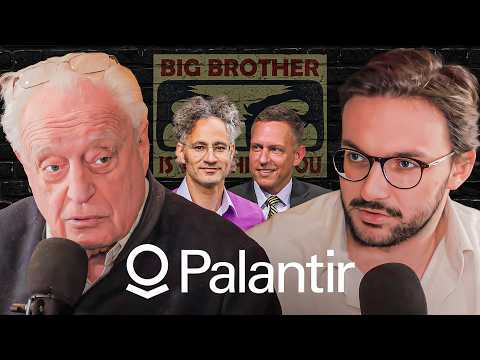
Big Brother: le manifeste de Palantir
AI Summary
The discussion centers on Palantir, a US company valued at $200 billion, which, despite its valuation, doesn't generate significant profits, with its revenue primarily coming from government contracts, particularly with the US and other Western nations. Palantir recently published a 22-point manifesto on the "Technological Republic" on X (formerly Twitter), a condensed version of a text by its CEO, Alex Karp. This manifesto has sparked strong reactions, with some decrying it as "techno-fascism" and others applauding it.
Palantir, founded in 2003 in Palo Alto, takes its name from "The Lord of the Rings," referring to a seeing stone that grants vast knowledge but corrupts its user. This name aptly reflects the company's business: developing data analysis software for intelligence agencies, the US military, border patrol, the Ukrainian army (since 2022), and the CIA. Their systems were instrumental in locating Osama bin Laden. The company, which went public in 2020 after 17 years of private operation, is deeply intertwined with government contracts, a fact noted as unusual for a publicly traded entity. The speaker advises against investing in Palantir.
Peter Thiel, a co-founder of PayPal and an early investor in Facebook, is identified as the ideological backbone of Palantir. A staunch libertarian, Thiel was one of the few Silicon Valley figures to openly support Donald Trump in 2016. His core thesis is that competition is detrimental and that the ultimate goal of any competition is to achieve a monopoly, as monopolies allow for the creation of lasting structures. Thiel laments technological stagnation, arguing that promises of flying cars were replaced by the internet, leaving the public disappointed. He believes the West is in decline due to intellectual cowardice and a refusal to define itself. His foundation funds scholarships for young people to drop out of university and start businesses, and he financed the lawsuit that bankrupted Gawker. Thiel is seen as both brilliant and dangerous.
Thiel's 2003 essay, "The Straussian Moment," published in 2007, is central to understanding his philosophy. This text, circulated primarily in conservative American circles, posits that while liberal democracies are defined by individual rights, they must sometimes act against this rigid identity to survive external threats like terrorism. This idea, which suggests a temporary "dictatorial" phase for survival, led to measures like the Patriot Act after 9/11 and the US's subsequent military interventions, which the speaker views as a betrayal of liberal ideals and a victory for adversaries like Bin Laden. The speaker critically compares this "Christianity of the right" to Nazi doctrine, highlighting its emphasis on military strength and a lack of moral constraint. The manifesto's call for hard power built on software and a professional army to enforce American values globally is described as "terrifying" and "abominable," centralizing power in the hands of a self-proclaimed intelligent elite.
The speaker rejects the argument that such advanced AI-driven warfare is necessary because enemies will develop it anyway, calling it a "first-strike" mentality that has led the US from disaster to disaster since 9/11. This approach contradicts the essence of the US as a decentralized power, wary of concentrated authority. The US Constitution, once a model of balance, has been betrayed for 30 years, leading to continuous failures. The speaker suggests that investing in education and cleaning up Washington's corruption would be far more beneficial than endless military spending.
Alex Karp, Palantir's CEO, has an interesting background. Born in New York to a Jewish pediatrician father and an African-American artist mother, he grew up dyslexic with parents active in civil rights. This background instilled in him a strong affinity for fighting discrimination. While not a libertarian like Thiel, Karp arrived at similar conclusions about the need to defend civilization, albeit through offensive methods. He studied philosophy and law, eventually pursuing a philosophy doctorate in Frankfurt under Jürgen Habermas, a central figure in European critical theory. However, Karp's focus on the psychodynamics of aggression and the origins of violence, including antisemitism, led to an intellectual break with Habermas's emphasis on rational dialogue and emancipation. Karp concluded that the European intellectual elite, while brilliant in critique, was paralyzed in action, producing sophisticated analyses without building anything. This "disgust with analytic nihilism" pushed him towards Thiel's view that true intellectual responsibility lies in construction, not commentary.
The speaker finds Palantir's vision both fascinating and terrifying, seeing it as a potential tool for dictatorship, where "virtuous men" wield immense power, mirroring the justifications of all dictatorships. The manifesto's claim of ensuring an "extraordinarily long peace" by the US is challenged, given the US's history of being almost constantly at war. The speaker interprets the manifesto as a declaration of post-liberal, post-Christian America, where the founding principles of preventing individuals from seizing power are abandoned in favor of a self-righteous elite taking all power. This is seen as a "folly" that could lead to catastrophe, akin to historical totalitarian ideologies.
The manifesto's lack of emphasis on individual liberty, democracy, or religion—concepts central to American identity—is noted. The idea of "technological republic" is deconstructed, with the speaker arguing that combining such terms often signifies the opposite of their original meaning (e.g., "technological republic" means "not a republic"). The company's practice of funding both Democrats and Republicans and its deep integration with the military-industrial complex are highlighted as means of influencing politics and ensuring continued government contracts. The speaker expresses deep concern that such ideologies, once confined to Europe, are now prevalent in the US, indicating a profound societal sickness.
The argument for universal national service is also criticized, as it undermines individual liberty by forcing citizens into military obedience, contrasting with the voluntary nature of a professional army. The notion that the US has the right to unilaterally debate and initiate military action abroad is equated to historical acts of aggression. The speaker fears that this philosophy represents a complete remodeling of the American identity, potentially leading to a surveillance state where human intelligence is replaced by artificial computation, ultimately breeding widespread resentment and a desire for escape from constant monitoring. The speaker concludes that this manifesto is an "abomination" that signals a dangerous path for the US, threatening individual liberties and potentially leading to disaster.