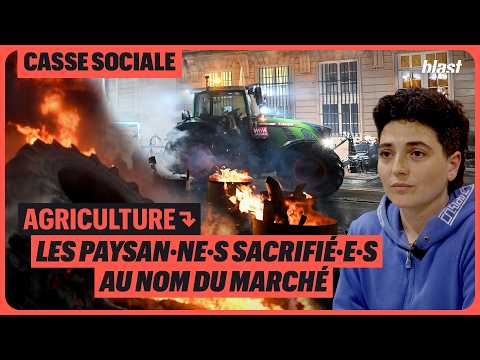
AGRICULTURE : LES PAYSAN·NE·S SACRIFIÉ·E·S AU NOM DU MARCHÉ
AI Summary
The agricultural sector is facing a severe social crisis, marked by exhaustion, inflation, and regulations imposed by multinational corporations. This situation is further exacerbated by incidents like the culling of herds, which often represent a family legacy. When the bond between humans and living beings is severed, devastating consequences can ensue. A recent example occurred last December in Ariège, France, where the outbreak of Contagious Bovine Dermatosis (DNC) led to the culling of 200 cows under the Ministry of Agriculture's orders. While some may view these animals as mere objects, for many farmers, these cows are considered "souls," and their culling feels like an attack on their very reason for being. The appropriation of living beings and the control over what farms produce, how they produce it, and their dependencies, are seen as contrary to the nature of farming. Many believe that national immunity and large-scale distribution are the primary culprits behind the current plight of farmers.
A recent episode of "Casse sociale" explored this issue, visiting Campaign sur Haris, a town near the affected farm. The trauma from the DNC outbreak is still palpable, making it difficult to find farmers willing to speak on camera. However, the team met with "neo-rural" individuals who left urban life to pursue farming in a neighboring area. They embraced agriculture out of conviction, seeking to find meaning in their lives. They shared their perspectives on the DNC crisis, the broader challenges facing the agricultural world, and the responsibilities of both political entities and multinational corporations, as well as their radical decision to become farmers.
Irina, one of these neo-rural farmers, has always felt a deep connection to animals. Despite starting her career in a business school in Lyon, she eventually returned to her passion for animals and living things. Her radical shift stemmed from a global reflection on her identity, what gives her life meaning, and how she wants to contribute to society. Thbo, another farmer, has been a market gardener for 15 years, with 10 years working independently. He sells three-quarters of his produce at markets and also supplies organic stores, with carrots and lettuce being his flagship products. For him, his farm is his entire life—his home, his workplace, and deeply intertwined with his personal existence. He expresses a profound love for the land, seeing his work as a service to society by providing fresh, quality vegetables year-round. He believes that living a good life means waking up every day in awe of the life you have, and for him, farming provides that fulfillment.
However, the reality for many farmers is harsh. Global competition and overproduction have led to the collapse of selling prices for certain products, such as meat and milk, which saw a 30% drop in one year. Farmers like Alain and Daniel sell milk for about 20 euro cents per liter, while their production cost is around 25 cents. Nearing retirement, they face a dire situation, forced to either wait for market prices to recover or discard their produce. The most significant degradation they've experienced is inflation, with charges increasing by 30-50% without being able to pass these costs onto consumers. They explain that market law dictates what people are willing to pay, and increasing prices would mean losing customers.
The farmers firmly believe that multinational corporations and large distributors, who manipulate the state and political decisions, are the biggest contributors to their predicament. They feel a lack of true independence, heavily reliant on EU agricultural subsidies (CAP aids), price increases, and certain quality services. They fear that if they don't conform to increasingly stringent regulations, they will be left behind. This uncertainty about the future causes significant anxiety among farmers, with many worrying about the prospect of losing their livelihoods.
The issue is compounded by consumer behavior. While some consumers seek out organic, farm-fresh products at competitive prices, the market is flooded with cheaper alternatives from other parts of the world, produced under less inclusive social and environmental standards. This creates a challenging environment for local farmers who adhere to higher standards. The push to conform to specific norms to access agricultural land is seen as a way to ensure that all products meet the same standards, use the same inputs, and are produced by the same large corporations, ultimately concentrating profits in the same pockets.
Many small-scale farmers note that they effectively earn the agricultural minimum wage, meaning two people working full-time might collectively earn the equivalent of one minimum wage. They can only survive through direct sales, as they lack the economies of scale to sell to large distributors at prices 30-50% lower than what they receive directly. They argue that current societal rules and norms do not support small farms, yet a robust, nourishing agricultural system would benefit from more small-scale producers rather than a few large ones. While large corporations feed many people, they often do so with low-quality, low-cost products, perpetuating institutionalized precarity that affects not only farmers but many others.
The farmers observe a growing public awareness that certain forms of agriculture produce "shit," both in terms of food quality and environmental impact, leading to degraded landscapes and water. The DNC, a non-transmissible nodular dermatosis in humans, characterized by nodules and fever, is spread by insect bites. It first appeared in Savoie in June and has since spread to the southwest. The recent culling of over 200 cows in Ariège, despite protests and clashes with law enforcement, deeply affected the community. The affected farm, located in Borde sur Haris, is just a few kilometers from where Irina, Thbo, and Sébastien work. A solidarity movement quickly formed among local farmers following the announcement of the culling.
The speed at which the information spread and the immediate mobilization of farmers to block authorities highlighted the deep-seated concern. The culled herd was the result of generations of genetic selection, making its loss even more devastating. The fact that the cows were culled on-site and then transported across France for incineration, despite a stated sanitary policy to prevent bovine movement, further fueled outrage. For many, the cows are not just objects but "souls" that live on the land and with them, touching their instinct for survival. The farmers question the scientific and economic justifications for such actions, which they perceive as a violent imposition of decisions, undermining public trust and human dignity.
They emphasize that nature takes time—trees grow slowly, and a cow raises its calf over time. To have years of work and dedication erased overnight is devastating, leading some farmers to suicide. They believe these farmers are trapped in a production system imposed by multinationals, so-called cooperatives, and lending institutions, all working hand-in-hand. For every farmer, there are many others who profit from their work—bankers, machinery dealers, and various organizations—all earning significantly more than the farmers themselves.
The arbitrary culling of a herd, regardless of the farmer's reasons or agenda, is seen as a stark reminder of their place within a larger system. A herd is an essential part of a livestock breeder's reason for living, a constant commitment regardless of weather or personal circumstances, often at the expense of family or other activities. The act of culling a herd against a farmer's will, especially for reasons not related to human or animal health, is an attack on their daily existence and their ability to cope with life's challenges.
This appropriation of living beings and control over agricultural production impoverishes the spirit, desire, and will to continue in a demanding profession that affects body, mind, and social life. When the desire to engage with the world is lost, suicide becomes a tragic outcome. The crisis extends beyond agriculture to the entire rural network; without clients and interconnected communities, the rural and agricultural sectors cannot survive. Such direct attacks on specific areas cause widespread and underestimated damage.
Coming together as a collective provides a vital source of support against a state perceived as morally bankrupt and insensitive. However, a sense of disillusionment has grown over the years, as their voices are rarely heard, and decisions seldom move in the right direction. The exasperating reality is that significant mobilization and struggle are often required to achieve common-sense decisions, diverting energy from production and family life towards fighting for basic principles.
The violence in the agricultural world is insidious and daily, making the profession even more challenging and requiring immense strength to resist the prevailing currents. Drawing on a quote from Coluche, the farmers suggest that if people simply stopped buying products from the conventional, industrial agricultural model, that production would cease. They believe that the most significant power lies in daily purchasing decisions, urging consumers to recognize their role in shaping the agricultural landscape.