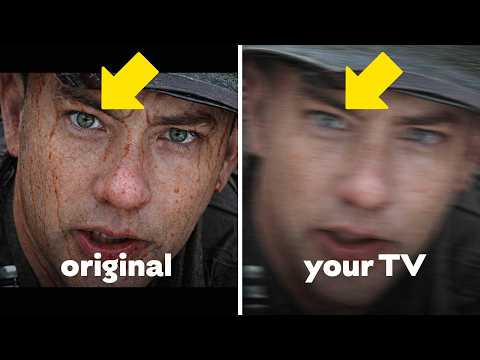
Your TV Is Ruining Every Movie You Watch
AI Summary
The presenter describes a "glitch" on modern TVs that makes movies look "too smooth," like store display models, which he later identifies as a feature designed to compensate for an older technological problem. This issue stems from the fundamental difference in how movies are shot and how modern TVs display them.
Movies have been traditionally shot at 24 frames per second (fps) for nearly a century. This standard emerged from early cinema, which leveraged the "persistence of vision" in human eyes to create the illusion of movement from a sequence of still images. Early cinematographers discovered that around 12 frames per second was the minimum to avoid flickering, but the industry eventually settled on 24 fps. This rate was partly chosen for practical reasons, such as syncing audio in the transition from silent films and aligning with film length calculations (90 feet of film per minute at 24 fps). It also became part of the "language of film," where subtle details like film grain, noise, and a slight flicker contributed to an immersive yet distinctly non-real aesthetic.
The 24 fps standard also dictated a specific "shutter speed" in film cameras. Traditionally, a 180-degree shutter meant that each frame was exposed for half the duration of the frame interval, or 1/48th of a second at 24 fps. This creates a natural motion blur that viewers have come to associate with a "cinematic" look. However, directors can intentionally alter this. For instance, "Saving Private Ryan" famously used a 45-degree shutter, exposing frames for only 1/200th of a second. This narrower shutter angle minimizes motion blur, creating a crisp, almost "frozen" effect that contributes to the film's distinct visual style, a technique also seen in movies like "Gladiator." Conversely, some films like "The Wolf of Wall Street" use slower shutter speeds (e.g., 1/12th of a second) for a blurrier effect, sometimes to capture more light in dark scenes.
The problem arises because modern TVs, particularly in North America, operate at a 60 Hz refresh rate. This standard was established because early television sets were tied to the frequency of the power grid (60 Hz in North America, 50 Hz in Europe). Content meant for broadcast TV was therefore shot at 30 fps (or 29.97 fps for color TV) to match the 60 Hz grid, while in Europe, it was 25 fps for 50 Hz grids. This created a disconnect between film (24 fps) and television (30 fps).
When a 24 fps movie is played on a 60 Hz TV, the TV must "cheat" to convert the frame rate. Since 60 is not a direct multiple of 24, a common method called "3:2 pulldown" is used. In this method, some movie frames are displayed for three refresh cycles and others for two, adding up to 60 cycles per second. This uneven display causes a noticeable "judder" or "stutter," especially during panning shots, which many viewers find distracting. This issue is not due to bad internet or cables but the TV's attempt to reconcile incompatible frame rates.
The alternative to 3:2 pulldown is the "smoothing" option found on most modern TVs. This feature generates "middle frames" to fill the gaps between the original 24 frames, making the motion appear smoother. However, this artificial smoothing alters the director's intended look, often resulting in what is pejoratively called the "soap opera effect," as television soap operas are typically shot at higher frame rates. The presenter argues that this feature undermines artistic intent, as it modifies how a film was designed to be seen.
The presenter's team experimented with shooting parts of their video at 60 fps versus their usual 24 fps to illustrate this difference, emphasizing the importance of viewers ensuring their playback settings are at 60 fps to properly observe the contrast. They note that even YouTube videos, which are often shot at 24 fps for a "cinematic" feel, face the same 3:2 pulldown problem on 60 Hz screens.
The industry has explored higher frame rates (HFR) for films, notably Peter Jackson's "The Hobbit" trilogy, which was shot at 48 fps. While intended to reduce flicker, particularly for 3D viewing, many viewers found the HFR films "unbearable," leading to its practical disappearance as a trend.
For other types of content, like sports, higher frame rates and smoothing can be beneficial, providing a more "buttery smooth" and immersive experience. Gaming also greatly benefits from higher frame rates.
A potential solution for film enthusiasts lies in newer TVs with 120 Hz refresh rates. Since 120 is divisible by both 24 and 30, it can cleanly display both film (24 fps) and broadcast TV (30 fps) content without 3:2 pulldown or artificial smoothing. Each 24 fps frame can be displayed for five cycles, and each 30 fps frame for four cycles, eliminating judder. Additionally, some modern TVs support Variable Refresh Rates (VRR), allowing the screen's refresh rate to dynamically match the content's frame rate (e.g., switching to 24 Hz for a 24 fps movie), provided the source device and HDMI cable also support VRR.
The presenter concludes by reflecting on his own YouTube channel's practice of shooting at 24 fps for a "cinematic" look, questioning if they should adapt to 30 fps given that their content is primarily viewed on 60 Hz screens. He emphasizes the importance of respecting the director's intent and seeking the most accurate viewing experience.