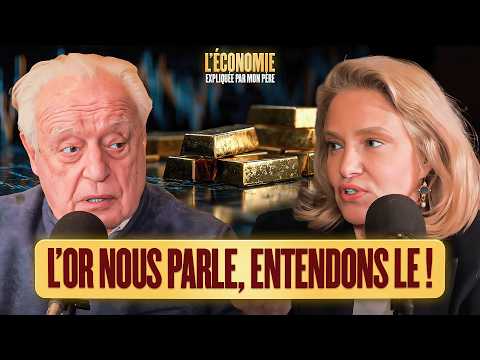
L'or nous parle, écoutons le ! Par Charles et Emmanuelle Gave
AI Summary
In this discussion from the Institut des Libertés, Charles Gave explores the complex and often misunderstood relationship between gold and the financial markets. He argues that understanding this relationship is essential because it touches upon the very nature of money—a concept so difficult that even the great economist Joseph Schumpeter reportedly abandoned a book on the subject toward the end of his life.
### The Nature of Money and the "Canary in the Mine"
Gave defines money not as an object of intrinsic value, but as an intellectual creation and a measurement tool used to fix prices. It is a philosophical idea that usually stays in sync with the productive system. However, when the price of gold begins to diverge significantly from currency values, it acts as a "canary in the coal mine." A sharp rise in gold indicates that the system is malfunctioning and that central bankers are failing in their roles.
Currently, gold and commodities like silver and copper are significantly outperforming the broader market. Gave points out a phenomenon he calls "monetary illusion": while the US stock market appears to be reaching new highs in dollar terms, it is actually lower today than it was in the year 2000 when measured in gold. This suggests that the perceived gains in the stock market are largely a byproduct of currency devaluation rather than real growth.
### The "One Gram of Gold" Rule
To illustrate this, Gave analyzes the history of dividends from the S&P 500 dating back to 1908. In nominal dollar terms, dividends have exploded from under a dollar to roughly $119 today. However, when these dividends are measured in gold, the value has remained remarkably flat for over a century.
A key insight from Gave’s research is that the annual dividend per share of the S&P 500 consistently reverts to the value of one gram of gold. This creates a reliable arbitrage signal:
- When the dividend value rises significantly above the price of one gram of gold, it is time to sell stocks and buy gold.
- When the dividend value falls well below one gram of gold, it is time to sell gold and buy stocks.
Gave notes that since 2020, we have been moving out of a "buy gold" phase and are gradually approaching a zone where buying stocks becomes more attractive, though we are not fully there yet. He theorizes that the market maintains this "one gram" equilibrium to entice "rentiers" (savers living off their capital). By offering a dividend indexed to gold, the market provides an alternative to simply selling off gold reserves, allowing investors to preserve their capital while receiving a steady income.
### Gresham’s Law and the Flight from the Dollar
The current market instability is driven by a loss of confidence in the US dollar. Gave invokes Gresham’s Law—the economic principle that "bad money drives out good." In this context, the dollar has become the "bad money." Investors are fleeing the currency in favor of real assets, such as gold or shares in productive companies.
This flight is justified by the "double deficit" in the United States: the combination of the budget deficit and the trade deficit. Historically, when this double deficit exceeds 10% of GDP—as it does now at 10.4%—it signals a currency crisis. Gave’s data shows a near-perfect correlation between the real price of gold and the US double deficit. Gold is not rising because of simple inflation or political risk, but because the dollar is failing as a stable store of value.
### The Crisis of Social Democracy
Gave argues that the major Western democracies—specifically France, Great Britain, and the United States—are in a state of "pre-collapse" regarding their social-democratic systems. These systems have only remained functional by accumulating massive amounts of debt. He criticizes central bankers for keeping interest rates artificially low for decades to fund state spending, a policy that "violates" savers.
This environment makes traditional "safe" investments, like government bonds in OECD countries, extremely dangerous. Gave warns that as the service on the US debt reaches $1.2 trillion, the system is reaching a breaking point. He advises against holding any fixed-income assets in the currencies of these three nations, suggesting that the "operating system" of Western capitalism is profoundly ill.
### Strategic Investment Conclusions
For those looking to protect their wealth, Gave suggests several shifts in strategy:
1. **The "Turkish Portfolio":** Move away from cash and bonds. Instead, focus exclusively on gold and "real" property, such as stocks in companies with global industrial footprints (e.g., Air Liquide or Total). These companies operate "on the mountain," far from the "tsunami" hitting the currency markets.
2. **Geographic Diversification:** Look toward Asia and Latin America for fixed-income opportunities. He mentions India as a market that, like the US, tracks gold closely and currently presents a "buy stocks" signal. He also notes Vietnam as a growing hub for manufacturing as companies move away from China.
3. **Real Estate Caution:** Gave warns against over-exposure to French real estate. In a severe crisis, the government is likely to block rent increases or implement heavy taxes on property owners to fund its deficits.
4. **Avoid the Debt Trap:** The wealthy currently use low interest rates to borrow against their assets to avoid taxes, but this is only possible as long as rates remain artificially suppressed. If the truth of market prices returns, this strategy will collapse.
Ultimately, Gave concludes that the markets are signaling a historical shift. The era of relying on the dollar and government promises is ending, and investors must seek refuge in real assets and productive industries that exist outside the failing monetary frameworks of the West.