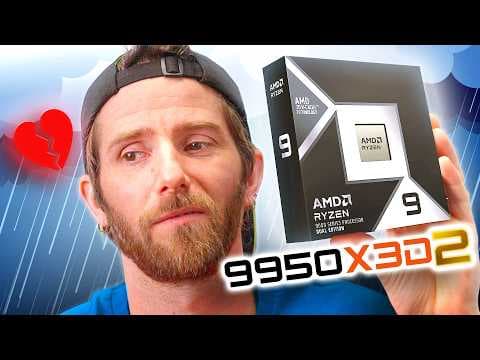
It's Overpriced and I'm EXCITED - Ryzen 9 9950X3D2 Dual Edition Review
Audio Summary
AI Summary
The Ryzen 9 9950X3D2 Dual Edition CPU is presented as an expensive, zero-compromise product designed to push technological limits, though acknowledged as unnecessary for most users. AMD did not provide review chips, causing a delay in the video's release.
The chip's name, 9950X3D2 Dual Edition, indicates several features. "9950X" signifies 16 Zen 5 architecture cores and 32 threads. "3D" refers to a large stacked 3D vCache, offering significant performance benefits, particularly in gaming. The "two" and "dual" aspects mean AMD's large 3D vCache is now present on both core complex dies (CCDs) under the heat spreader, rather than just one. This results in a substantial 192 megabytes of level three cache.
Historically, AMD did not use 3D vCache across all cores due to trade-offs, including increased price and a considerable 30-watt increase in total design power, bringing the dual edition to a 200-watt TDP, which it sometimes exceeded. This extra power also led to a small decrease in boost clock speeds.
In gaming benchmarks, the Ryzen 9 9950X3D2 Dual Edition showed strong performance in titles like Cities Skylines 2 and Cyberpunk 2077, often leading the pack. However, in Cyberpunk 2077, some older, less expensive chips performed comparably in 1% lows. In F124, many high-end processors from previous generations performed well. The chip returned to the top in The Last of Us Part 1 and Counter-Strike 2 (for 1% lows). Despite its speed, the chip is difficult to recommend for gaming for several reasons.
Firstly, gaming CPUs are benchmarked at 1080p to highlight CPU bottlenecks. However, users buying a $900 chip are likely running at 1440p or 4K, where GPU bottlenecks are more common. Secondly, even for esports professionals, the dual edition performs similarly to other 9000 series X3D chips in real-world gaming scenarios. This is because most games do not require more than eight cores. While the dual edition has 3D vCache on all cores, coordinating work across multiple CCDs introduces latency due to data travel across the infinity fabric and IO die. To mitigate this, AMD continues to use "core parking," a technique that forces programs to use specific CPU cores, typically those on CCD0, despite the presence of vCache on all cores. This explains why the dual edition performs similarly to other X3D chips in gaming.
The dual edition is more useful for specific workloads. It benefits users running multiple tasks that benefit from extra cache, such as streaming or recording gameplay without burdening the GPU. Overclockers could theoretically identify faster CCDs for performance-sensitive workloads, but current limitations prevent users from choosing which CCD to use for games, as they are locked to CCD0.
In productivity benchmarks, AMD claimed a 5-10% increase. The Ryzen 9 9950X3D2 Dual Edition performed as an "absolute monster." In 7-Zip, it led other consumer CPUs in both compression and decompression. In Cinebench, it topped or neared the top of charts for multi-core and single-core performance, though its closest competitor was significantly cheaper. In Blender, it showed an advertised 5% improvement over its "less endowed twin" and a 15% improvement over the 7950X3D, making it stand out for value in this specific application. This performance, though only 10 seconds faster than a much more affordable Intel 14700K, can be valuable for professionals where every second counts. It also supports ECC UDIMs on select motherboards, making it a strong semi-pro offering. Similar top-tier performance was observed in H.264 encoding and close performance in AV1. In PugetBench's Photoshop benchmark, it was the first consumer x86 CPU to exceed 14,000 points, but this was a negligible increase over other Zen 5 contenders. In video editing, it topped charts and offered a noticeable uplift over older 3D vCache chips like the 7950X3D, with potential for greater enhancements depending on file types, though significant improvements over non-dual versions were rare. Premiere Pro showed only minor gains.
Beyond standard benchmarks, the extra level three cache can be highly beneficial in "mathy and sciencey workloads," as demonstrated by Pharonix's Linux and scientific benchmarking, where some workloads showed substantial benefits from the extra V-cache. This suggests it could be a powerhouse for niche applications like de-gridding radio signals from space.
Regarding power, the 200-watt TDP is AMD's highest for a consumer chip, drawing up to 260 watts across the total CPU package in Cinebench, comparable to Intel 14900K levels. However, it avoids the 14900K's power density and IHS problems. Users upgrading from older Ryzen CPUs, like the 5950X, should ensure their power supply and CPU cooler can handle the increased power draw. This high power draw is mainly observed in heavy, all-core CPU workloads; in gaming, power draw was similar to its siblings, allowing for manageable temperatures.
In conclusion, the Ryzen 9 9950X3D2 Dual Edition marks a high point in AMD's CPU dominance. However, despite being the fastest, its high price for relatively small gains makes it difficult to recommend. The presenter suggests this chip feels like an "unnecessary victory lap" and prefers AMD to focus on community-desired features like FSR for RDNA 3 GPUs or bringing Zen 5 to budget buyers.