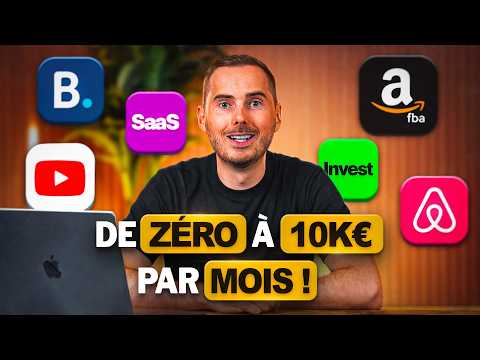
5 façons de gagner +10.000€/mois en 2026
AI Summary
In this video, the speaker shares concrete, personal methods used to reach and exceed €10,000 in monthly profit. Unlike generic advice, these insights are based on business models and investments he has personally implemented. He breaks down these goals into manageable steps, analyzing the time and capital required for each to help viewers achieve financial freedom.
### The Philosophy of the €10,000 Goal
The speaker identifies €10,000 per month as the first major threshold for financial freedom. He believes this level is accessible to anyone willing to put in consistent effort, whereas higher levels—like €100,000 or €1 million a month—require specialized skills or circumstances. However, he offers a reality check: at €10,000 a month, you are "surviving" comfortably rather than becoming truly wealthy. In his view, real wealth begins at €30,000 a month, where significant portions can be reinvested to buy back your time.
A crucial prerequisite to reaching this goal is tax optimization. The speaker warns that without a legal international structure to minimize taxes, a business owner might lose 50% to 70% of their income to the state. He advises entrepreneurs to organize their lives and businesses internationally from the start to accelerate their path to profit.
### Business Model 1: Amazon FBA
Having operated in this space for over ten years, the speaker considers Amazon FBA (Fulfillment by Amazon) one of the best ways to sell physical products. The model involves creating a private label brand and leveraging Amazon’s massive traffic and logistics.
**Key Insights:**
* **Asset Creation:** Beyond monthly cash flow, a brand is a sellable asset usually worth two to three years of profit.
* **Market Strategy:** Success comes from identifying market inefficiencies—finding products with high demand but poor quality or limited options—and sourcing improved versions from factories in China or Europe.
* **Conversion Power:** Amazon’s conversion rates (15% to 30%) far outperform private websites (1% to 3%) because customer trust and payment info are already established.
* **The Math:** To net €10,000 in profit (at a 20-25% margin), one needs €40,000 to €50,000 in monthly turnover. The speaker recommends launching four to five products generating €10,000 each to diversify risk.
* **Requirements:** Reaching this level typically takes 8 to 12 months of reinvesting all profits. A realistic starting budget is €20,000 to €30,000.
### Business Model 2: YouTube and Content Creation
The speaker has used his channel to generate significant profit through three main pillars: selling online courses, individual coaching/mentorship, and affiliate marketing.
**Key Insights:**
* **Affiliate Marketing:** This involves promoting tools and services the creator personally uses (e.g., gold investment platforms or web hosting). While it is his smallest revenue stream, aggregating multiple affiliate programs can exceed €10,000 in profit.
* **Courses and Coaching:** These are high-ticket items. Selling ten training programs at €1,000 each reaches the monthly goal.
* **Requirements:** The budget is minimal—just a smartphone and a microphone. However, it requires a massive investment of time and personality. It took the speaker about a year of consistent effort to hit the €10,000 mark.
### Business Model 3: SAS (Software as a Service)
Software applications with recurring subscriptions have become more accessible due to "Vibe Coding"—using artificial intelligence (like Replite) to write code.
**Key Insights:**
* **Democratization:** Previously, building software required expensive developers. Now, AI allows non-coders to build functional applications for a few hundred or thousand dollars.
* **Micro-Niches:** The strategy is to solve specific micro-problems that were previously too small to be profitable for large firms.
* **The Challenge:** While building the app is now fast (days or weeks), success depends on marketing skills, SEO, and finding the right audience on platforms like Twitter or Reddit.
### Business Model 4: Hybrid Hospitality and Concierge
The speaker’s first business involved managing a family guest house in Morocco. By using Booking.com and Airbnb, he turned a €330,000 property into a €70,000 annual profit.
**Key Insights:**
* **Scaling:** He expanded by creating an Airbnb concierge service, managing up to eight properties for neighbors. This required managing 20 to 30 employees.
* **Sub-leasing:** He notes that "professional sub-leasing"—renting a property long-term and re-renting it on Airbnb—is a viable way to reach €10,000 profit by multiplying operations across several apartments.
* **Limits:** This model is highly stressful and energy-intensive, often hitting a "glass ceiling" due to the operational demands of physical property management.
### The Final Stage: Pure Investment
Once a business generates significant surplus capital, it can be moved into passive investments. The speaker currently generates over €50,000 a month from his capital through fixed-term accounts, bonds, and structured funds.
**Capital Required for €10,000/Month:**
The amount of capital needed depends on the interest rate and risk tolerance:
* **4% Return:** Requires €3 million in capital.
* **5% Return:** Requires €2.4 million in capital.
* **6% Return:** Requires €2 million in capital.
* **10% Return:** Requires €1.2 million in capital (though this involves much higher risk).
### Conclusion
The speaker emphasizes that one should focus on active business models first to build the necessary capital. Once the "snowball effect" takes hold, that capital can be transitioned into passive investments to maintain and grow wealth. The journey requires a realistic timeline—usually at least a year of focused work—and a willingness to reinvest early gains rather than consuming them.