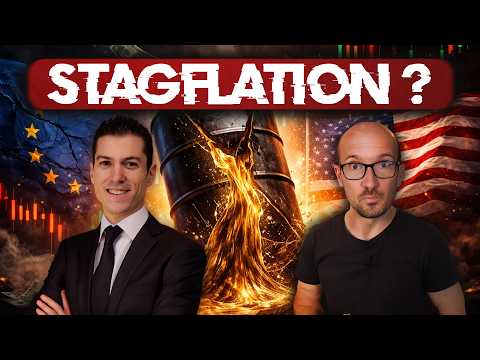
Stagflation en 2026 ? Fed bloquée, pétrole à 100$... Quelle suite pour tes investissements ?
AI Summary
The provided transcript outlines a macro-economic discussion set in 2026, featuring Alexandre Baradez, head of markets at IG. The conversation focuses on the unexpected shift in global markets following conflict in Iran and the resulting surge in oil prices to over $100 per barrel. While the beginning of 2026 was expected to bring monetary easing and relief for central banks, new geopolitical tensions have forced a reassessment of interest rate trajectories and inflation expectations.
**The Dilemma of Central Banks: Fed vs. ECB**
Baradez highlights a significant divergence between the US Federal Reserve and the European Central Bank (ECB). Before the Iranian crisis, the Eurozone was in a relatively comfortable position, with inflation having stabilized below 2% for three consecutive months. Although the oil shock will likely cause a temporary inflationary rebound above 2%, Baradez argues that the ECB is unlikely to implement aggressive rate hikes. He explains that central banks cannot solve a supply-side shock, such as high energy prices or blocked trade routes, through monetary tightening. Consequently, while the ECB may adopt a hawkish tone to maintain credibility, actual rate hikes are improbable unless the crisis becomes prolonged.
In the United States, the Federal Reserve faces a more difficult path. Even before the recent tensions, US core PCE inflation (the Fed's preferred metric) was stuck above 3%, around 3.1%. This persistent inflation, combined with new energy pressures, effectively removes the justification for the Fed to lower interest rates. Baradez suggests the Fed will maintain a "status quo" for several months unless there is a severe impact on employment or a major economic slowdown.
**The Resilience of Wall Street**
A central theme of the discussion is the "immunity" of American markets. Despite 10-year Treasury yields rising above 4.3%, the S&P 500 and NASDAQ have shown remarkable resilience, correcting only about 6% from their highs. Baradez attributes this to three main factors:
1. **Energy Independence:** The United States is a major producer of gas and oil, making it far more autonomous than Europe during energy crises.
2. **Safe-Haven Status:** During geopolitical stress, the US dollar and American assets attract global capital.
3. **Corporate Performance:** Recent earnings for major US companies have remained solid without significant negative surprises.
Furthermore, the enthusiasm surrounding artificial intelligence continues to support the market, though Baradez warns that the full extent of a potential correction may not have been reached yet. He notes the risk of "stagflation" if growth slows while inflation remains high due to energy costs.
**European Markets and Fundamentals**
In contrast to the US, European indices like the CAC and DAX have suffered more significantly, dropping roughly 12%. This underperformance is directly linked to Europe’s lack of energy self-sufficiency. However, Baradez maintains that European fundamentals were sound prior to the shock, with growth forecasts around 1.3% and a dynamic job market.
He posits that the current decline in European markets should be viewed as a "DIP"—a buying opportunity for the medium term. He argues that because the inflation is driven by an external energy shock rather than internal factors like wage acceleration or overheating, the Eurozone is not necessarily headed for a recession. The duration of this downturn depends on the length of the military intervention in Iran. Baradez suggests that because a quick resolution is in the interest of major global players like China, the US, and Europe, the crisis may not last beyond the summer.
**Conclusion and Outlook**
The discussion concludes by emphasizing that while central banks are currently "stuck" between rising inflation and signs of economic fatigue, the structural situation in the Eurozone remains correct. The speakers announce a new partnership to provide regular macro-economic analysis on the channel, aiming to help investors navigate these complex geopolitical and monetary shifts. The key takeaway is to monitor the duration of the Iranian conflict, as a short-term stress event would have a limited impact on long-term growth, whereas a prolonged crisis could force more drastic economic shifts.