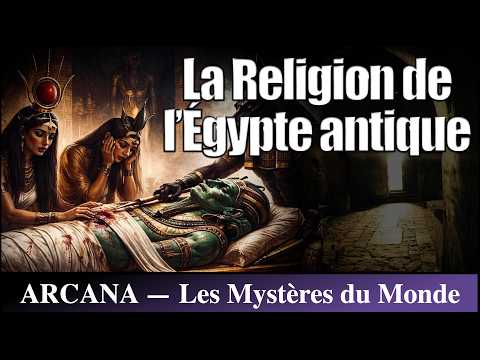
La Religion de l'Égypte antique - Du Mythe à la Réalité
AI Summary
This summary explores the complex reality of ancient Egyptian mythology, religion, and cults, moving beyond the "Egyptomania" of the 17th and 18th centuries to examine the actual beliefs practiced over 3,000 years of history.
### The Problem of Context and Egyptomania
For centuries, Western fascination with Egypt—known as Egyptomania—created a fantasized vision of the pharaohs as the source of all esoteric traditions. This was compounded by the fact that hieroglyphs were not decoded until Jean-François Champollion did so in the mid-19th century. Real Egyptian history is not a monolith; it evolved significantly. For example, the pyramidal architecture of the Old Kingdom (2700–2200 BCE) predates the famous *Book of the Dead*, which only appeared during the New Kingdom (starting in 1550 BCE). Furthermore, Egypt did not have a single unified religion but rather several coexisting cosmogonies (creation myths) that eventually merged.
### The Major Cosmogonies
Unlike Greek mythology, which is relatively unified under Zeus, Egyptian belief varied by region. Each major city had its own explanation for the origin of the world, though they shared common elements like the "Nun" (the primordial ocean).
1. **The Ennead of Heliopolis:** This is the most famous system. From the Nun, the demiurge Atum emerges on a lotus flower. Atum represents the sun in three phases: Khepri (rising), Ra (zenith), and Atum (setting). He produces the first pair, Shu (air) and Tefnut (moisture), who then give birth to Geb (earth) and Nut (sky). Their children are the famous deities: Osiris, Isis, Set, Nephthys, and Horus the Elder.
2. **The Ogdoad of Hermopolis:** This system features eight primordial deities representing chaos. In one version, Thoth (the god of wisdom) is the demiurge who creates the world through his voice (the "Logos"). In another, Thoth is the architect who follows Ra’s creation.
3. **The Memphite Theology:** Here, Ptah is the central chthonic (underworld) creator. He creates Ra (the visible/day) and Thoth (the invisible/night). This cosmogony is one of the oldest, dating back to the Old Kingdom.
4. **The Esna Cosmogony:** A rare matriarchal view where the goddess Neith is the creator. She births both the sun (Ra) and the serpent of chaos (Apophis).
5. **The Cult of Amon (Thebes):** Originally a local god, Amon became a national deity when Thebes rose to political power. He eventually merged with Ra to become Amon-Ra, the "Hidden One" who fertilizes the cosmic egg.
Regarding Akhenaten’s famous "monotheistic" reform, the transcript clarifies that he did not deny other gods but argued they were merely manifestations of the solar disk, Aton. He essentially replaced the top of the divine hierarchy rather than inventing monotheism from scratch.
### Divine Narratives and Mythological Cycles
The myths often lack linear logic but carry deep spiritual meaning. A central theme is the **Sun Barque**, where Ra travels across the sky by day and through the underworld by night. Every night, he must fight **Apophis**, the serpent of chaos. This is an "eschatological" myth: the Egyptians believed that one day Ra would grow too weak to defeat the serpent, and the world would return to primordial chaos.
The **Osiris Myth** is the cornerstone of Egyptian culture. Osiris, the civilizing king, is murdered by his jealous brother, Set, who traps him in a sarcophagus and later dismembers him into 14 pieces. Isis, Osiris's wife, recovers the pieces (assisted by Anubis and Thoth) and performs the first rite of mummification. Osiris does not resurrect physically; instead, his spiritual double is restored so he can become the Judge of the Dead. Their son, Horus, eventually battles Set for the throne, a conflict that mirrors historical transitions between "civilized" Nile dwellers and "barbaric" desert tribes.
### The Composition of the Being
Egyptian "psychology" was far more complex than the Greek "body-soul-spirit" triad. An individual consisted of several interconnected parts:
* **Jet:** The physical body and its image (statues/paintings).
* **Ka:** The vital energy or spiritual double. It requires a preserved body (*Jet*) to survive.
* **Ba:** The personality or uniqueness of the individual, often depicted as a bird.
* **Sheut:** The shadow or ghost-like vestige.
* **Ib (Heart):** The seat of conscience and memory, which is weighed during judgment.
* **Ren:** The name. If a person's name was erased (as with Akhenaten), they were cut off from the material world.
* **Ankh:** The breath of life or divine spark.
* **Heka:** The power of magic, which allowed one to manipulate these forces.
### Death, Judgment, and the Clergy
The goal of life was to prepare for a "good death." Mummification, which evolved from simple preservation to the highly technical 70-day process of the New Kingdom, aimed to keep the *Jet* intact so the *Ka* could journey through the underworld.
The deceased faced the **Tribunal of Osiris**. Their heart (*Ib*) was weighed against the feather of **Maat** (Truth and Justice). The deceased had to recite a "negative confession," claiming they had not committed specific sins. If the heart was balanced, they entered the **Fields of Ialu** (a paradise mirroring earthly life). If it was heavy with sin, the soul was devoured by the monster Ammit and ceased to exist.
Finally, the transcript addresses the **Mystery Cults**. While the "Mysteries of Isis" are famous, they are actually a late Hellenistic (Greek) invention from the 4th century BCE. They adapted Greek initiatory structures (like the Eleusinian Mysteries) to Egyptian gods after Alexander the Great's conquest. Real Egyptian religion was managed by a powerful, organized clergy who performed daily rituals to maintain the cosmic order, serving as delegates for the Pharaoh, the ultimate intermediary between gods and men.