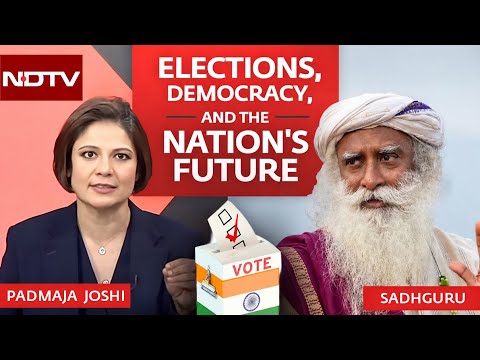
Sadhguru on the 2026 Assembly Election Results | NDTV Interview
AI Summary
The recent elections in India reflect a profound level of maturity and commitment to democracy among the people. Voter turnout, exceeding 80% in most states and over 92% in some, demonstrates the value Indians place on the ballot and the democratic process, a stark contrast to many Western democracies. This is not merely a political shift but a clear statement from the populace, showing their willingness to bring about change when necessary.
The results in West Bengal, where a three-time Chief Minister was significantly defeated, surprised many, but the speaker suggests it was a natural outcome of the Indian public's non-reactive yet resolute nature. While Bengalis are known for their spirited protests, the general populace typically expresses discontent through the ballot, not daily street fights. The victory is attributed to the inspiring commitment of the Prime Minister and the strategic approach of the Home Minister, who demonstrated how to leverage the democratic process effectively. The work of individuals like Mr. Subendu Adhikari, reminiscent of Mamata Banerjee's earlier activism, also played a role. However, the outgoing Chief Minister's reliance on loyalties rather than administrative capacity led to a decline, with corruption and exploitation taking root. A significant factor in Bengal's electoral shift is believed to be events in Bangladesh over the past 12 months, which served as a wake-up call for Bengalis regarding potential future trajectories. The shared history, language, and culture across the artificially drawn border mean that events in Bangladesh deeply resonate in West Bengal, particularly concerning radicalization. While West Bengal is a secular state, the experience of people on the street can differ from official declarations. The historical context of Bengal, a culturally rich "Wanga nation" even in ancient times, has suffered from a decline in intellectual and talented populations due to prolonged periods of violence and lack of administrative foresight, pushing societal issues to street-level conflicts. The speaker emphasizes that political battles should be fought through ballots, not street violence. The migration of a large number of people, including both elites and laborers, from Bengal due to lack of livelihood, protection, and safety, particularly for women, highlights a critical administrative failure that the new government must address with nurturing, not just suppression.
The mention of "saving Sanatan" by Shuvendu Adhikari is seen as a legitimate, though not party-exclusive, agenda, rooted in the historical memory of India's partition on religious grounds. The proximity of Bangladesh, which was once part of Bengal and divided on religious lines, makes the changing demographics a sensitive issue, leading to natural insecurities when changes occur artificially rather than through organic societal evolution.
In Tamil Nadu, the rise of Vijay as a political phenomenon was not a surprise to locals, who are characterized as patient and intelligent voters. They have grown tired of the "ping-pong game" between two fundamentally similar Dravidian parties, both perceived to be engaging in a relay of corruption and promoting a separatist identity that ultimately doesn't serve the people. Vijay, a film star, represents a "fresh breath" and a break from the past, following a tradition of screen idols becoming leaders in Tamil Nadu. While he may lack administrative experience, his decision to abandon a peak film career for public service is seen as a sign of commitment. The speaker believes Vijay, unencumbered by traditional political obligations, has a unique opportunity to lead. He advises Vijay to listen to various sectors of society—industry, farmers, technology—to understand their needs and set achievable goals for the next five years. The central government, viewed as the government of Bharat, has a crucial role in nurturing this new leader, given Tamil Nadu's significant contributions to the nation's economy, technology, and intellect.
The notion of a "Dravidian ideology" being on its last legs is dismissed as a media construct, not a widespread belief among Tamil people. While Tamil language, culture, and literature are important, the idea of Tamil Nadu as a separate cultural entity is a recent political construct, not reflective of historical reality where a broader "Dravidian" culture extended across various regions. The speaker hopes Vijay will adopt a more inclusive approach, moving away from divisive tropes. Regarding the freeing of temples from state control, this is seen as a central government responsibility requiring legislation, not a state-level decision.
Moving to the East, the success of Himanta Biswa Sarma in Assam is highlighted as an example of building bridges with the Muslim community, crucial for the future of Bharat where Muslims identify as Indians, not a separate entity. His focus on addressing illegal immigration, even if it disproportionately affects the Muslim community, is framed as a national security issue, not an anti-Muslim stance. The election results in Assam demonstrate confidence in his leadership and a desire for nationalistic integration over religious division.
Finally, the discussion turns to Kerala, where the Left's continued power, though dwindling, is noted. The erosion of the "red corridor" across India is seen as vital for national development and sovereignty. The shift from Left to Congress in Kerala is viewed positively, as a credible national opposition party like Congress is essential for a healthy democratic process. The speaker criticizes the proliferation of numerous small, divisive parties, advocating for a constitutional amendment to regulate party formation, as they often lack a national vision and can undermine democratic principles. While acknowledging the rare emergence of leaders like Vijay, the long-term well-being of the nation requires established parties with nationalistic roots. The Congress party, despite its current challenges, is seen as the only entity with the fundamental basis to become a credible, constructive opposition. The speaker urges Congress to shed appeasement politics, promote capable leaders, and rebuild itself to ensure a robust opposition in Parliament, essential for a developed nation. The dependence on a single individual, even a popular one, is not sustainable for a party with a century-long history.