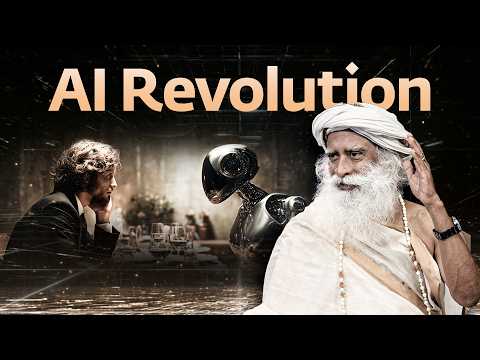
Gen Z, AI, and the Coming Mental Health Crisis– Sadhguru, Swami Sarvapriyananda | Harvard Panel
AI Summary
This panel discussion explores the transformative impact of Artificial Intelligence (AI) on mental health, medicine, and spirituality. The conversation brings together clinical experts and spiritual leaders to debate whether technology will replace human professionals and how it is fundamentally altering the human experience.
**Will AI Replace the Professional?**
The discussion begins with the provocative question of whether AI will replace psychiatrists, psychologists, and spiritual leaders. Dr. John Torous references a famous medical quote: "Any doctor who can be replaced by a computer should be." However, the panel agrees that while AI will not replace humans in general, "AI-boosted" professionals will inevitably replace those who do not use the technology.
Dr. Vikram Patel argues that the interpersonal connection between the helper and the seeker is central to the healing process. He asserts that no matter how advanced a large language model becomes, it cannot replicate the genuine human touch or the deep-seated need for relationship-based care. Sadhguru adds a different perspective, suggesting that AI will likely "wipe out" pundits, priests, and anyone whose role is merely to assimilate and repeat information from books. He views this as a positive development, as it forces humanity to move beyond data processing toward genuine consciousness.
**The "Runaway Horse" of Technology**
A major theme is the unprecedented speed of AI development. Sadhguru uses the metaphor of a horse and rider. Currently, humans are the riders, but he predicts that within 15 to 25 years, both the horse and the rider will be AI. Unlike previous technological revolutions, such as the steam engine, AI moves so rapidly that no legislature or social structure can adapt in time. Those who are agile will "ride" this change, while those who are not may be "crushed" by it.
**Mental Health and "Ultra-Processed Information"**
The panel expresses deep concern regarding the effect of AI on the human mind, particularly for younger generations. Swami Sarvapriyananda highlights three primary risks:
1. **Multiplication of Desires:** AI is being used by commercial forces to target individuals at a granular level, fueling addictive consumption.
2. **Attention Deficit:** The pervasive nature of digital interaction is exacerbating a global crisis of focus.
3. **Philosophical Reductionism:** AI treats humans as bundles of behaviors and data points, ignoring the spiritual concept of humans as conscious beings with higher purposes.
Additionally, the panel notes a decline in critical thinking skills. As people rely on AI for basic cognitive tasks, there is a risk that human intellectual capacity will atrophy. Sadhguru points out that AI is not the root problem; rather, the "compulsive nature" of human beings is the issue. Humans tend to turn every convenience into a "curse" because they lack the consciousness to use tools responsibly.
**Prevention vs. Treatment**
The medical experts emphasize that the current mental health system is reactive, focusing on crisis management rather than prevention. Dr. Patel argues that no medical field has ever reduced the burden of disease through treatment alone; it is always achieved through prevention (such as smoking cessation for lung cancer).
The panel debates the tension between "precision medicine"—which uses AI to target biological pathologies—and "person-centered care," which addresses social, spiritual, and environmental factors. They conclude that a healthy society requires a shift from a biomedical paradigm to one that incorporates social interventions, addressing issues like loneliness and spiritual void.
**The Collapse of the "Human Software"**
Sadhguru offers a stark warning about the long-term trajectory of human health. He argues that mental health is the "software" and physical health is the "hardware." He links the current mental health crisis to a fundamental disconnection from the Earth. He points to the degradation of topsoil and the extinction of microorganisms as a primary cause of human weakening. He predicts that if we do not fix our ecological foundation, we will see a "hardware collapse" where physical bodies begin to fail on a massive scale within the next few decades.
**The Path Forward: Consciousness and Connection**
The panel concludes that the only solution to the challenges posed by AI and environmental decay is a "massive wave of awareness."
* **Individual Responsibility:** Health must be viewed as 100% the responsibility of the individual.
* **Education:** Just as society successfully implemented universal dental hygiene (brushing teeth), it must now implement universal "mental hygiene" through simple meditative practices.
* **Connection to Nature:** Sadhguru urges parents to get children off their phones and back into contact with the soil and the natural world to balance their systems.
* **Universal Possibility:** Despite the risks, there is optimism. If AI handles the "drudgery" of earning a living, it could lead to a future where human genius is allowed to unfold, provided humanity becomes conscious enough to handle its own tools.
Ultimately, the panel agrees that while technology is a great possibility, it requires a "smarter humanity" to ensure it serves as a blessing rather than a source of extinction. The goal is to move toward a "conscious planet" where technology, ecology, and human well-being are in alignment.