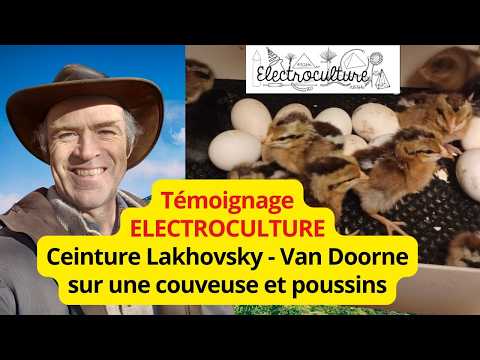
Résultats comparatif d'une ceinture Lakhovsky d'électroculture sur des poussins de poules d'Alsace
AI Summary
This summary provides an overview of a video recorded on February 20th, where a practitioner of electroculture demonstrates the application of these techniques during the incubation and rearing of chicks. The speaker highlights his observations and the specific equipment used to enhance the vitality of the young birds.
**The Incubator Experiment**
The speaker begins by comparing two identical incubators, both maintained at the same temperature. The primary difference between the two is the addition of a "Lakhovsky circuit" to one of them. This circuit consists of a copper cable made of hundreds of individual strands, wrapped around the incubator with its ends overlapping but not physically joined, creating an open loop.
The speaker acknowledges that his experiment is not conducted under strict scientific research conditions but is the work of a passionate gardener and poultry enthusiast. Despite this, he notes clear differences in the results. In the incubator equipped with the Lakhovsky belt, the chicks hatched earlier and appeared more vigorous. By the time of filming, all the chicks in the electroculture group were dry, whereas several in the control group were still damp, indicating they had emerged more recently.
The hatch rate for both groups was approximately 50%, which the speaker attributes to the fact that the eggs had been exposed to freezing temperatures before the experiment began. However, the electroculture incubator had a slightly higher success rate, with 13 or 14 chicks hatching out of 24, compared to 12 in the control incubator. Furthermore, all chicks in the electroculture group were in perfect health, while the control group included one chick with a leg handicap.
**The Theory of Lakhovsky and Christofleau**
The speaker explains that the Lakhovsky circuit is designed to increase well-being and vitality based on principles developed by Georges Lakhovsky in the 1930s and 1940s. While historical texts suggest various health benefits, the speaker is careful to frame these effects in terms of general "well-being" rather than medical claims, noting the sensitivity and potential censorship surrounding non-official medical practices.
In addition to Lakhovsky’s theories, the speaker references the work of Justin Christofleau. While Lakhovsky typically placed circuits around an organism, Christofleau’s method involved placing vertical open circles at the southern end of an area. According to this theory, these circles create a radiating electromagnetic cylinder that moves toward the North, dynamizing any living organisms in its path.
**The Rearing Box Setup**
Once hatched, the chicks are moved to a specially prepared rearing box located in a workshop surrounded by books on electroculture and honey extraction equipment. This box is highly specialized, featuring several electroculture tools:
1. **A Magnetic Antenna:** Made from galvanized iron wire, this antenna must be strictly oriented along a North-South axis to function correctly.
2. **A Round Tower:** The speaker notes that chickens are particularly sensitive to these structures and seem to enjoy their presence.
3. **Lakhovsky/Christofleau Circuits:** These are positioned on the southern side of the box to project energy northward through the wood of the crate, which does not block the electromagnetic radiation.
To ensure the box is correctly aligned, the speaker uses a compass and has mounted the crate on wheels to allow for precise positioning. For warmth, he uses a heating plate rather than a traditional heat lamp. This plate mimics a mother hen, allowing chicks to huddle underneath it for warmth or move away to acclimate to the cooler air in the rest of the box. The speaker finds that this method helps the birds adjust to the cold much faster than heating the entire environment.
**Observations on Instinct and Application**
Upon being placed in the new box, the chicks—primarily "Alsace Gold" with a few "Alsace Black" individuals—immediately display their natural instincts. Even though they have just hatched and have no mother to guide them, they quickly begin to peck at food, scratch the ground, and seek out water. The speaker expresses his ongoing amazement at this innate animal knowledge.
In closing, the speaker suggests that these electroculture techniques are not limited to poultry. Similar methods, including the use of magnetic antennas and Lakhovsky circuits, can be applied to garden plants and seedlings to achieve similar boosts in vitality and growth. He encourages viewers to experiment with these tools and consult his books and website for detailed instructions on building their own antennas and towers.