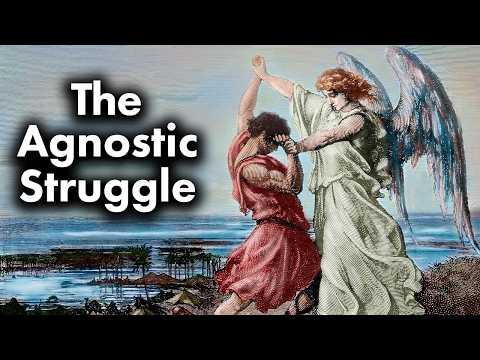
Agnostics Spiritually Struggle More Than Atheists—But Feel Better About God
AI Summary
A recent study published in the International Journal for the Psychology of Religion suggests that the distinction between atheists and agnostics is not solely philosophical or epistemological, but also emotional. While atheism is often understood as a positive belief that no God exists, and agnosticism as a suspension of judgment regarding God's existence, the study reveals significant emotional and relational differences. Agnostics, on average, report more spiritual struggles, including wrestling with doubt, ultimate meaning, and moral conduct, indicating a greater sense of anguish and existential restlessness. Concurrently, agnostics tend to hold more positive views of God, picturing God as more loving and less cruel, and feeling a stronger pull towards the divine compared to atheists.
The study, led by Dr. Julie Exline and her team, including Kenneth Pargament, a prominent figure in the psychology of religion, carefully defined terms to differentiate between these groups. Atheists were defined as individuals who hold a positive belief that no god or gods exist, further categorized as "closed atheists" (firm in their non-belief) and "open atheists" (conceding the possibility of God but not believing). Agnostics, on the other hand, maintain a suspension of judgment, stating they do not know if God exists. "Closed agnostics" believe no one can know, while "open agnostics" suggest it might be possible to figure out. The common thread for agnostics is uncertainty, which the researchers emphasize stems from personality traits like skepticism and openness, as well as doubt. The deliberate use of narrower definitions allowed the researchers to isolate two psychologically distinct groups, revealing interesting differences that are often missed when these groups are lumped together in surveys as "nuns" or "non-believers."
Prior research has already indicated differences, showing agnostics tend to score higher on neuroticism (emotional reactivity, anxiety) and openness to experience, while atheists tend to score higher on analytical thinking and value rationality. Exline's study aimed to delve deeper into the emotional aspects of non-belief using the framework of "spiritual struggle," developed by Dr. Pargament. This framework identifies six types of struggles: ultimate meaning, interpersonal (around religion), doubt, moral, demonic, and divine.
The study found that agnostics scored higher than atheists on the overall spiritual struggle scale and on five of the six subscales: ultimate meaning, moral, doubt, divine, and demonic. They tied on interpersonal struggles. The most significant gap was in doubt struggle, with agnostics experiencing much more troubling uncertainty about their beliefs. "Open agnostics" exhibited the highest levels of spiritual struggle, suggesting their questioning posture extends beyond just the existence of God, encompassing a broader existential wrestling.
Regarding the "desire to believe," agnostics, particularly open agnostics, expressed a significantly higher desire for God to exist compared to atheists. When asked to imagine God's characteristics, agnostics pictured God as substantially more loving, less distant, and less cruel than atheists did. This suggests that the God an atheist doesn't believe in is, on average, a harsher and more unpleasant figure than the God an agnostic doesn't believe in.
Both groups cited intellectual reasons as primary for their non-belief, with atheists emphasizing this more heavily. Atheists also scored higher on "intuitive reasons," feeling that disbelief simply felt right. Agnostics, however, scored higher on "relational reasons," implying that anger, hurt, or disappointment with God contributed to their non-belief. Interestingly, atheists were more likely to admit that negative emotions about the possibility of God's existence influenced their non-belief, suggesting a desire for God not to exist.
Two hypothetical scenarios further illuminated these emotional differences. If presented with undeniable evidence of God's existence, both groups predicted confusion. However, agnostics anticipated significantly more positive emotions (happiness, love, relief, hope) and less anger, while atheists reported more anger and a "loss of freedom," viewing the hypothetical as an imposition. In the "doorway prompt," where participants imagined standing before God, agnostics were significantly more likely to say they would approach God. Atheists were equally likely to approach or move away, with "closed atheists" showing a stronger inclination to move away from God. This indicates that for some non-believers, non-belief is not a neutral intellectual stance but an active emotional preference for distance.
The researchers conclude that while atheists and agnostics share non-belief, they inhabit vastly different emotional and relational spaces. Agnostics remain oriented towards the question of God, unsettled by its openness, and carry the weight of spiritual struggle, often picturing a benevolent God whom they desire to believe in. Atheists, on average, have closed the question, experiencing less spiritual struggle, possibly due to imagining a less appealing, harsh God, making non-belief not just correct but preferable, and protecting their autonomy from a potentially coercive relationship.
This study contributes to a growing body of scholarship challenging the idea of non-believers as a monolithic group. It highlights that different types of non-believers exist, with distinct personalities, emotional experiences, relationships to the divine, and reasons for their positions. It also reinforces research suggesting that people's religious or non-religious stances are not solely the product of careful reasoning. Instead, emotional and relational factors, such as the perceived nature of God, the desire to believe, and feelings of freedom or entrapment, significantly influence where individuals ultimately stand.