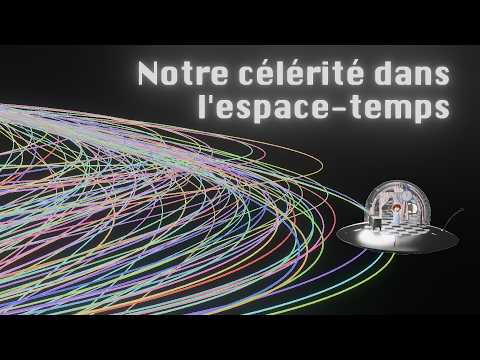
Notre célérité dans l'espace-temps
AI Summary
This summary explores the fundamental nature of our velocity within the four-dimensional fabric of spacetime, based on the provided transcript. The speaker begins by challenging common perceptions of mass and relativity, ultimately focusing on a core question: at what speed do we move through the universe? While a popular scientific analogy suggests that all objects move through spacetime at a constant speed—the speed of light ($c$)—by redistributing a fixed "speed budget" between spatial movement and the passage of time, the speaker argues that this explanation is slightly misleading. While the conclusion is mathematically useful, the underlying geometric logic often presented is flawed because it typically relies on standard Euclidean geometry rather than the hyperbolic geometry that actually governs the relativistic universe.
In standard geometry, the distance between two points is calculated using the Pythagorean theorem, where the squares of the components are added ($a^2 + b^2 = c^2$). However, spacetime operates under what the speaker calls "Pythagoras’s cousin," a metric where the square of the spatial component is subtracted from the square of the temporal component. In this hyperbolic framework, the relationship between space and time is not one of simple trade-offs where one decreases as the other increases. Instead, to maintain a constant interval in this "minus-sign" metric, the temporal component must actually increase as spatial speed increases. This is a crucial distinction that separates the speaker’s view from the common "liquid in a cylinder" analogy.
To clarify these concepts, the speaker distinguishes between "speed" (measured in kilometers per second) and "celerity" (the components of movement along the axes of spacetime). He demonstrates the reality of spacetime movement through a simple, "world-first" experiment: measuring his own celerity. By choosing two events at his current location—"now" and "twenty seconds later"—he calculates his displacement. Since he has not moved in space, the spatial distance is zero, and the temporal distance is 20 seconds. Dividing this spacetime distance by the time recorded on his own watch (his "proper time") yields a celerity of exactly 1. This result is fundamental: we all move through spacetime at a celerity of 1 second per second (which, when converted, equals $c$). This experiment reveals that time is homogeneous; while there is no absolute time, every observer experiences their own time axis in an identical manner.
The most significant consequence of this constant celerity is the derivation of the world’s most famous equation, $E=mc^2$. By multiplying an object’s mass by its celerity, we arrive at what the speaker calls "4D momentum" or the energy-momentum four-vector. In Newtonian physics, momentum is simply mass times velocity, and an object at rest has zero momentum. In relativity, however, even an object at rest possesses a massive amount of 4D momentum directed entirely along the time axis. This temporal momentum is essentially energy divided by the speed of light ($E/c$).
Because of the hyperbolic metric of spacetime, when an object gains spatial speed, its temporal component must increase to keep the total 4D momentum constant. Mathematically, the speaker demonstrates that for small velocities, the specific increase required in the temporal component to compensate for spatial movement perfectly matches the classical formula for kinetic energy ($1/2 mv^2$). Thus, the energy of an object increases with speed not as an arbitrary rule, but as a geometric necessity to preserve the constant length of the 4D momentum vector. This makes the conservation of 4D momentum a more fundamental principle than $E=mc^2$ itself, as the latter is merely a derivative of the former.
The speaker then addresses the paradox of symmetry in relativity. When observing a high-speed train, a stationary observer sees the train's clocks slowing down. Conversely, from the perspective of a passenger on the train, the station's clocks appear to behave strangely. By calculating celerity using "proper time"—the clock attached to the moving object itself—we find a value that is absolute and independent of the observer's frame of reference. This "absolute celerity" uses the Lorentz factor, gamma ($\gamma$), to adjust for high speeds. While relative speed is strictly capped at the speed of light, celerity can reach values much higher than $c$ because it compares the distance in one frame to the time elapsed in another.
Finally, the video clarifies the unique status of light. While all massive objects move through spacetime at a constant celerity of $c$, light itself has a celerity of zero. Because a photon has no "proper time" (its internal clock does not advance), its temporal and spatial components are always equal. In the hyperbolic metric, where components are subtracted, this results in a null interval ($t^2 - x^2 = 0$). Although a photon has no mass, it still possesses momentum and energy, which are determined by its frequency. This energy is relative; visible light might shift into the dangerous range of X-rays or gamma rays for an observer moving toward the source at high speed.
In summary, the speaker concludes that our existence is a constant journey through spacetime at the speed of light. This movement is defined by a 4D momentum where energy and spatial momentum are two sides of the same coin. The equation $E=mc^2$ represents our "rest" energy—the temporal momentum we possess simply by existing—and the increase of energy with speed is the universe's way of maintaining geometric consistency within a hyperbolic spacetime. This perspective renders the principle of equivalence redundant and places the focus on the absolute nature of celerity.