NQ Futures Review & 1st Presented Reflection FVG
Audio Summary
AI Summary
The speaker reviews last Friday's trading, focusing on fair value gaps (FVGs) and their distinctions. He explains the difference between a "first presented fair value gap" and a "first presented fair value gap with displacement." The latter, characterized by being part of a price run that takes out a high or low, is given more emphasis, especially if it's the first one after 9:30 Eastern time. This concept was previously discussed in the Trader's Roundup spaces.
He introduces a new concept: the "first presented reflection fair value gap." If the first FVG after 9:30 AM is a buy-side imbalance, sell-side inefficiency (BISI), then the "reflection" is the very first opposing FVG, a sell-side imbalance, buy-side inefficiency (SIBI), that forms afterward. This reflection FVG is crucial, particularly when it aligns with a macro timeframe inefficiency, as it helps in trading the day's high or low. He illustrates this with an example from Friday, where the first BISI was followed by the first SIBI (reflection FVG) at 10:01 AM.
The speaker emphasizes that while all PD arrays are usable, those with displacement and the reflection FVG carry more significance. He warns against complaining about too many elements on the chart, as he expects viewers to manage this information by having these levels on their own workspaces. He reiterates that the reflection FVG is a "mirror image" of the first FVG, meaning it's the opposite characteristic. The validity of the first SIBI as a reflection is contingent on the first FVG being a BISI.
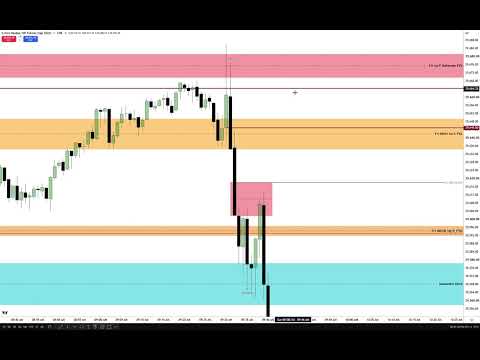
Moving to Monday's trading, price meandered and eventually returned to the first presented reflection FVG. On Tuesday at 1:00 AM, price overshot this level but later, during the 9:30 AM open, traded up into it, wicking above but closing below. The speaker acted on two pieces of information: price had traded above the previous week's overnight high, and the candle closed below a specific Asia session target. This gave him conviction to short, watching the middle of the wick (consequent encroachment) as a key level.
He details his trade, which involved reducing contract size from six to one for teaching purposes, especially considering it was the first trading day after a holiday (Labor Day). He explains that post-holiday trading can be "funky" due to abbreviated hours and skewed volume, making it prudent to trade with less leverage and manage expectations. His entry was within a bearish FVG with a volume imbalance, aiming for relative equal highs. The exit was a "low-hanging fruit" objective, meaning the easiest target to achieve, a strategy to prevent greed, particularly after a holiday.
The market then dropped, clearing the first presented FVG with displacement from Friday, September 4th. It failed to retest the 9:30 AM opening price, indicating weakness. The speaker set a condition: if the market closed above the midpoint of a SIBI, it would return to the 9:30 AM open. Since it didn't, and bodies remained in the lower half of the SIBI, it signaled extreme weakness. His exit was at the consequent encroachment of a suspension block from the 7:00-9:00 AM pre-market session, a "low-hanging fruit" objective in line with post-holiday trading caution.
He addresses viewer comments asking why he closed early, reiterating that the context was about engaging price action after a holiday, not maximizing trades. This approach avoids heavy leverage and unrealistic expectations. The market continued to aggressively break down, clearing the 7:00-9:00 AM range low, London low, and overnight Globex low.
Switching to another chart layout, he discusses the London session's trend, followed by consolidation, expansion, and then reversal for the New York session – the four phases taught in his 2016 mentorship. He notes how price respected the overnight high and the last Friday's first presented reflection FVG, with bodies unable to close inside it, indicating bearish order flow.
He acknowledges that these concepts are complex but insists that anything superior requires effort. He warns against complaining about complexity, stating that such comments will lead to him muting the user. He then describes how the market, after expansion, created today's first presented FVG with displacement, trading into it but staying in the lower half, confirming his bearish bias. His exit strategy was the suspension block, again chosen with post-holiday trading in mind, to avoid potential retracements.
The market continued lower, taking out the London low. He highlights how all the levels, including the 7:00-9:00 AM gradient levels and the first resistance FVG, confirmed the downside movement. The bodies of candles consistently stopped at key levels, indicating aggressive drops. He concludes by reiterating that days after holidays can be "funky" and are not ideal for aggressive trading, emphasizing the importance of patience and diligent study. He encourages keeping a topical journal for questions and answers to manage the learning process of highly technical concepts.