J'aurais dû coder cette app pour vous.
AI Summary
For at least three years, the speaker has been told to create a tool for their developer community, but they always responded that developers usually build their own tools and rarely pay for anything, being resourceful and often frugal. However, the speaker recently discovered a tool that changed their perspective, realizing they were wrong about the impossibility of finding a product that would sell well within the community. This tool, coded by a Japanese (or potentially Chinese) developer, is exactly what their community needed.
The speaker emphasizes that "vibe coding" has completely transformed the developer profession. Instead of just typing code, developers now act as orchestrators, managing numerous AI agents like Claude and Codex. The speaker personally uses multiple instances of Claude simultaneously, dispatching information between them. A major problem, shared by many developers, is getting lost among these parallel conversations, not knowing which agent is awaiting input or where specific discussions are located across countless tabs. This often leads to frantic clicking to find the right tab.
To address workflow inefficiencies, the speaker has reorganized their setup. A significant change was moving to Vietnam, acquiring a standing desk, and using an external monitor, contrasting with their previous habit of working from cafes with just a MacBook. While they enjoy working from cafes occasionally, having a dedicated desk and monitor has been a vast improvement.
Another fundamental shift, influenced by vibe coding, is the screen layout. Previously, the speaker used a stacked dual-monitor setup (MacBook screen below, 27-inch monitor above) with code at the bottom and the rendering at the top. Now, with less constant coding required, they are comfortable having their laptop to the side, interacting with AI, and using the main monitor for primary tasks.
The speaker also mentions a "horrible" yet functional mat/towel-like item purchased in Japan, which is an odd but present part of their setup.
A radical change in their workflow involved switching from the classic terminal to iTerm. The primary reason was the classic terminal's inability to handle accented characters with a QWERTY keyboard, which was a source of frustration. The second reason was the lack of notification capabilities to alert the user when an AI agent like Claude had finished processing. iTerm solved both these issues, allowing for accents and custom notifications. More recently, the speaker discovered iTerm's ability to split tabs, enabling multiple terminals within a single tab. This is a significant improvement, as it allows for grouping related tasks and avoids the clutter of numerous open tabs.
The speaker's current iTerm setup involves a large Claude conversation on the left, acting as a "product owner" for pure product discussions, and a "code agent" on the right that implements what the product owner dictates. This separation prevents the product owner from being bogged down with coding details. Above these, a mini-tab is reserved for quick commands like `git push`. The speaker appreciates iTerm's current tab highlighting feature, which helps maintain focus.
Additionally, a dedicated Claude instance continuously runs "Rodin," an AI agent designed to challenge ideas and provide critical feedback, preventing self-congratulatory bias.
The speaker then discusses a recent change to their keyboard setup, which they introduce by playing a sound. They recall a previous video about keyboards with Zirofre, where they admired a particular keyboard sound. They were almost ready to purchase a 600-800€ keyboard with "Cream Cycles" switches due to its satisfying ASMR-like sound and comfortable typing experience. However, being constantly on the move, a heavy keyboard wasn't practical.
Upon setting up their new workspace, they visited a local computer store and unexpectedly found a keyboard that produced the desired sound and feel. To their surprise, this "luxury" keyboard from a Chinese brand called Moses cost only 40€. It's a bit heavy, connects via Wi-Fi, USB, and a cool magnetic dongle, and features numerous LED lighting effects. This mechanical keyboard has transformed their work sessions into a pleasurable experience.
Despite these setup improvements, the initial problem of managing multiple AI agents across different tabs and sub-terminals remained. The speaker then introduces the "miracle solution" developed by the Japanese/Chinese developer: an application called Vibe by Island.
Before revealing the tool, the speaker promotes Hostinger, their long-standing VPS and hosting provider, and a sponsor of the video. They highly recommend VPS for anyone interested in computing, describing it as a 24/7 online machine for running scripts, hosting websites, and experimenting. Hostinger offers VPS with excellent value, and a 10% discount is available with the code "Benjamin code." The speaker highlights the empowering feeling of having a powerful online machine accessible from anywhere. While previously daunting for beginners, AI now makes VPS administration much easier, as one can simply connect via SSH, install Claude, and then have an AI network administrator manage projects.
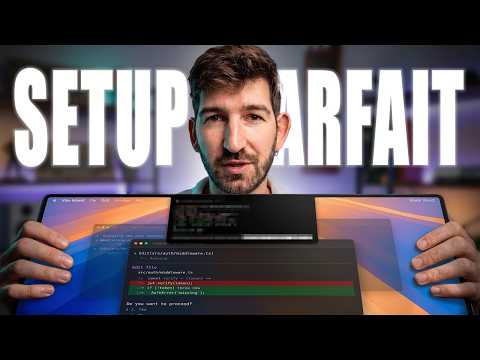
Returning to Vibe by Island, the speaker describes it as an app that makes "vibe coding" even more enjoyable. The app features a central "hub" in the screen's center that monitors all running AI agents across different terminals (Claude, Codex, Gemini, etc.). The interactive demo clearly shows how it tracks discussions, allows direct navigation to specific conversations, and enables users to respond to AI questions directly from the hub without switching back to the terminal.
The speaker demonstrates Vibe by Island on their own computer, showing how hovering over the central icon reveals ongoing discussions. Clicking on a discussion expands it, and clicking again directly opens the correct tab and conversation. They illustrate its utility by simultaneously posing complex questions to two different AI agents. Vibe by Island clearly indicates when an agent is working and when it has finished responding, allowing the user to quickly switch between completed tasks and review responses. For example, one agent might analyze website visitors after a viral tweet, while another calculates the cost of sending 100,000 emails.
The speaker expresses immense satisfaction with Vibe by Island, calling it "incredibly well done" and strongly recommending it. The tool costs a one-time fee of $14.99, which the speaker finds astonishingly low. They mention an affiliate link in the description, admitting some regret for not having conceived such an idea themselves. They praise Edward Lo (the developer, whose nationality they clarify as potentially Chinese despite earlier saying Japanese) for a "masterclass" product, from marketing to installation and usage.
The speaker concludes by reiterating their regret for not having developed this tool, as it perfectly addresses a need within their community that they failed to recognize. This experience prompts them to ponder what other essential, un-coded tools might be missing for "vibe coders" and their community. They invite viewers to share ideas in the comments.