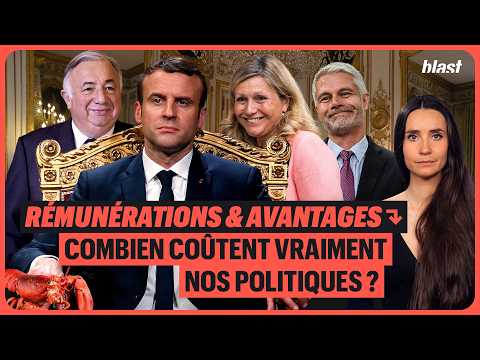
RÉMUNÉRATIONS ET AVANTAGES : COMBIEN COÛTENT VRAIMENT NOS POLITIQUES ?
AI Summary
The question of how much political leaders earn and the benefits they enjoy is a recurring and often explosive theme in French public debate. This investigation by *Blast* breaks down the complex hierarchy of remuneration, the often-opaque world of "benefits in kind," and the resulting sociological disconnection between the governing class and the citizens they represent.
### The Pyramid of Remuneration
Political pay in France functions like a pyramid. At the base are the mayors of small communes (under 500 inhabitants), who earn a modest €1,155 gross per month. At the other end of the local scale, the Mayor of Paris earns approximately €9,700. While local officials can vote on their own indemnities within legal limits, the majority of French mayors (70%) manage small villages for very low pay, often balancing their duties with a primary job.
At the national level, the pay is more uniform. Members of Parliament (MPs) and Senators receive a base indemnity of roughly €7,637 gross per month. However, those in leadership roles, such as the President of the National Assembly, see their total pay climb to over €15,000.
At the top of the executive branch, salaries are fixed by decree. Following a 30% reduction initiated by François Hollande, a Minister now earns approximately €10,700, while the Prime Minister and the President of the Republic both receive a monthly salary of just over €16,000.
### Benefits in Kind and "Pocket Money"
The transcript notes that for high-level officials, the base salary is often secondary to the extensive "benefits in kind" that cover almost all living expenses. These benefits include official housing in historic mansions (hôtels particuliers), private chauffeurs, and substantial representation allowances.
In large cities, mayors have access to representation funds intended for institutional gifts and ceremonies. However, these are often used for personal grooming; for instance, the Mayor of Paris spent over €73,000 on luxury clothing over four years, including Dior and Burberry outfits, arguing that "being well-dressed" is a requirement of the office.
Parliamentarians receive a monthly "mandate expense allowance" (AFM) of €6,353. While intended for professional costs, the lack of strict oversight has led to numerous scandals. Investigations have revealed MPs using these funds for luxury lingerie, personal moving costs, children's school fees, and even dog-sitting services. Furthermore, until recently, the "collaborator envelope" of €11,000 per month was frequently used to employ family members in fictitious roles, most notably in the "Fillon Affair."
### The Cost of the Executive
The lifestyle of the executive branch represents a significant state expense. The Prime Minister resides at the Hôtel de Matignon, which features the largest private garden in Paris and a staff of cooks, gardeners, and butlers. The President occupies the Palais de l’Élysée, an 11,000-square-meter estate with 365 rooms and 800 employees.
The budget for the Presidency is approximately €120 million per year. A significant portion of this goes toward travel and diplomatic hosting. For example, a three-day presidential trip to Marseille cost over €342,000, and a single diplomatic dinner for the King of England cost nearly half a million euros, including €42,000 for wine and champagne. Even after leaving office, former presidents cost the state roughly €3 million annually each for lifetime offices, security, and staff.
### The "State Nobility" and Democratic Disconnect
The video highlights a profound sociological gap. While 50% of the French workforce consists of laborers and employees, they make up only 5% of the National Assembly. Conversely, the "upper class" occupies 60% of parliamentary seats despite being only 20% of the population.
This lack of representation leads to a "disconnection" where leaders are unaware of the daily realities of citizens. Famous examples include politicians being unable to estimate the price of a *pain au chocolat* or a metro ticket. This gap is particularly galling to the public when leaders who enjoy state-funded luxury simultaneously call for national austerity and criticize "welfare dependency" among the poor.
Sociologist Étienne Ollion notes that high pay was historically a leftist demand to ensure that those without personal wealth could afford to enter politics. However, others, like philosopher Barbara Stigler, argue that France has evolved into a "plutocracy"—a system where the wealthy govern for the wealthy.
### Transparency: France vs. International Models
While transparency laws have improved since the 2014 "Cahuzac Affair," France remains behind other nations. In Sweden, transparency is a constitutional right; citizens can inspect every receipt filed by an MP. A Swedish minister once famously resigned for buying €1,000 worth of personal items (including chocolate) on a professional card. In contrast, many French mayors still refuse to disclose their expense reports despite court rulings mandating they are public documents.
### Conclusion
The transcript concludes that the debate over political pay is not just about the figures, but about trust. The combination of high salaries, opaque benefits, and a lack of sociological diversity has fostered a perception of an "oligarchy" or a "State Nobility" (as described by Pierre Bourdieu). For democracy to function healthily, the video suggests that the "epidemic" of secrecy surrounding political expenses must be replaced by an open, calm, and transparent public debate.