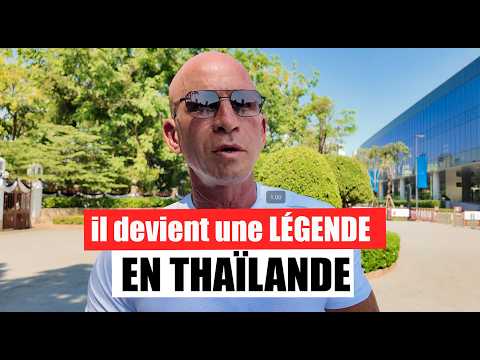
Dida Diafat: Il débarque en Thaïlande à 18 ans… et devient une légende du Muay Thaï 🇹🇭
AI Summary
The speaker, Dida, discusses his experiences in Muay Thai in Thailand, contrasting his reality with the fictional portrayal in a film. He clarifies that he never went to prison, unlike in the movie. His initial motivation for going to Thailand was to learn Muay Thai.
Upon arrival, he found that Thai camps were primarily focused on training young Thai fighters and were not readily open to foreigners seeking to learn, viewing it as a business where they didn't have time to waste on outsiders. Dida acknowledges that at the time, there was a belief that foreigners couldn't box effectively, and the sport was more exclusive to Thais. He credits legendary fighters like Ramon Dekkers and others who paved the way for international fighters to compete and prove their capabilities.
Dida admits he came to Thailand with some prior boxing experience, having trained for a month in France. His decision to go to Thailand was driven by a loss in a fight, prompting him to seek better training. He emphasizes that he went with limited financial resources, viewing it as his own responsibility and a choice he made.
He debunks the idea that he was given easy accommodation or a place in the camps. He explains that camps are training centers, and there wasn't space for him, even if it meant sleeping on the floor. He likens it to trying to join a professional football team like Real Madrid without being invited. Dida recounts a pivotal moment when a drunk Thai camp member challenged him to a fight. After winning this impromptu fight, the coach offered him a chance to train with the other fighters, which he believes was his turning point. He attributes this opportunity to luck and perhaps showing he had heart.
The acceptance into the camp was the first key element, but the second, and more important one for him, was the happiness he found in the daily routine: training, eating, and interacting with the Thai fighters. He was 18 when he arrived and felt a deep sense of contentment being among them, even before he could speak the language fluently. He reflects that it's difficult to say if he was truly accepted as one of them or just at a certain level, but he is grateful for the opportunity.
Dida views Muay Thai as a school of humility, where losing taught him valuable lessons about his limitations and the strength of others, contributing to his life stability. He mentions that gambling was prevalent in stadiums during his time, with betting on fights and even lists of banned individuals for not paying debts. However, he has never witnessed or been asked to participate in fixed fights, stating that any such attempt would be obvious to anyone watching. He dismisses rumors of fighters being drugged, finding such stories sensationalized and not aligned with his positive outlook.
He observes significant changes in Thailand since his arrival in the 90s, noting the development of infrastructure like the metro. He also contrasts the past difficulty of staying in touch with family due to the lack of phones and easy communication with the present day. He stresses that travel is a choice, and if one is unhappy or struggling, they can always return home, as one is not imprisoned there.
Dida recounts how he was discovered by Marc Guérin, the doctor for the French Muay Thai Federation, while fighting "in secret" on weekends for extra money in Pattaya. This led to an opportunity to fight for the French championship, which he won by knockout in the first round. He also discusses his fight against Ramon Dekkers, which came about unexpectedly when the original opponent withdrew. He had only a week to prepare, and his training had to adapt quickly, reintroducing elbow and knee strikes after being told to avoid them.
Regarding influential figures, Dida prioritizes human qualities over fighting prowess. He admires humble champions like Zidane and Mike Tyson, and local French fighters who are both skilled and good people. He states he has never refused a fight and has not been refused fights himself.
For aspiring young fighters, Dida advises making sport a source of pleasure rather than just work. He emphasizes the importance of having a good relationship with trainers and enjoying the process. He describes all his opponents as difficult, with challenges varying in physical and mental aspects, including fear of failure and disappointing those who supported him.
Remarkably, Dida claims to have never suffered a significant injury throughout his career and never used a mouthguard, acknowledging this is not advisable. He lists Thailand as the premier country for Muay Thai training, with Algeria, Morocco, and Jordan also being strong contenders. He notes the shift in dominance from Thai fighters to international competitors, particularly from Holland, making it harder for Thais to win by points as they once did. He explains that while Thai fighters might feel pressure when losing to foreigners, their camps are also proud of their fighters' success regardless of nationality, as it reflects well on their training.
Dida has no plans to live permanently in Thailand, preferring to visit and return, describing himself as a "citizen of the world." His favorite cities are Bangkok and Pattaya, and his favorite Thai dish is rice with chicken and fried egg, along with mangoes. He finds Thai smiles to be genuine, even when masking other emotions, and prefers it to a frown.
Looking ahead, his primary focus is on good health for himself and his family, and a sense of lightness in the world, acknowledging the current global difficulties. He believes that while life is hard, it is also beautiful, and it's up to individuals to navigate its challenges with a smile, even amidst sadness and doubt. He considers professional matters secondary and private. He expresses gratitude for his own circumstances, contrasting them with the struggles of many others. He advocates for mental well-being and engaging in sports, pointing out the prevalence of mental health issues like depression and anxiety. He finds discussions about personal future and how to navigate life more meaningful than superficial content. He refrains from judging the direction of the world but focuses on his own path and can offer opinions when asked by loved ones.