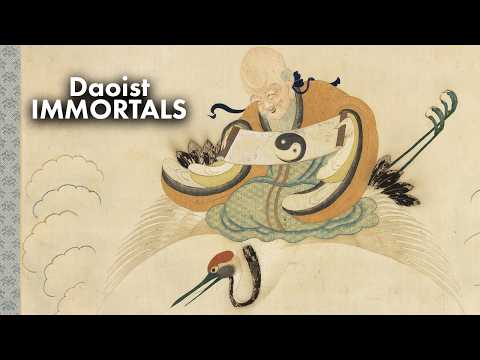
How to Become Immortal According to Daoism (in 5 not-so-easy steps)
AI Summary
In 1222, Genghis Khan met with the Daoist Master Chongqen, who, despite his name meaning "eternal spring," did not possess an elixir of immortality. Instead, Chongqen suggested a long process of transformation to extend life and achieve transcendence, known as becoming a Daoist "Shien."
Shien are supernatural beings in Daoism, capable of traversing realms, possessing extended lifespans, and exhibiting superhuman abilities like flight or teleportation. The term is often translated as "immortal," but this can be misleading. Shien escape ordinary death but do not necessarily exist forever in an absolute sense. Scholar Robert Campany notes that Daoist thought views human and divine, or mortal and immortal, on a spectrum, allowing beings to become more or less refined and long-lived. Translating Shien as "transcendent" better captures this idea, as they operate on a higher level within the same cosmos, rather than escaping it entirely. Daoist texts distinguish between merely avoiding death and transforming into an entirely different being.
The ancient Chinese scholar Ge Hong described three levels of transcendence: "tien" (celestial immortals) who live among gods, "dishian" (earthly transcendents) who wander mountains, and those who achieve transcendence through "corpse release" (shijie). Corpse release involves shedding the physical body to continue in a more refined form, akin to a cicada leaving its shell. Early depictions show transcendents ascending into the sky with wings, riding on clouds.
While becoming a transcendent is a key feature of Daoism, the term Shien is rare in early Daoist texts like the *Daodejing* or *Zhuangzi*. These texts focus on ideal people like the "zhen" (perfected person) or "shenren" (sage), often emphasizing living without anxiety about death rather than escaping it. However, later Daoist texts, especially in the early common era, increasingly embraced the idea of cultivating oneself to become a Shien, asserting that one's fate is in one's own hands.
The path to becoming a Shien involves five steps:
1. **Go Low Carb (Bigu):** The first step is to eliminate grains from the diet, a practice called "bigu" (avoiding grains). This is more than just cutting carbs; it's a rejection of the ordinary human diet and lifestyle, symbolizing a separation from civilization. Grains were believed to feed "three worms" within the body that shortened lifespan. Practitioners also avoid onion-family vegetables, meat, eggs, and fish. This dietary restriction is not for wellness but for cosmic progression. Higher-level practitioners subsist on "wind and qi" (vital energy), while others consume water, herbs, and medicinal formulas. Most historical Daoists, however, practiced moderation rather than strict avoidance. The goal is a complete transformation of the "qi body," replacing decay-producing foods with refined nourishment like herbs, minerals, breath, and chi.
2. **Embrace Celibacy:** For male Daoist practitioners, sex is typically avoided to conserve "jing" (vital essence), the raw material for "chi." Ejaculation was believed to deplete jing, which is a finite resource. Celibacy is about conservation, not sexual morality. However, for those unable to practice full celibacy, advice like limiting sex to once a night was offered, as Master Chongqen advised Genghis Khan. The practice of "returning the essence to replenish the brain" (huan jing bunao) involves redirecting sexual energy upwards to nourish the "embryo of the Dao," the seed of transcendence. For women, the equivalent was transforming menstrual blood into chi, a process called "beheading the red dragon." The ultimate goal was an androgynous, perfected body, transcending ordinary reproduction and decay. Not all Daoists agreed on total celibacy; some early traditions included "arts of the bed chamber" for regulated sexual practice, with figures like Ge Hong arguing against complete abstinence in some contexts. The key was managing vital energy, not necessarily eliminating sex.
3. **Get Your Qi Moving:** After conserving chi, the next step is to build it up. Daoists view the human body as a microcosm of the cosmos, with interconnected systems and "mutual resonance" between body parts, planets, and divine realms. Texts like the *Huangting Jing* (Scripture of the Yellow Court) describe the body as an inner landscape populated by gods in different organs. Practitioners visualize these gods, circulate chi, and imagine celestial forces within themselves. The body has three "cinnabar fields" (brain, heart, lower abdomen), each with a deity that consumes chi. Nourishing these gods generates more chi, which feeds the "embryo of the Dao." Modern Daoists often interpret this metaphorically. More chi is acquired through meditation, visualization, and special breathing techniques called "fushi" (ingestion of qi). This involves sitting quietly, visualizing chi entering the body with breath, and circulating it through the cinnabar fields before exhaling. Techniques can be highly specific, with texts detailing postures and mindsets, emphasizing slow and careful practice to avoid harm.
4. **Become an Alchemist:** This step focuses on refining chi into something more stable and incorruptible, based on the principle that if everything is composed of chi, a mortal body can be transformed by incorporating non-decaying substances. This can be achieved through "outer alchemy" (waidan) or "inner alchemy" (neidan).
* **Outer Alchemy:** Involves mixing substances to produce elixirs. Historically, Daoists used minerals like mica, medicinal herbs, and highly toxic substances like cinnabar (mercury sulfide), lead, and arsenic. These were believed to transform the body's composition. Numinous mushrooms ("zhi") were also sought, believed to grow in mythical places and grant longevity or transcendence. Outer alchemy was a highly ritualized, sacred process, often requiring fasting and purification. Recipes for "gold liquor" promised transcendence and a golden hue to the body. However, these elixirs were often deadly; several Tang emperors reportedly died from them. This led to a shift towards inner, metaphysical transformation.
* **Inner Alchemy (Neidan):** Practiced since the 2nd century CE, inner alchemy has the same goal as outer alchemy—becoming a transcendent—but works with the body's internal substances through breathing patterns and visualized meditation. It's described as the "way of the golden elixir" (jindan dao) and unfolds in stages, refining "jing" (essence) into "chi" (vital energy), then "chi" into "shen" (spirit), and finally returning "shen" to emptiness. This process creates an "inner elixir" or "embryo of the Dao" within the practitioner, leading to a "return to the origin" and transcendence of physical constraints. Inner alchemy often involves visualizing the body as an internal laboratory, gathering energies through controlled breathing ("huahuo" or fire phasing), and circulating them. This process reverses the ordinary outward flow of energy, drawing everything inward for reintegration into the Dao.
5. **Practice, Practice, Practice:** The final step emphasizes years of consistent practice. One woman, seeking transcendence, chanted the *Scripture of the Yellow Court* daily for over a decade before progressing. Eventually, she received celestial visitors and was taught by the goddess Wei Huacun, receiving an elixir of immortality after 13 years of practice. She then spent another eight years refining herself before ingesting it, and two more years before her ascent to the heavens, even amidst a major rebellion. This illustrates that transcendence is rarely instantaneous and requires decades of dedicated effort, often in seclusion, though not always.
Daoism does not offer a simple shortcut to eternal life, but a comprehensive set of techniques for transforming the body, mind, and essence. Diet, sexual energy management, breath, visualization, and alchemy are all part of this project to re-engineer a decaying body into something stable, refined, and unbound from ordinary life.