The Moto Watch Surprised Me (Motorola + Polar Review)
AI Summary
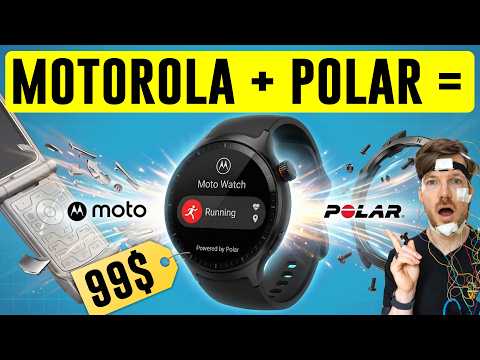
This review examines the Moto Watch, a device aiming to combine Motorola's hardware expertise with Polar's software algorithms, potentially offering a budget-friendly Polar alternative for around €99. The reviewer, a post-doctoral scientist specializing in biological data analysis, extensively tested the device, focusing on data quality and day-to-day functionality. His overall experience was largely negative, leading him to recommend it to only a small group of people due to numerous issues.
Starting with subjective experience, the reviewer immediately encountered significant usability problems. He was unable to access his exercise data or connect the device to platforms like Strava, which severely limited his ability to perform a deep analysis of the raw data. This lack of access suggested that the company might not be "fitness driven" or "fitness first," positioning the device more as a smartwatch than a dedicated sports and health tracker, despite its Polar algorithms. The device appeared to function only on Android, as the reviewer couldn't download the app on his iPhone, though he wasn't sure if this was a region-specific or general issue.
A major recurring problem was the device's storage. Even after syncing with an Android phone, the watch frequently displayed "storage full" messages during exercises, preventing data collection or causing exercises to cut short. Furthermore, the watch often froze at the "1" mark during the countdown to start an exercise, leading to many lost sessions. Based on these issues, the reviewer described the Moto Watch as one of the worst devices he'd reviewed in a while for usability. He speculated that it might use cheaper Chinese hardware with Polar firmware and algorithms, noting that the menu interface resembled those of other budget Chinese brands he had tested.
Moving into data analysis, the reviewer assessed the device's performance in heart rate tracking, sleep stage tracking, and GPS. For heart rate, the inability to access raw data meant he had to rely on screenshots comparing the Moto Watch's readings against a reference ECG chest strap (Polar H10).
During indoor cycling sessions, the Moto Watch consistently struggled. In one exercise with eight intervals, it only accurately detected three, showing excessively low heart rates for the others. In a second indoor cycling session with six complete intervals, the Moto Watch detected five but missed the sixth, incorrectly registering a decrease in heart rate instead of an increase. A final indoor cycling test also showed partial detection of intervals and an early termination of the recording. The reviewer expressed dissatisfaction with these results, noting that indoor cycling is typically an easier activity for devices to track due to minimal movement.
Running performance was also problematic. For a steady-paced run with two pauses, the Moto Watch partially detected the pauses but also registered several non-existent dips in heart rate. The reviewer suggested these might be instances of "cadence lock," where the device measures running frequency instead of heart rate. In an interval run, where quick heart rate increases were expected, the Moto Watch "barely" detected some intervals, leading the reviewer to conclude that the performance was "not good enough." He emphasized that even excellent algorithms are ineffective if the underlying hardware and firmware are inadequate.
Next, the review delved into sleep stage tracking, where the reviewer hypothesized that data processing (Polar algorithms) might be more crucial than raw measurements. The Moto Watch's sleep stages were compared against a ZMAX EEG device, considered a "silver standard" for scientific sleep tracking. Focusing on deep, light, and REM sleep, the Moto Watch showed 54% agreement with the ZMAX for deep sleep, which was deemed "okay at best," with some confusion with light sleep. Light sleep agreement was slightly better at 58%. However, REM sleep tracking was a significant weakness, with only 44% agreement, a common struggle for many sports devices like Polar and Garmin. This suggested the Moto Watch might be using the same Polar sleep algorithm.
An overview comparing the Moto Watch's sleep tracking performance to other devices tested between 2025 and 2026 placed it near the Polar Loop and Polar Grid X2, but potentially performing slightly worse due to its hardware. It also came close to some Huawei devices, which generally perform below Polar. The reviewer highlighted top-performing sleep trackers like Apple Watch, Google Pixel watches, Oura Ring, Whoop Strap, Eight Sleep Pod, and the Sleep 2 app (not in the overview). He also mentioned Fitbit as a good, affordable alternative, offering similar sleep tracking to Pixel Watches. Despite the Polar algorithms, the reviewer concluded that the Moto Watch is not a device he would recommend for sleep stage tracking.
Finally, GPS tracking was assessed. Again, raw data was inaccessible, so the reviewer compared recorded distances from the Moto Watch against a Garmin 4970 and a Coros Pace Pro. The Garmin and Coros devices showed excellent agreement in distances for both biking and running, suggesting reliable GPS tracking from both. In contrast, the Moto Watch consistently recorded less distance than the reference devices. For biking, it often recorded nearly half the distance, and similar significant discrepancies were noted for running. Only one instance showed good agreement. The reviewer expressed strong dissatisfaction with this performance.
In conclusion, while the reviewer appreciated Motorola's attempt to integrate sports-focused data and algorithms, the implementation on the Moto Watch was deemed poor. He stressed the importance of cohesive hardware and firmware. He strongly recommended dedicated Polar devices over the Moto Watch, acknowledging they are pricier but offer better performance. He also suggested alternatives like Garmin, Suunto, and Coros, all of which he uses and recommends as superior to the Moto Watch. Ultimately, despite being "powered by Polar," the Moto Watch failed to deliver Polar's performance, leading to a clear recommendation against purchasing it at this time.