Who Was Allah Before Islam?
AI Summary
The Quran describes Mecca during Muhammad's time as a city populated by "mushri," often translated as pagans or polytheists. These individuals were Muhammad's primary adversaries, resisting his message, ridiculing his claims, and refusing to worship Allah exclusively. However, the Quran makes a surprising assertion about their beliefs, stating that if asked who created the heavens and the earth, or humans, they would unequivocally say "Allah." They also credited Allah with controlling the sun and moon and sending rain. This seemingly contradictory belief system, where polytheists already acknowledge Allah as a creator god, can be clarified by understanding the term "mushri" more literally as "those who associated others with God." This implies they believed in and worshipped Allah, but also assigned partners or associates to him, praying to lesser deities and invoking intermediaries within a broader polytheistic framework. Some venerated the sun and moon, while others worshipped pre-Islamic Arabian gods like Allat and Manat, yet Allah remained supreme as the creator.
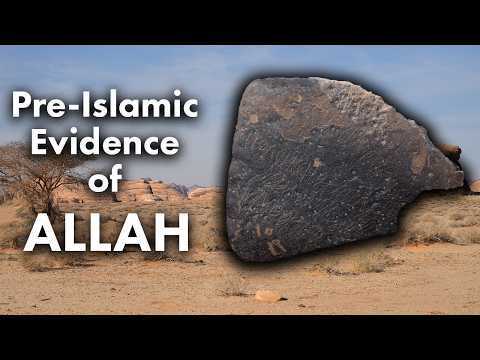
This raises the question of how the mushri already knew about Allah. The answer lies in the pre-existence of a god named Allah in pre-Islamic Arabia. Inscriptions from the deserts of Jordan, dating hundreds of years before Muhammad, show Arab nomads invoking multiple gods, including "ba al-samine" (a storm god), "shakam" (a protective deity), and "Allah." This indicates that long before the Quran, ancient Arabs carved Allah's name into stone, used it in prayers, incorporated it into personal names, and, according to recent discoveries, conceived of him as a high god connected to light and creation.
The etymology of "Allah" is crucial for understanding its meaning. Most scholars agree it derives from the contraction of the Arabic "al-ilah," meaning "the god." This word belongs to an older Semitic root for "god," related to terms like "El" (a high god in Canaanite pantheon) and "Elohim" (in the Hebrew Bible). "Al-ilah" could be used generically to refer to any deity, or with an elevated sense, meaning "the God" who stands above others, as a supreme deity within a religious system, including monotheism. Arab Christians in the 5th century CE, for instance, used "al-ilah" to refer to the Christian God, reflecting a direct translation of the Greek "ho theos" (the God). This usage is not exclusive to monotheism; "al-ilah" also fits within henotheism, where one god is elevated as supreme among many. The Nabataeans, for example, referred to their top god Duchara as "the god" despite being polytheists. Over time, in certain regions and dialects of Old Arabic, "al-ilah" contracted into "Allah," which became standard in Islamic usage. A similar linguistic evolution is seen with the goddess Allat, whose name is thought to derive from an earlier form "al-ilat," meaning "the goddess," which eventually contracted to "Allat."
While "Allah" originated as a generic term, Old Arabic inscriptions demonstrate its use as a specific name. Across southern Syria and the Arabian Peninsula, archaeologists have found "Allah" carved into stones, often beside other gods like Ruda and Darus, functioning as a personal name akin to Zeus or Thor. This suggests that even if the word began as a descriptive title, people used "Allah" to refer to a particular deity.
The pre-Islamic Allah, based on Safaitic inscriptions (tens of thousands of short texts carved by Arab nomads in the Black Desert of Jordan, Syria, and northern Arabia), was not the most popular god. Allah is invoked fewer than 50 times in a corpus of 50,000 texts, compared to over 1,400 invocations of the goddess Allat. However, these inscriptions consistently show people invoking Allah for safety, relief, and survival in harsh conditions, often alongside other gods like Shy. In Nabataean inscriptions, Allah primarily appears embedded in personal names like "Wahbah" (gift of Allah) or "Abdullah" (servant of Allah), indicating widespread recognition but less direct worship compared to deities like Duchara. This suggests Allah was known across northern Arabia from roughly the last few centuries BCE into the early CE, treated as a distinct deity, and occasionally invoked for protection, but not as a dominant cult figure. Dr. Al-Jalad suggests this is consistent with Allah being a remote or overarching cosmic god, acknowledged and respected, but not the focus of daily ritual life.
Until recently, little was known about pre-Islamic Allah's mythological profile. However, a 2024 discovery by Dr. Al-Jalad's team in northeastern Jordan revealed a Safaitic inscription dating to around year zero, roughly 600 years before Muhammad. Though difficult to translate, the inscription describes Allah as a creator who brings light into the world, with one possible reconstruction reading: "Oh Allah, let there be light and protect against the darkness of his grave and grant him that light. Oh one of creation, and may he who has created grant him that light." This is significant because it provides archaeological evidence supporting the Quran's assertion that pre-Islamic Allah was a creator god, a concept previously inferred from the Quran. The phrase "Let there be light" echoes Genesis 1:3, suggesting possible influence from Judaism or Christianity, as Arab tribes interacted with these communities. Another Safaitic inscription calls Allah "the living," a loaded term in the Hebrew Bible, where God is called "the living God," implying a god who is eternally alive and the source of life. Dr. Al-Jalad argues this might not be direct borrowing but rather a shared Near Eastern way of imagining creation as an act of ordering chaos through division, consistent with the Arabic verb "haka" (to create), derived from a root meaning "to divide or separate."
Pre-Islamic Arabic poetry, though preserved and transmitted later, also points to Allah as a creator god. Poets swear oaths by him as the one who raised the heavens and the full moon, and describe humans as "made by Allah." This poetry also depicts Allah as the bringer of rain and a god to be called upon in times of trouble, mirroring the Safaitic inscriptions. This challenges the idea of Allah as a distant, inactive philosophical high god, suggesting people expected him to respond.
This evidence brings us back to the Quran's portrayal of the mushri, who recognized Allah as a high creator god, controlling the sun, moon, and rain. The Quran, therefore, seems to preserve a historically real aspect of pre-Islamic beliefs. Across these sources, Allah is described as a creator, rain-giver, supreme over the world, and actively involved in human life. However, early inscriptions show Allah as relatively minor compared to other deities. This discrepancy might be explained by a late pre-Islamic monotheizing trend in the centuries before Islam (400s and 500s CE), where inscriptions increasingly referenced only Allah. This trend was not isolated, as the idea of a single supreme god was gaining popularity across the ancient Mediterranean and Near East, even among pagans. Greek and Roman philosophers spoke of "theos hipsistos" (the high god), viewing other gods as manifestations of this one supreme power. Arabian society was connected to the Roman and Persian Empires and Christianity, leading to cultural exchange. Dr. Nikolai Sinai suggests that in this environment, Allah could have become a shared concept, understood by Christians as the God of the Bible and by pagans as their high creator god. Dr. Patricia Crone argues that the Quranic mushri were "functionally pagan monotheists," believing in Allah as the creator but associating lesser divine beings (pre-Islamic gods, angels, or "sons and daughters of Allah") with him as intermediaries. The Quran's criticism of "shirk" (association) was their failure to worship Allah exclusively. Crucially, the pre-Islamic Allah, unlike the Allah of Islam, was not an end-times judge, a concept emphasized by the Quran and controversial to the mushri of Mecca. Thus, Muhammad did not introduce Allah but redefined him, calling for exclusive worship and emphasizing his role as humanity's ultimate judge.