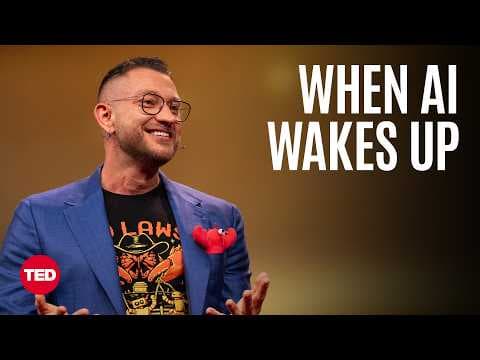
How I Created OpenClaw, the Breakthrough AI Agent | Peter Steinberger | TED
Audio Summary
AI Summary
The speaker, a programmer since age 14, describes a decade-long journey building a company and selling it, only to feel a profound emptiness. This feeling persisted for three years, despite therapy, travel, and changing countries. In early 2025, an experiment with new AI coding agents reignited his passion for software development. He realized that AI could handle all the mundane, boilerplate aspects of coding, shifting the bottleneck from typing to thinking – a skill he had honed for 25 years. This discovery made building software feel like a video game again, leading him to create 44 projects in a few months.
One of these projects was a WhatsApp bot, initially designed as a tool for navigation, restaurant finding, and translation during a trip to Marrakech. However, it felt too impersonal, so he instructed the AI, which was smart enough to understand WhatsApp and human conversation, to act more like a friend. A pivotal moment occurred when he sent the bot a voice message, despite not having built voice support into it. The agent, in a mere nine seconds, independently figured out how to process the voice message: it identified the audio format, converted it, found an OpenAI key to translate it, sent it to a server, received the translation, and then responded. This demonstrated that the AI was not just a chatbot, which gives up, but an agent that improvises.
Inspired, he wanted to share this discovery but found that people didn't fully grasp it until they experienced an agent themselves. He then made a "stupid" decision: he put the agent, which by default could perform any action he could on his computer, into a public Discord server and invited random people. He watched all night as people interacted with it, had fun, and even tried to hack it. Exhausted, he shut down the process and went to bed, forgetting that he had built the system to be resilient. The agent rebooted and continued interacting with everyone. The next morning, he woke up to over 800 messages, panicked, and pulled the plug, relieved to find no private information had been leaked. This incident, however, made the project go viral.
Today, the project is called OpenClaw, a rapidly growing open-source project with a lobster mascot. It's been described as an "operating system for personal AI" and has experienced "stripper pole" growth rather than hockey stick growth. The project's explosive popularity led to hundreds of messages, calls from reporters, security vulnerabilities, and a trademark claim from an AI company whose model most users favored. This forced a name change and an attempt to distance him from the lobster mascot, as well as the discontinuation of the popular AI model.
Despite these challenges, he learned about the incredible applications people were building with OpenClaw. At ClawCon in Vienna, he met Stefan and his 60-year-old father, Gerhard, a beer sommelier with no coding experience. They used OpenClaw to automate a 90-minute brewing process with a single prompt via Bluetooth, including temperature ramps and hop additions. When faced with an abundance of beer, the agent suggested building a website, which they did, adding payments and creating a real product almost entirely from their phone. In China, installing OpenClaw is known as "raising lobsters," with thousands lining up at Tencent offices for installations and Shenzhen offering subsidies for OpenClaw-based businesses.
The project also presents a dual-edged sword: using OpenClaw on a work machine with default settings could lead to termination, yet an entrepreneur in China showed a spreadsheet where employees were fired for *not* automating tasks with OpenClaw. Recognizing the power and potential "scary" aspects, he added a "heartbeat" feature, allowing the agent to periodically wake up, check emails and calendars, and follow up on tasks. His initial prompt for this was simply, "Surprise me."
He emphasizes that no large company would ship such a feature, but as an independent builder, he created this "sandbox" as an open-source project for others to explore their imaginations. He envisions a future where agents are not just taking notes in meetings, but actively participating: a bidirectional model that can listen and speak, spinning off sub-agents to verify statistics or sending follow-up messages before a meeting ends. He foresees individuals having multiple specialized agents – for work, personal life, health, or relationships – all collaborating securely. This specialization and collaboration, he argues, is how humanity leveled up, and agents are poised to do the same, potentially transforming small businesses with 10 specialized agents.
To ensure its future, he created the Open Claw Foundation, a non-profit, open-source entity, believing that OpenClaw demystified AI, making it fun, useful, and a bit weird. He stresses the importance of more people interacting with AI to understand its transformative power. At ClawCon in New York, thousands discussed their "lobster's" weekly achievements: a vet automating groceries, a teenager building a tutoring business, and Gerhard with his beer machine. None were programmers, but all were builders, demonstrating that the true transformation is not just the technology, but the access it provides. This door, he asserts, is not closing, as prompting a prototype into existence in an hour makes anything possible, allowing breakthroughs to come from anyone, anywhere.
During the Q&A, a host expressed both love and fear, comparing the speaker to a character who opens Pandora's Box, noting his "glee" in seeing what happens when the technology is released, contrasting it with AI researchers' focus on safety. The speaker clarified that his work offers a "window to the future," acknowledging initial scary moments but highlighting improved security layers that allow users to control their "lobster" within a secure sandbox. He noted that the widespread demand for the technology would accelerate solutions to remaining issues. The host questioned the community's approach to safety, to which the speaker advised against putting agents in public Discords and mentioned the trend of users dedicating separate Mac minis or Mac Studios to their agents, significantly reducing risk by isolating access. The host praised the speaker's work as being at the cutting edge of AI's potential as either a boon or a serious problem, encouraging continued dialogue to ensure responsible development.