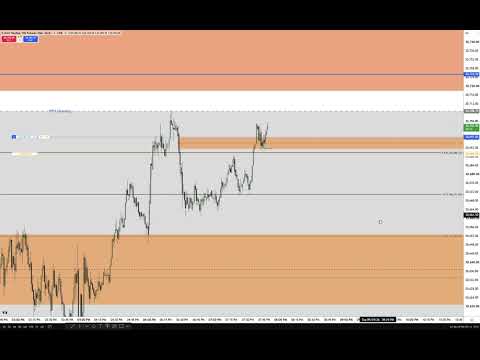
NQ December Asian Session Execution 09/29/2026
Audio Summary
AI Summary
The speaker initiates a long trade, targeting an inversion fair value gap anchored to an octant from Tuesday's open range gap. The expectation is for the price not to drop back down into the current area but to ascend towards a pool of liquidity. A partial profit is taken just above this liquidity pool. The speaker expresses a desire for the volume imbalance to remain open, allowing the price to surge, but states that if it retraces, it should immediately rebound higher.
Upon entering the trade, the speaker adds three more contracts, explaining the "double tap" strategy: one target at the "head" (higher price) and one at the "chest" (center mass or torso). The center mass target is considered easier, allowing half the position to be closed there, with the remaining half aiming for the "head shot."
The speaker mentions rendering a video commentary that has already been uploaded to YouTube, explaining that stopping the current recording to share the link on Twitter would interrupt the trade execution. The immediate goal is for the price to run up and take out the liquidity pool, specifically to snap above 708.75. The next area of interest is Monday's record trading hours open range gap low. The speaker notes that the Asian session is typically subdued unless driven by significant events.
The trade then sees acceleration from the volume imbalance, clearing a level and moving towards Monday's opening range gap low. The buy side resting above the 709 level is taken, leading to a "bread and butter" profit. Risk is then removed from the trade.
The market trades back down to 9:30 AM Eastern time, today's regular trading hours opening price, which the speaker hopes will act as support. The speaker adds three more contracts, expecting the price body to remain in the upper half of the current range. The stop loss is placed below the gap candle. The speaker emphasizes the need for significant upward movement due to liquidity resting at a higher level, having already taken liquidity above the 9:30 opening price in the morning session.
The speaker desires to see the current candlestick flip bullish and aggressively run above a specific high, describing this as order flow visually represented without gimmicks. Upon reaching a particular liquidity zone, the market is expected to use it as "rocket fuel" to propel prices higher into the next liquidity pool. The speaker adds to the position, now with 12 contracts, risking $525 for a potential $3,000 profit.
A new volume imbalance forms, which the price is expected to respect, creating a "ladder" of steps leading to higher prices without needing volume profile or level two data. The price successfully reaches the low of Monday's regular trading hours opening range gap low. The speaker then wants to see further upward animation, not just a fill of the partial order, but an aggressive acceleration to the next liquidity pool.
The speaker introduces the concept of "event horizon" to manage two pools of liquidity, staggering exits to fund the position rather than relying solely on a single terminus for profit. Despite a pullback, the speaker remains confident, explaining that it's simply a retracement to a newly created liquidity pool, respecting its consequent encouragement.
The market pulls back to today's record trading hours open range gap high. The speaker encourages patience, anticipating further upside movement. The price then rips through a liquidity pool, leading the speaker to remove risk completely, securing a profit while acknowledging the possibility of being wrong.
After a brief retracement into a small gap, which acts as the "last line of defense," the price needs to find its way higher. The stop loss is raised, locking in at least $1,000 profit. The trade continues to move higher, taking out a short-term high. The speaker aims for an event horizon partial target, taking five contracts off and leaving four for a "runner" to aim for the "head shot."
The speaker explains that the video is being recorded live and is not a market replay, emphasizing the importance of live execution over hypothetical scenarios or hindsight analysis. The speaker seeks more upward momentum, desiring the price to deny classic support and resistance traders the opportunity for a pullback, which would signal greater bullish strength for the "headshot" objective.
The speaker further explains the "head shot" and "center mass" targets using a gun range analogy. A center mass exit is taken with three contracts above a liquidity pool. The price pulls back into a previously targeted liquidity pool, but the stop loss is well-defended by a wick consequent encouragement, Monday's regular trading hours open range gap low, and the upper portion of a buy-side imbalance/sell-side efficiency. These three "PD arrays" are used defensively to maintain trade viability.
The price retraces to Monday's early trading hours opening range gap low. The speaker introduces a "Deadpool technique" (sarcastic, not real) to accelerate the price higher to the midpoint of the next liquidity pool (event horizon). Five more contracts are peeled off. The stop is raised again due to some concern, as a return to the low would indicate a deeper, undesirable retracement. The speaker aims for the 742s to peel off five more contracts.
The price hits a fair value gap high. The speaker wants to see it rip higher, avoiding a return to the current candlestick, and accelerate through higher candlesticks. The speaker adjusts the target to six contracts, leaving three for a runner towards the final "head shot" objective. The speaker addresses potential accusations of cherry-picking by emphasizing that the execution is live and proves profitability, regardless of external opinions or attempts to scam others using their content.
The price redelivers to the top of a fair value gap. The speaker wants to see strong upward momentum, potentially squeezing higher and running over a recently created wick that could be a false high designed to lure in stops. The speaker's stop is placed just below an order block mid-gap, the fair value gap, and Monday's trading hours opening range gap low—these three PD arrays frame the risk.
The price comes very close to hitting the stop, then rallies back up, taking out relative equal highs. The speaker anticipates being stopped out, acknowledging that it's good to show that trades don't always pan out perfectly. The stop-out occurs, but the speaker views it as a "bread and butter" setup, highlighting the importance of having the three PD arrays framing the risk, which prevented a larger loss from a deeper retracement. The speaker concludes that the trade, while not reaching the ultimate objective, still yielded profit and provided valuable insights