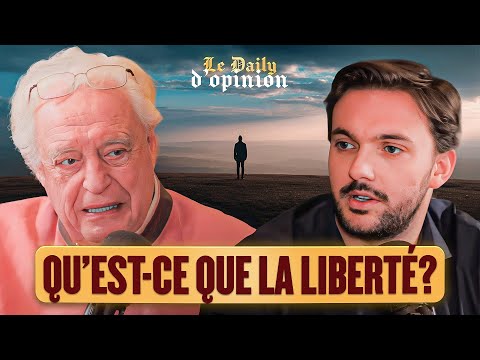
La liberté n’est rien sans responsabilité.
AI Summary
The video explores the complex relationship between liberty and virtue, questioning whether true freedom can exist without a virtuous citizenry. Drawing on thinkers like Rousseau, Lord Acton, and Edmund Burke, the discussion distinguishes between several key concepts: liberty, license, and the difference between singular "liberty" and plural "liberties."
Rousseau is cited for his idea that liberty is demanding and requires virtuous citizens, a concept illustrated by the perceived difference between Swiss citizens, who respect laws, and subjects, who might defy authority. The speaker argues that free nations, while seemingly open, are often virtuous and perhaps even "annoying" because of this demand for civic responsibility.
A crucial distinction is made between "liberty" (singular) and "liberties" (plural). The speaker advocates for the latter, viewing the singular "liberty" as potentially totalitarian, while "liberties" refer to specific, practical rights like freedom of assembly, speech, or the choice not to be vaccinated. The paradox of the modern era is highlighted: despite having more formal rights and possibilities than ever before, there's a sense that liberty is eroding, becoming a mere catalog of individual rights. This is contrasted with the idea of freedom as the absence of arbitrary power, not the freedom to do whatever one desires.
Lord Acton's famous quote, "Liberty is not the power to do what we please, but the right to do what we ought," is presented as a core principle. This leads to a discussion of liberty versus license. Classical liberal thinkers like John Locke are referenced, who defined liberty not as freedom from all norms, but as freedom from the arbitrary will of others, within the bounds of reason. License, in contrast, is seen as formless and potentially harmful, as it can lead to the violation of others' rights, exemplified by extreme arguments defending harmful behaviors.
Edmund Burke is presented as a foundational figure for the "Institut des Libertés," lauded for his foresight in predicting the excesses of the French Revolution. Burke's assertion that "a generally corrupt people cannot remain long free" underscores the idea that liberty stems from virtue, and a lack of self-control leads to external control.
The distinction between the "liberty of the ancients" and the "liberty of the moderns" is explored, referencing Benjamin Constant. The liberty of the ancients, associated with Rousseau and revolutionaries, emphasizes participation in collective power and the general will, where individual liberty can be sacrificed for the collective good. This concept is critiqued for its potential to be coercive, as the idea of being "forced to be free" raises questions about who decides and the risk of a minority imposing its will.
Conversely, the liberty of the moderns, championed by Locke, Montesquieu, and Constant, focuses on a sphere of personal independence protected from state interference. This includes rights like freedom of conscience, press, movement, and private property. These are seen as negative rights, imposing limits on the state, rather than positive rights requiring state action. The importance of private property as a foundation for individual liberty is emphasized, as it provides independent resources.
The concept of "voluntary servitude," as described by Tocqueville, is introduced. This occurs when a population consents to giving up concrete liberties in exchange for a promise of abstract freedom or collective emancipation. This is linked to Tocqueville's notion of "gentle despotism," where individuals may abandon their freedoms because they are pleased that others are also restricted, without realizing their own loss.
Montesquieu's idea that each political regime has a core principle – honor for monarchy, fear for despotism, and virtue for republics – is discussed. Virtue, in this context, is the love of laws and country, prioritizing the general interest over private interest. The American constitution is presented as an example built on these principles, but concerns are raised about the decline of virtue in contemporary political elites. The speaker critiques the election of figures like Mitterrand as a choice for "scoundrels," questioning the public's judgment.
The discussion touches on the idea of enlightened despotism, which may function for a limited time but lacks institutional mechanisms for long-term sustainability, often leading to a succession of less capable leaders. The tension between liberty and virtue is framed as a struggle against centralized authority dictating morality. The role of the state is to enforce law, not morality, which is seen as an individual matter. The speaker controversially suggests that a democracy might function best if it is "Christian," implying a foundation in individual pursuit of salvation and honorable conduct.
Machiavelli is presented as a turning point, introducing the idea that being "disgusting" or manipulative could be an intelligent means to power, contrasting with the earlier Christian notion of a ruler's personal salvation. This is seen as a contradiction to democratic principles, as exemplified by Mitterrand's perceived Machiavellian approach.
Tocqueville's observations on American democracy are highlighted, emphasizing the importance of religion, free associations, and customs, rather than just laws, in maintaining the system. He noted the American tendency towards "compulsive associators" who form committees for various purposes, fostering cooperation and responsibility. The decline of social capital, as documented by Robert Putnam in "Bowling Alone," is presented as a consequence of individualism degenerating into atomization and egoism.
The speaker contrasts the Christian ideal of individualism, where individuals are personally cared for by God but must avoid egoism, with the modern conflation of individualism and egoism. True individualism is seen as the foundation for personal salvation, not self-serving behavior.
The importance of intermediary bodies between the individual and the state, such as families and associations, is stressed. The funding of unions by the state is seen as compromising their independence. The speaker argues that the state often aims to create and impose a collective morality. The solutions offered are individual: rereading liberal texts and the Gospels, and acting with honor. Hypocrisy is warned against, citing Mélenchon as an example of someone claiming integrity while engaging in questionable actions.
The American model of direct democracy and the emphasis on associations are revisited. Tocqueville's observation of Americans forming committees for everything, from building churches to digging wells, is seen as a mechanism for societal reproduction outside the state, fostering cooperation and shared responsibility. The "Robert's Rules of Order" are presented as tools for organized and productive meetings, a skill the speaker feels is lacking in France.
The question of whether only Christian countries can be democratic is posed. While acknowledging that many Christian countries have ceased to be democratic, the speaker suggests that other civilizations, like Confucianism, which emphasize order and respect for hierarchy, may provide a framework for social order but potentially stifle individual invention. Confucian societies are characterized by a segmented approach to liberty (social, economic, political), contrasting with the Western view of liberty as a holistic concept.
The discussion then shifts to the nature of political legitimacy and the role of the state. The speaker questions whether populations truly desire democracy, citing the persistent leadership in Maghreb countries despite the Arab Spring. The Moroccan monarchy is presented as an example of a system with perceived legitimacy due to its historical lineage. The core problem is identified as determining who has the legitimate right to exercise power, or "cut off heads."
The speaker contrasts the Western emphasis on individual rights and dissent, exemplified by figures like Antigone, with the Confucian emphasis on group unity and stability, where dissent can be seen as a threat. This difference is framed as a fundamental divergence in civilizational values, with Western societies potentially prone to anarchy due to their strong individualism, while Confucian societies prioritize order and may suppress dissent more readily.
The American Revolution is contrasted with the French Revolution. The American Revolution is based on the premise that humans are flawed and require checks and balances to prevent abuse of power. The French Revolution, conversely, is seen as operating on the belief that humans are inherently good and can be perfected through collective action, leading to a focus on transforming individuals. The speaker notes the paradox that those who believe humans are good often advocate for more constraints, while those who believe humans are bad advocate for fewer restrictions on individual liberty.
The prohibition of religious services during the COVID-19 pandemic in France is cited as an example of restrictions on religious processions and ceremonies, while political demonstrations, such as those for Adama Traoré, were permitted. This is seen as an arbitrary application of power, justifying restrictions in the name of a flawed collective morality.
The concept of "gentle despotism" in the US is examined, questioning its gentleness given the country's history of military interventions and its extensive military presence worldwide. The speaker argues that American society is not inherently "gentle" but rather characterized by a willingness to impose its will, both domestically and internationally. The trend of individuals expecting collective, state-driven solutions for personal problems (health, education, retirement) is seen as diminishing individual capacity and liberty.
The idea of a "free society" being dependent on armed citizens, as per the Second Amendment in the US, is raised. The speaker suggests that an armed populace might deter excessive state power or alter police responses, referencing the Gilets Jaunes protests.
The notion of "responsible liberty" is introduced as the counterpoint to unchecked liberty or libertarianism, which the speaker feels often neglects collective concerns like environmental quality or public spaces. The difficulty of balancing collective liberties with individual liberties is acknowledged, particularly in ensuring access to public spaces for children's well-being.
The importance of shared collective endeavors that express a desire to live together is emphasized, contrasting with coercive collective actions like concentration camps. The resurgence of interest in churches and the concept of a "common destiny" are seen as positive signs of a renewed search for collective meaning, distinct from forced collectivism.
The historical role of the church in French society and its attempt to be replaced by the Republic is discussed. The speaker argues that the Republic's efforts to create equality in education have led to mediocrity, and that people now prefer their children to be educated with a moral framework, as offered by institutions like Catholic schools. The decline of the Republic's educational prestige and the preference for religious education are noted.
The speaker concludes by reiterating that liberty is the essential element of civilization, not equality, and that the pursuit of liberty must be individual. He rejects the idea of social harmony imposed by the state, emphasizing the necessity of individual struggle for liberty. The current societal crisis, with its totalitarian temptations, is seen as a challenge to this individual pursuit. The analogy of "The Life of Brian" is used to illustrate that true individualism lies in recognizing one's own distinctness, rather than conforming to a collective declaration of individualism. The ultimate goal is to move from egoism back to true individualism.