What the Odyssey Gets Wrong About Bronze Age Greek Religion
Audio Summary
AI Summary
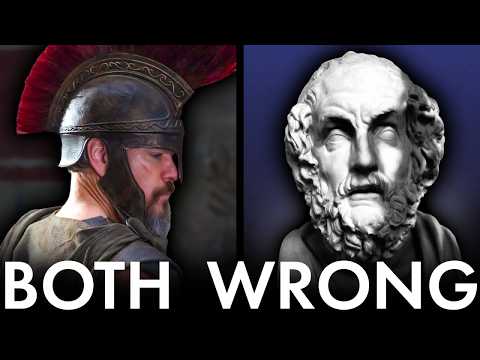
The recent trailer for Christopher Nolan's *Oppenheimer* sparked a debate about historical accuracy, specifically concerning Matt Damon's portrayal of Odysseus wearing a bronze helmet with a horsehair crest. Critics pointed out this as an anachronism, as the Odyssey is set in the late Bronze Age (around 1200 BCE), the era of the Mycenaean civilization, whose warriors are known to have worn boar's tusk helmets and bronze plate armor like the Dendra panoply. However, the critique hinges on the assumption that Homer's epics are reliable historical accounts of the Bronze Age.
Scholars now recognize Homer as a complex source. Homer himself, if a single individual, lived in the 700s BCE, and his poems may not have been finalized until the late 7th or 6th centuries BCE. This creates a significant gap of at least 500 years between the Mycenaean period and Homer's epics, comparable to the historical distance between Nolan and Christopher Columbus. Both Nolan's film and Homer's *Odyssey* contain anachronisms. While Homer sometimes accurately depicts Bronze Age elements, such as boar's tusk helmets, he also includes inaccuracies, particularly regarding armor.
More crucially, the accuracy of Mycenaean religion as depicted by Homer is difficult to ascertain. The primary source for understanding Mycenaean religion is Linear B, the earliest written form of Greek, found on clay tablets containing administrative records. These tablets, deciphered in the 1950s, reveal a system of syllable-based script. They originate from major centers like Knossos, Pylos, Mycenae, and Thebes, and function as palace bookkeeping, detailing livestock, grain, bronze, oil, and personnel.
Crucially, Linear B tablets do not contain myths, hymns, prayers, or ritual instructions. As scholar Thomas Palaima notes, they lack any direct articulation of Mycenaean beliefs about their gods or their worship. Instead, gods appear as budgetary line items, recipients of offerings. A tablet from Pylos (PY TN 316) lists sanctuaries and the gods receiving offerings, such as "Potnia, Manasa, Posidaea" at Sphagianes, and Zeus, Hera, and "Drymeios, son of Zeus" at another sanctuary. This provides information on god names, shrine locations, and potential divine groupings, but it's akin to understanding Christianity solely from a megachurch's financial ledger, revealing liturgical calendars and financial flows but not core beliefs.
Despite these limitations, the tablets name approximately 50 to 60 deities. Zeus appears as Diwayos, possibly derived from a Proto-Indo-European term for "shining sky." He is widely mentioned, with a sanctuary bearing his name at Knossos and receiving a gold vessel at Pylos, grouped with Hera. This pairing might suggest Zeus and Hera were already a divine couple, though their marital status isn't explicitly stated. Mycenaean Zeus also had a feminine counterpart, Diwia, a goddess derived from the same root as Zeus but absent in later Greek mythology. Dionysus appears as Diwonuso, possibly meaning "son of Zeus," and is recorded receiving honey in Zeus's sanctuary at Knossos.
However, Zeus might not have been the supreme deity. Poseidon, appearing as Posidao, seems to have held a more dominant position at Pylos. Numerous tablets record contributions to Poseidon, akin to a tithe, and a specific tablet (UN 718) details provisions for a feast in his honor, with contributions from the king (wanax), the lawagetas, and the community (damos). This suggests a state-sponsored worship of Poseidon.
The figure of Potnia, meaning "lady" or "mistress," also played a significant role. While later Greek uses "Potnia" as an epithet, in Mycenaean times, it designated various goddesses of specific places and domains, such as the Potnia of horses, Sitopotnia (mistress of grain), and Potnia Asiwia (Potnia of Asia). A phrase "Atana Potnia" on a Knossos tablet aligns with Homer's "Potnia Athenaia." The tablets are ambiguous about whether Potnia refers to one goddess with many manifestations or multiple distinct goddesses. An unmodified Potnia at Pylos received valuable offerings, and palace workers were designated as "Potnian," suggesting a central role for this figure. Scholars debate whether this indicates a single powerful mother goddess, a theory largely dismantled by modern historians.
Other Olympian gods like Hermes, Artemis, and Ares appear in Linear B. Notably absent are Aphrodite and Demeter, though Palaima suggests Sitopotnia might have fulfilled Demeter's role. Gods absent from later Greek religion include Pelewa (possibly "dove") and Enyalios, who appears as a distinct deity at Knossos but later becomes an epithet for Ares. Gods with non-Greek names, possibly from the Minoan pantheon, like Pipituna and Padae, are also present.
Mycenaean worship, inferred from tablets and archaeology, involved sanctuaries called Nawiy, the precursors to classical temples. The cult center at Mycenae, with figurines and a fresco possibly depicting Sitopotnia, is a key site. Animal sacrifice was central, evidenced by burnt ox bones at Pylos and depictions on frescoes and seals, mirroring later Greek sacrifices where a portion was burned for the gods.
The available evidence primarily reflects "state religion" of the elite. The wanax, the Mycenaean king, drew power from religion, with his title possibly linked to "birth or regeneration." The Lion Gate at Mycenae, depicting lions flanking an altar or goddess, is interpreted as a public assertion of the ruler's divine connection. The megaron, the palace's ceremonial hall, served as the stage for state rituals led by the wanax. Religious imagery adorned its walls, depicting sacrifices and feasts. The hearth may have held significance, possibly tied to Hestia.
Royal initiation was a religious event, with provisions recorded for the wanax's initiation at Sphagianes, the "place of slaughter." Religious officials, including key bearers and sacrificers (sphagios), formed a professional class employed by the palace, holding land and participating in administration. A priestess's dispute over land tax exemption highlights the privileged status of religious officials. This top-down view reveals a king whose authority was intertwined with the gods, state-sponsored sacrifices, and a religious bureaucracy.
However, the religion of ordinary people remains largely invisible. The widespread discovery of small, female clay figurines (phi and psi figurines) in houses and graves suggests their importance in household religion, but their users left no records.
Returning to Homer, historian Moses Finley argued Homer is not a reliable witness to the Bronze Age. While Homer captures some Bronze Age elements, like Telemachus witnessing communal bull sacrifices to Poseidon at Pylos, mirroring Poseidon's importance there, and the specific ritual of burning defleshed bones, he also incorporates anachronisms reflecting his own Iron Age era. This includes cremation of heroes, a practice uncommon in the Mycenaean period but prevalent in the Iron Age, as evidenced by a 10th-century BCE burial at Lefkandi.
Homer's pantheon also differs significantly from the Linear B tablets. The absence of Aphrodite and Demeter, and the disappearance of figures like Diwia and the Potnia system, contrast with the Bronze Age evidence. The title "Potnia," once naming a powerful goddess, survives only as an epithet. Furthermore, Homer demotes the Mycenaean king. The sacred wanax of the Bronze Age, who held economic and religious authority, is replaced by the basileus, a lesser chief. While the term "anax" survives in Homer, referring to gods and great heroes, the office of the sacred palace king has vanished, leaving only a grander title.
The question of continuity in Greek religion from the Mycenaean to the Classical era has been debated. Walter Burkert argued for minimal continuity, with Classical Greek religion largely shaped after the Bronze Age collapse. However, scholars like Susan Lupack propose greater continuity, distinguishing between palace religion and popular religion. While the palace governments and the wanax system collapsed, local sanctuaries and ritual practices likely persisted.
Evidence for this continuity includes:
1. **Archaeological sites:** Open-air shrines like Mount Lykaion show continuous operation from the Bronze Age through later periods, without elite markers. Mount Lykaion's ash altar demonstrates continuous ritual use across centuries.
2. **Rituals:** Processions, communal offerings, and festivals like the Teophoria (bearing of the gods) described in Mycenaean times find parallels in Classical Greek religion. The scene of women carrying a peplos to Athena's temple in the *Iliad* may reflect an older tradition of female offering processions.
3. **Religious vocabulary:** Many Classical Greek religious terms, such as "sphag" (to slaughter) and "geras" (priest's share), appear in Linear B tablets, indicating linguistic continuity in religious practice.
Lupack argues that while state cults and the wanax system disappeared, local and communal religious practices endured, making Mycenaean cult practices familiar to later Greeks.
In conclusion, the critique of Matt Damon's helmet is valid regarding historical accuracy, as it's a five-century anachronism. Homer similarly incorporates Iron Age elements into his Bronze Age setting, reflecting a "half-remembered past in the costumes of Homer's own era." Yet, striking parallels exist between Homeric epics and Bronze Age material culture, suggesting Homer drew upon fragments of a ruined past, including rituals and possibly even artifacts like boar's tusk helmets. While literary consistency is challenging, Homer's epics offer glimpses into both the Bronze Age and his own time, highlighting the vast differences and surprising continuities between these periods.