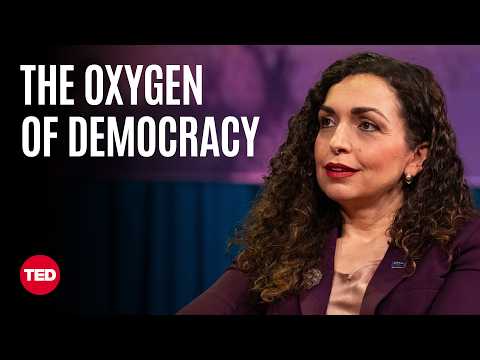
What Kosovo Can Teach the World About Freedom | Vjosa Osmani Sadriu | TED
AI Summary
President Osmani reflects on lessons learned from her life, growing up as a child of war in Kosovo under an apartheid-like regime that escalated into genocidal conflict. She emphasizes that the line between a child of war and a leader of peace is often an opportunity—to live, to survive, and then to thrive. This opportunity was afforded to Kosovo by those who believed in humanity, from political and military leaders to religious figures and ordinary people who offered support. This experience shaped her into a leader for peace, giving Kosovo, despite its small size, a powerful voice against oppression and autocracies. She believes a nation's strength lies not just in political, military, or economic might, but in the strength of its story and the courage to tell it.
Kosovo, with fewer than two million people, achieved visa-free travel to Europe and applied for EU membership under her presidency. From her insider perspective on geopolitical tensions, President Osmani observes widespread devastation and suffering. However, she also sees the importance of sharing success stories like Kosovo's, which demonstrates what democracies can achieve when united by values and in defense of freedom. It also shows that even under oppression, a people determined to be free will eventually succeed, as Kosovo did after centuries of occupation. Sharing this story in international forums is crucial to influencing mindsets, encouraging action to save lives, and prioritizing human values, even when it means making difficult, inconvenient decisions for the sake of long-term humanity.
When personal moral values clash with strategic geopolitical decisions, President Osmani asserts that one must fight through dynamic diplomacy to protect both. While not every fight is won, and sometimes interests other than moral values prevail, the resilience of her nation serves as a constant reminder to continue fighting. This resilience is about not only surviving but also thriving, and never giving up, knowing that countless people worldwide depend on these decisions. She recalls listening to international meetings on a small radio as a child, hoping for rescue, and carries that memory into present-day leadership, ensuring she never forgets the millions of children hoping leaders won't ignore their suffering.
Regarding AI, President Osmani expresses concern about its abuse, particularly in politics, where cloned voices, fabricated videos, and fake images can undermine truth. She believes truth is the "oxygen for democracy," and its erosion threatens democracy itself. While acknowledging AI's potential for good in areas like medicine, she stresses the need for education to help people differentiate between AI-generated content and truth, and for systems that defend truth without over-regulating beneficial AI use. If propaganda triumphs over truth, populism and extremism will flourish, replacing human values with lies.
Finally, President Osmani highlights Kosovo’s enduring commitment to humanity over hate. Despite experiencing a genocidal war that targeted people regardless of religion, Kosovo witnessed instances where mosques sheltered Catholics and churches sheltered Muslims. She shared a personal story of her Muslim family being sheltered in a church during the war by a courageous pastor who protected civilians of different faiths, embodying "besa," a code of promise to protect others with one's life. This tradition led Kosovo to have a higher Jewish population after World War II than before, demonstrating respect for all human lives. She believes this example of valuing humanity and respect above all else can save lives globally. President Osmani concludes by emphasizing that every child of war, whether in Ukraine, Gaza, or Africa, can become a leader of peace if given the opportunity.