COMMENT LES NAZIS ONT VOULU FAIRE DISPARAÎTRE LES PREUVES DE LA SHOAH - M-N-O-P-Q
AI Summary
The following summary explores the deep and often overlooked connections between Nazi ideology, modern management techniques, and the psychological structures of performance and denial, as discussed in the provided transcript.
### The Nazi Origins of Modern Management
One of the most striking insights is the historical link between the Third Reich and contemporary corporate management. The term "management" itself, often used without critical distance today, finds a significant ancestor in the Nazi concept of *Menschenführung*—the art of leading or directing men. A central figure in this transition was Reinhard Höhn, a high-ranking SS general and academic who specialized in state institutions. During the 1930s and 40s, Höhn worked within the SS to adapt government structures to the massive spatial expansion of the Reich. He focused on a core neoliberal question: how to do more with less?
After the war, Höhn avoided the Nuremberg trials and reinvented himself as a management guru. In 1956, he founded a prestigious business school in Bad Harzburg, modeled after institutions like INSEAD. There, he recruited former SS comrades to teach marketing and commercial law. Höhn’s "Harzburg Model," or "management by delegation of responsibility," became the standard for West German industry.
### The Illusion of "Freedom to Obey"
Höhn’s management philosophy was built on the concept of being "free to obey." He argued that in a Western, democratic context, workers must feel free, yet remainsubordinated. His model functioned like the Prussian military: a superior sets a clear objective, but the subordinate is "free" to choose the means to achieve it.
While this sounds like autonomy, it is actually a trap of total responsibility. If the subordinate fails, the failure is theirs alone, shielding the leader from accountability. This system anticipated the modern neoliberal trend of "irresponsibility," where the true decision-makers are hidden behind empty shells or fiscal paradises. Höhn explicitly told corporate executives that under his method, they would never be held responsible again.
### Performance and the "Human Material"
The transcript highlights that the term "Human Resources" is a sanitized version of the Nazi term *Menschenmaterial* (human material). In the Nazi worldview, performance (*Leistung*) was the only measure of a person's worth. Those incapable of productivity—the elderly, the disabled, or the depressed—were viewed as "dead weight" and targeted for elimination through programs like Operation T4.
To maximize the performance of those deemed "fit," the Nazis pioneered "happiness at work." Through the "Strength through Joy" (*Kraft durch Freude*) initiative, they improved workplace ergonomics, provided libraries, and organized concerts. However, this was not out of kindness; it was a strategy to boost output while keeping wages low. They replaced the concept of "equality" with "equity," meaning each person received only what their performance merited.
### The Drugged Society and Unlimited Growth
The Nazi obsession with performance extended to the physical body. To sustain a war of movement, the German army distributed millions of Pervitin pills (methamphetamines). This "Panzer chocolate" allowed soldiers to march for days without sleep or food, effectively creating "augmented" humans. This drive for unlimited power and the refusal of physical limits mirrors modern trends, such as the push for "enhanced" athletic competitions or the pursuit of infinite profit regardless of environmental or human costs.
### The Invention of Negationism
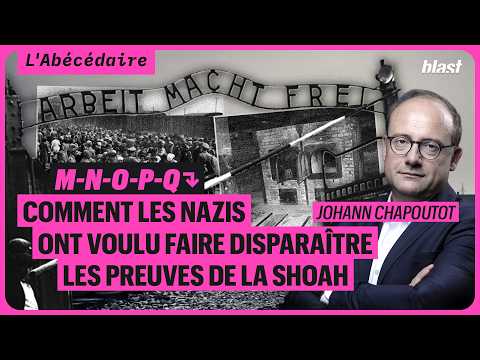
The transcript clarifies that historical negationism—the denial of the Holocaust—was not a post-war invention but a program designed by the Nazis themselves. In his 1943 Posen speech, Heinrich Himmler described the extermination of the Jews as a "glorious page of history" that must never be written. The Nazis knew their crimes were "literally unbelievable" and banked on the idea that future generations would find the scale of the horror impossible to credit.
As they retreated, the SS launched Operation 1005 to dig up mass graves and burn the evidence. Modern negationists continue this work by using pseudo-technical arguments about gas chamber ventilation to hide their political and racist motives. The historian’s role, therefore, is to prove that the Holocaust was "thinkable" and "rational" within the Nazi system, thereby making it undeniably "doable."
### Terror as Routine
The massacre at Oradour-sur-Glane is presented not as an anomaly, but as the "routine of the Eastern Front" imported to the West. For Nazi troops, the destruction of entire populations was a standard counter-insurgency tactic. The mindset was "all or nothing"—either total victory or an apocalyptic end. This extreme violence was fueled by a colonial project that promised German citizens they would become "lords and masters" over the "sub-humans" of the East, mirroring the colonial empires of Britain and France.
### The Social Contract of the Third Reich
Finally, the transcript explains how Hitler "bought" the consent of the German people. He did not redistribute wealth or challenge the industrial elite; instead, he offered psychological and material gratifications. Germans were told they were the "salt of the earth" and were promised a future of colonial luxury. In exchange for their civil liberties, they were given the right to dominate others. This "dictatorship of consent" relied on the promise that while Germans would remain dominated by their own elites, they would at least be masters over the rest of the world.