Review: Mortal Kombat (1995) Is a Bad Movie, But Does Anybody Care?
Audio Summary
AI Summary
The 1995 live-action "Mortal Kombat" movie, while not a great film by conventional standards, holds a unique place in video game adaptations. For a long time, it set the bar, albeit a low one, for how to translate a video game to the big screen. Recent films like "Detective Pikachu," "Sonic the Hedgehog," and "Super Mario Brothers" have surpassed it in quality, but "Mortal Kombat" understood what fans wanted: great martial arts action, a healthy dose of cheese and camp, respect for the source material, and iconic characters like Cary-Hiroyuki Tagawa's Shang Tsung.
The film's strength lies in its embrace of the source material. It features a martial arts tournament with the fate of the world at stake, wild special moves, cheesy one-liners, and violent fatalities (as violent as a PG-13 rating allowed in 1995). However, it struggles with fundamental movie elements like plot, character development, and logical scene transitions. The source material, drawing from only two games at the time, lacked deep lore, resulting in one-dimensional heroes. The disparate backgrounds of Liu Kang, Johnny Cage, and Sonya Blade mean there's no organic relationship building, despite the script's attempts to portray them as a tight-knit group by the final act. Their most memorable interactions are often antagonistic or awkward, like Liu Kang tossing Johnny Cage's suitcase or Sonya's insistence on working alone despite being part of a task force.
Where "Mortal Kombat" truly excels is in its combat. The choreography is clever, and the martial arts are impressive, with subtle nods to the games. While some wished for more screen time for iconic characters like Scorpion and Sub-Zero, their limited appearances deliver two of the most memorable fights. The casting is also a highlight. Cary-Hiroyuki Tagawa's Shang Tsung is iconic, setting the blueprint for the character in future games with his venomous words, vicious expressions, and menacing fighting style. Robin Shou perfectly embodies Liu Kang, nailing the character's look, exuding a natural vibe, and showcasing incredible martial arts skill, making him a believable champion.
The soundtrack, particularly "Techno Syndrome," is another enduring element. It perfectly sets the tone and elevates the climactic final battle between Liu Kang and Shang Tsung into a genuine final boss fight.
Despite its flaws—a flimsy story, non-existent character development, and jarring CG effects (though practical effects like Goro are impressive)—"Mortal Kombat" is recommended for fans of the series or video games in general. It successfully brings a lore-light fighting game to the big screen, offering two hours of impressive martial arts, Tagawa's exceptional performance, and the head-banging "Techno Syndrome" riff.
Mitchell Saltzman, IGN's resident fighting game guru, reviewed the film, noting his personal history with it. He watched it frequently as a kid, appreciating the action and gore during his immature school days, without a critical eye. He has fond memories of it, often talking about it in schoolyards and mimicking lines like "Your soul is mine."
Scott Kalora, another reviewer, admitted he hadn't seen the movie in its entirety until recently. He started watching it and was initially captivated, especially during the tournament fights. However, he noted a shift in enjoyment when the movie moved away from the continuous fight sequences to focus on taking down the main villain, as the "Mortal Kombat tournament stuff" concluded. He agreed that the cool fighting and violence were the main draws, overshadowing the less impressive effects, character development, acting, or story.
Both reviewers praised the acting of Cary-Hiroyuki Tagawa as Shang Tsung and Robin Shou as Liu Kang. They also acknowledged Johnny Cage's portrayal, given that the actors had minimal source material (a few taunts and paragraphs of intro/outro) to build characters. The film's adherence to game mechanics, like Johnny Cage's continuous chest kicks, was noted as a fun nod.
A point of discussion was the film's pacing, particularly the long wait for the first tournament fight, which occurs about 40 minutes in. The opening sequence, with the "Mortal Kombat" scream before the production logo, immediately establishes the film's identity and target audience. While some early scenes, like Johnny Cage's "this is where you fall" line, are memorable, the reviewers felt the film dragged until the core fighting began.
The visual style, even with its low-budget aspects, was appreciated. The composited backgrounds in the opening fight and the cool practical sets for locations like the Netherrealm (their version of hell) added to the world-building, despite some budget limitations. However, the CGI, particularly for Reptile, was deemed "inexcusable" and a stretch too far, suffering from being an early example of the technology. In contrast, the map paintings and practical effects were lauded.
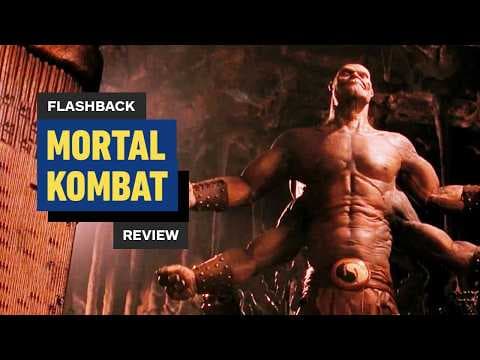
Goro's practical effects were highlighted as a "mastery" of puppetry, showcasing the peak of that art form alongside the nascent CGI. The combination of a person in a suit controlling movements and another inside handling body movement, along with robotics for facial expressions, created a physically imposing and believable character. The only time Goro's effect faltered was during fight scenes, where his movements appeared too slow. A memorable moment involving Goro was Johnny Cage's "nut punch," a direct callback to one of Johnny Cage's iconic moves in the game, made even more humorous by Goro's excellent facial expression.
The reviewers agreed that "Mortal Kombat" is a movie that had to be caught at the right time. While it embodies the spirit of the game with its fun and silly nature, a critical eye on story and character development reveals its flaws. The abrupt transitions between fights, lacking context or announcements, reflect the game's structure but are jarring in a movie. The ending, with the sudden appearance of the emperor, felt incomplete, likely setting up a sequel that was optimistically anticipated. This highlights a common dilemma in video game adaptations: balancing adherence to source material with cinematic storytelling requirements. Often, the core fighting is what fans want, while the narrative elements feel like obligations.
A "nerdy question" was raised about the inconsistent soul-sucking after fights, given Shang Tsung's claim that "the rules are clear." Raiden's role as a "legal counsel" for the tournament, constantly intervening, was noted as a humorous and unexpected take on the character, enhanced by Christopher Lambert's unique whisper talks.
In conclusion, "Mortal Kombat" stands as a flawed but beloved adaptation, cherished by those who encountered it at the right age, and appreciated by fans for its dedication to the game's core appeal: thrilling martial arts and iconic characters, even if the cinematic storytelling falters.