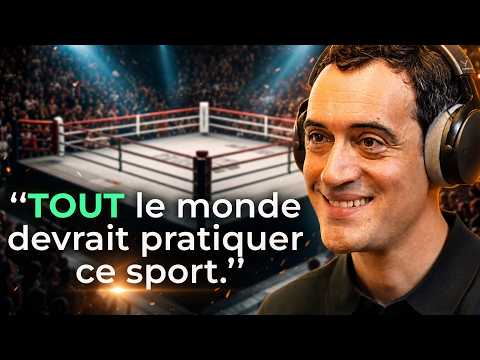
Courage, discipline, endurance : ce sport sous-côté qui développe TOUT
AI Summary
Cyril Duran, founder of Le Temple, a high-end boxing club concept in Paris, shares his journey and the philosophy behind his thriving business. Le Temple, which began 12 years ago, now boasts 5,000 members with the mission to "put all of Paris to boxing." Duran emphasizes that boxing is not just a sport but a tool for self-improvement, fostering self-confidence and emotional management. He cites Thierry Marx, a member of Le Temple, who attests to boxing's positive impact on his professional life, enabling him to be more demanding and maintain a rigorous rhythm.
Duran acknowledges that his initial decision to open a boxing club was met with skepticism from friends who worried he was jeopardizing his career. However, his swift success with Le Temple proved them wrong. He expresses his belief that he made the best choice by finding a "life project" that nourishes, fulfills, and stimulates him daily. He sees failure not as a setback but as an opportunity to learn and pivot, stating, "If failure is a burden you drag, then you have lost. But if you move on, pivot, branch out, build upon it to move on, you have won everything." He focuses on the future, rarely dwelling on alternative paths not taken.
The conversation then shifts to the remarkable member Sixtine, a prominent social media figure known for her communication skills and work with business leaders on platforms like LinkedIn and Instagram. Sixtine discovered boxing through a charity gala organized with Alexandre Mars to raise funds for the Épic foundation. Initially participating for the event, she became passionate about the sport, competing in three galas and dedicating herself to frequent training. Her commitment is highlighted as genuine, especially in contrast to the suspicion often surrounding public figures using such activities for self-promotion. Sixtine's dedication, training multiple times a week, and embracing the challenge of the ring are presented as testaments to her sincerity.
A significant part of the discussion revolves around Le Temple's unique approach to boxing, particularly its "light sparring" format, which intentionally avoids knockout intentions. Duran explains that while a clean, visible "touch" is scored by a judge, the aim is not to injure or demolish the opponent. This contrasts with traditional boxing, where the goal is often to incapacitate the opponent. He clarifies that the intense, full-power training is reserved for heavy bag sessions, serving as a stress release and the most popular class. The Temple's signature lies in controlled intensity, requiring self-control, a difficult but rewarding aspect of the sport. This emphasis on technique over brute force is a core principle, cultivated through mastering one's movements and control.
The discussion touches upon the evolution of boxing rules, including the recent removal of headgear in Olympic boxing, purportedly to increase spectacle and the likelihood of knockouts. Duran notes that in France, knockout boxing is permitted in official competitions up to age 39 for safety reasons. For members over 39 who seek the adrenaline of full-power combat, Le Temple partners with a London club that organizes "white collar boxing" galas where knockouts are allowed. These events feature enhanced safety measures like protective gear and a structured organization. Notable participants in these London events include Saham Golchani, CEO of White and Case Paris.
The concept of "white collar boxing," or "gentleman boxing," is explored, with Duran recalling its early development in London around 2004. He reflects on how this concept initially made boxing more accessible to a broader, perhaps more "white-collar" demographic, challenging the perception of boxing as solely a "blue-collar" sport. He contrasts this with the traditional, often intimidating, municipal boxing clubs he experienced growing up.
Duran recounts his personal journey to founding Le Temple, stemming from his own negative experiences with traditional boxing clubs in Paris. He found them uninviting due to the immediate combat aspect, lack of personal attention from coaches in crowded classes, and unappealing locker room facilities. His realization of boxing's potential for self-improvement, coupled with a transformative experience in a New York boxing club that offered a more welcoming and upscale environment, inspired him to create Le Temple. This club featured high-end locker rooms and combat-free classes, making boxing accessible to a wider audience.
The first Le Temple club opened 12 years ago in the 1st arrondissement, featuring spacious and comfortable locker rooms designed to accommodate professionals who needed to store suits or work attire. Duran emphasizes that his initial venture was met with significant doubt, but its immediate success, with many early members remaining loyal for over a decade, validated his vision. He highlights that Le Temple attracted influential Parisians who were drawn to the originality of the sports proposition, offering a mythical sport in a refined setting, a stark contrast to the traditional fitness chains focused on treadmills and weightlifting.
The discussion delves into the business model and operational aspects of Le Temple. Duran explains that sports clubs are "destination concepts," allowing for locations with less public visibility but reasonable rent. He prioritizes high ceilings, ample space, and functional design, often utilizing basements. Key features include a consistently present ring (at least 5m x 5m, with an Olympic-sized 7m x 7m ring in some clubs), and well-appointed locker rooms and showers, which occupy a significant portion of the space (around 40% of a 500m² club). The club also incorporates a bar/lounge area, serving as a control center for staff and a space for member interaction, though alcohol is limited to beer and the overall ambiance is health-focused.
Operational efficiency is paramount, with Le Temple utilizing tools like Monday.com for task management and detailed checklists, often accompanied by video tutorials. This meticulous approach, described as "micromanagement" by some, ensures consistent quality and experience across all clubs. The focus is on human interaction and exceptional coaching, with a rigorous recruitment process for coaches who are often former high-level competitors with excellent pedagogical skills. Regular technical workshops further enhance coaching quality.
The financial model is subscription-based, with membership costs around €160 per month, reflecting the premium experience and limited class sizes. Duran highlights a high member retention rate (over 90% after the initial two months) and a low annual churn rate, attributing this to the consistent quality of experience and the gym's focus on member engagement rather than "dormant members."
Duran emphasizes Le Temple's commitment to inclusivity, welcoming individuals of all ages, backgrounds, and fitness levels, including those seeking personal development and emotional management rather than purely performance-driven goals. He shares an anecdote about a member who, after experiencing mockery in a conventional gym due to her weight, found encouragement and acceptance at Le Temple, ultimately losing 30kg and regaining her confidence. The club's values of respect and inclusivity are strictly enforced, with members who exhibit disrespectful behavior being expelled.
The conversation touches upon the broader fitness landscape, acknowledging the rise of boutique fitness concepts and the "fitnessification" of various sports. Duran differentiates Le Temple by its focus on an authentic, progressive boxing experience, rather than a purely experiential or trend-driven approach. He contrasts this with the ephemeral nature of some fitness fads like CrossFit, asserting that boxing, as a timeless sport with deep historical roots, offers sustained appeal.
Regarding expansion, Duran's immediate focus is on opening five more clubs in Paris within the next two to three years, followed by international expansion in major global cities. He is open to discussing franchise opportunities but emphasizes his personal preference for hands-on involvement in creating unique, high-quality club experiences, working closely with architects and his team.
Finally, Duran addresses the concept of "less is more" in boxing, emphasizing its minimal equipment requirements and its focus on the individual's physicality and mental fortitude. He highlights the sport's benefits for well-being, including cardiovascular health, muscle development, flexibility, and mental resilience, all crucial for aging well. He positions boxing as a form of personal development, equipping individuals with confidence, emotional control, and enhanced leadership skills, making it an ideal pursuit for those seeking self-improvement and a competitive edge in all aspects of life. He also touches upon the visual appeal of boxing, with members enjoying the opportunity to capture memorable photos and videos, particularly during annual gala events that create extraordinary experiences.