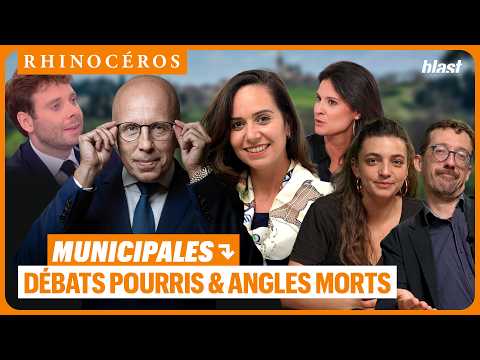
🦏 MUNICIPALES : DÉBATS POURRIS ET ANGLES MORTS
AI Summary
The first round of the French municipal elections has arrived, presenting a unique challenge for national media. These elections are inherently difficult to cover because the stakes are localized—ranging from housing and transport to public service access—and the political color of a candidate often matters less to voters than their ability to manage a small slice of "Macron’s France." However, as the transcript reveals, national political journalists often struggle to make these local issues "spicy," leading to a specific type of media framing that prioritizes personality, scandal, and a very narrow set of ideological themes.
A primary example of this media fascination is Sarah Knafo, a European deputy for Éric Zemmour's "Reconquête" party and a candidate for the mayoralty of Paris. Despite being a candidate for a small far-right party, she has received disproportionate coverage, even winning a "revelation of the year" award from political journalists. This coverage is cited as a new stage in the "banalization" of the hard right. Knafo’s campaign relies heavily on artificial intelligence and a massive, arguably artificial, presence on social media. Data suggests her visibility on X (formerly Twitter) far outstrips her rivals, leading to suspicions of bot usage or algorithmic boosting by Elon Musk.
Despite her online polish, Knafo’s traditional media appearances have exposed a disconnect from everyday life. During interviews, she struggled with basic local knowledge, such as the price of a Paris Navigo pass or naming players for PSG. Furthermore, her campaign faced early criticism for "amateurism" after her website had to shut down a contribution section due to a flood of racist comments and the exposure of contributor data.
This disconnect is not exclusive to the far right. In Lyon, former football mogul Jean-Michel Aulas, running a campaign reminiscent of Emmanuel Macron’s 2017 bid, also failed to correctly identify local transport prices. However, the Lyon campaign was quickly derailed by the death of a neo-fascist militant, shifting the media narrative away from urban planning and toward aggressive debates about "La France Insoumise" (LFI) and the "Young Guard" (antifa groups). Journalists from major outlets like BFM TV and *Le Figaro* focused almost exclusively on forcing candidates to distance themselves from LFI, largely ignoring local issues like bike lanes or tunnels.
The transcript highlights a significant shift in the French media landscape: the rise of "BFM Regions." Since 2019, the Altice group and later Rodolphe Saadé have been acquiring local stations, transforming them into BFM-branded regional outlets. This has allowed private interests to impose specific "framings" and obsessions—most notably a relentless focus on security, surveillance cameras, and arming municipal police. In Marseille, this environment led to a surreal moment where the candidate supported by Macronists, Martine Vassal, accidentally used the Vichy regime’s slogan "Work, Family, Fatherland" (Travail, Famille, Patrie). Rather than sparking a scandal, the media present treated it as a joke or a sign of "ignorance," illustrating how far-right rhetoric is being normalized.
In Nice, the campaign between Christian Estrosi and Éric Ciotti took a bizarre turn involving a pig's head left at Estrosi’s home. While the media initially framed this as a sign of a "violent" campaign, police investigations later suggested that members of Estrosi's own team might have staged the incident as a PR stunt to boost his social media visibility. Meanwhile, in Toulon, the media treatment of RN candidate Laure Lavalette further demonstrates this shift. While local papers like *Var Matin* have been critical, BFM Var has portrayed her as a "friendly mom," ignoring her radical political past and her previous associations with identitarian movements.
The transcript argues that this "bourgeois" media dominance—characterized by pro-business agendas and a fixation on national political feuds—is systematically weakening public service broadcasting. France 3 and France Bleu, recently rebranded as "Ici," are facing budget cuts and forced mergers. Despite these struggles, the transcript maintains that public regional stations remain the only outlets providing genuine local reporting. For instance, while BFM focused on "pig head" conspiracies, France 3 was one of the few outlets to provide detailed coverage of actual physical violence against candidates, such as the knife attack on LFI candidate Jamila Adou in Strasbourg.
The conclusion drawn is that the "hunt for the left" is being legitimized by national editorialists who have now expanded their reach into every local market through regional BFM affiliates. These private channels are unlikely to report on social issues or corporate scandals (such as potential issues with Saadé’s shipping company) that conflict with their owners' interests. The suggested solution is a radical one: the nationalization of BFM TV to merge its national and local branches into a strengthened public service, restoring a focus on pluralism and the actual concerns of citizens rather than the "spicy" obsessions of the Parisian media elite. For now, the municipal elections serve as a stark reminder of how local democracy is being reshaped by private media ownership and the normalization of the far right.