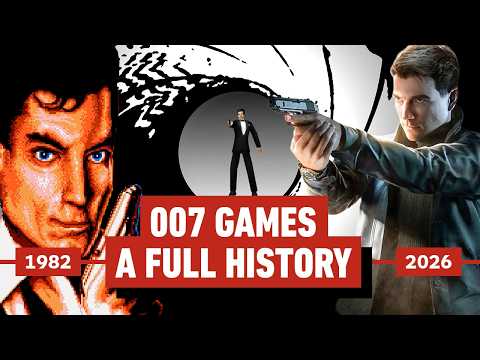
The Complete History of James Bond Games
AI Summary
James Bond, the iconic spy created by Ian Fleming, has a rich history extending beyond his literary origins into various media, including a film series spanning over 60 years and a video game legacy stretching back more than 40 years. While Bond's video game history may not be as extensive as his cinematic one, it is still significant, predating even the Super Mario series.
The very first James Bond game, "Shaken But Not Stirred," was released in 1982 for the ZX Spectrum. Developed by Richard Shepard Software, it was a text adventure. However, it was not an officially licensed Bond game, as Parker Brothers had already secured the rights. This led to the game being reissued as "Super Spy."
In 1983, Parker Brothers released the first official Bond video game, "James Bond 007," for Atari, ColecoVision, and Commodore 64, with a version also released in Japan for Sega's SG-1000. This game was a side-scrolling vehicle shooter loosely based on four Bond films: "The Spy Who Loved Me," "Diamonds Are Forever," "Moonraker," and "For Your Eyes Only." Players controlled a transforming Bond car, and the game featured the iconic Bond theme music.
The year 1985 saw two games based on "A View to a Kill," the final Roger Moore film. One was an action game for home computers published by Domark, featuring driving and action sections. The other was a text adventure for MS-DOS, Apple II, and Macintosh, published by Mindscape and written by Raymond Benson, who would later take over the Bond novel series.
Domark continued its Bond game releases with "The Living Daylights" in 1987 for Timothy Dalton's debut as Bond. This was a traditional side-scrolling shooter that mirrored the movie's plot and offered some replayability with weapon choices. In 1988, Domark released "Live and Let Die," a speedboat shooter loosely inspired by the Roger Moore film. This game was originally an unrelated speedboat shooter called "Aqua Blast" to which Domark added the Bond license.
Timothy Dalton's second and final film, "License to Kill," received a tie-in game in 1989, a top-down vertically scrolling shooter developed by Domark for various home computers. That same year, a light gun game, "The Living Daylights," was bundled with a Christmas relaunch of the Spectrum Plus 2.
Domark revisited the Roger Moore era in 1990 with "The Spy Who Loved Me" for home computers, a Spy Hunter clone that featured a notable remix of the Bond theme. Also in 1990, Interplay released "007 James Bond: The Stealth Affair," an officially licensed point-and-click adventure that was originally released in Europe as "Operation Stealth" and had its protagonist changed to Bond for the North American market.
The early 1990s also saw games based on the animated series "James Bond Jr." in 1991 for the NES and 1992 for the SNES, developed by Eurocom and Grey Matter respectively. These games were generally not well-received. In 1992, an unofficial adaptation of the Roger Moore film "Octopussy" was released in Slovakia for the ZX Spectrum.
Domark's final Bond game was "James Bond: The Duel" in 1992, released on Sega consoles. This game featured an original story with Timothy Dalton's likeness and was a passable action platformer, though criticized for its health replenishment mechanic involving rescuing blondes.
A significant turning point arrived in 1997 with the release of "GoldenEye 007" for the Nintendo 64, developed by Rare. Despite initial low expectations and a development team with limited shooter experience, the game became a massive success. It was a story-based first-person shooter with a revolutionary split-screen multiplayer mode that set the standard for console FPS games for years to come. "GoldenEye 007" is widely considered one of the greatest video games ever made, selling over 8 million units and becoming the best-selling N64 game in the US.
Following "GoldenEye 007," EA acquired the Bond license. Their first Bond game was "Tomorrow Never Dies" in 1999 for the PlayStation, a conventional third-person shooter that lacked multiplayer and was not critically acclaimed. EA continued with "The World Is Not Enough" in 2000, with different versions for PlayStation and N64. The PlayStation version was a first-person shooter without multiplayer, while the N64 version, developed by Eurocom, offered four-player split-screen multiplayer. EA also released "007 Racing" in 2000, a PlayStation exclusive action driving game that, while conceptually interesting, couldn't compete with titles like the "Driver" series.
The turn of the century brought new consoles and a new era of Bond games, starting with "James Bond 007: Agent Under Fire" in 2001 for PS2, later ported to GameCube and Xbox. This game, an original adventure, featured a mix of first-person shooting and driving missions, with optional cinematic "Bond Moments" and four-player split-screen multiplayer with jetpacks. EA followed this with "James Bond 007: Nightfire" in 2002, which brought back Pierce Brosnan's likeness and featured an original song. However, the PC port of "Nightfire" was a distinctly different and inferior game.
In 2003, EA pivoted to a third-person perspective with "James Bond 007: Everything or Nothing." This game was visually impressive, featured a strong cast of voice actors and likenesses including Brosnan, Judy Dench, and John Cleese, and offered engaging gameplay. However, its multiplayer component, while featuring a co-op mode, did not replicate the success of "GoldenEye 007's" deathmatches.
EA's next Bond game, "GoldenEye: Rogue Agent" in 2004, was a disappointingly bland attempt to blend mid-2000s edginess with the Bond brand. Set in an alternate timeline, it was a first-person shooter that suffered from being released in the same month as "Halo 2" and "Half-Life 2." EA's final Bond game was "From Russia with Love" in 2005, a return to a third-person shooter perspective and an adaptation of the Sean Connery classic, featuring Connery himself in his video game debut. While charming with its 1960s setting, it was considered somewhat shallow.
In May 2006, Activision acquired the Bond video game license. Their first release was "Quantum of Solace" in 2008, a fairly unremarkable game despite featuring Daniel Craig. In 2010, "James Bond 007: Blood Stone," an original third-person shooter with driving sequences, was released, alongside a remake of "GoldenEye 007" for the Wii, which was praised as a good first-person shooter for the platform.
Activision's final Bond game was "007 Legends" in 2012, released to coincide with the film franchise's 50th anniversary. This game aimed to celebrate the entire series by featuring missions from films with all six Bond actors, though it used Daniel Craig's likeness throughout. However, "007 Legends" was a tepid "Call of Duty" clone that failed to capture the essence of Bond, misunderstood his character, and even fumbled his iconic catchphrases. Shortly after its release, all Activision Bond games were abruptly pulled from Steam and the publisher's web store, leading to speculation about a souring relationship with MGM.
Since "007 Legends," there has been a decade-long hiatus in new Bond games. However, Bond has appeared in other forms, including classic cars in "Forza Horizon 4" and "Rocket League," and the original "GoldenEye 007" was re-released in 2023. A Lego James Bond game pitch also leaked in 2024. The long absence is set to end with the upcoming "007 First Light" from IO Interactive, an original origin story for Bond that appears to draw on the gameplay of their "Hitman" series.