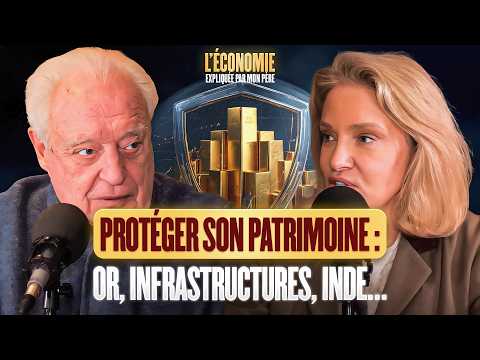
Protéger son patrimoine : or, infrastructures, Inde… les actifs antifragiles par Charles Gave
AI Summary
This summary outlines the key economic, geopolitical, and philosophical insights from a recent Q&A session at the Institut des libertés featuring economist Charles Gave.
**Taxation and the Erosion of Property Rights**
The discussion begins with a critique of the Netherlands' decision to tax unrealized capital gains at a rate of 36%. Charles views this as a profound "attack on property rights" and a penalty on risk-takers. From an economic perspective, taxing savings directly reduces the pool of capital available for investment. Since investment drives productivity, such policies inevitably lower a nation's standard of living. He predicts a flight of capital and wealthy residents toward more favorable jurisdictions like Italy or Singapore. This trend reflects a broader European malaise where the state increasingly absorbs the resources of the productive sector to fund its own expansion, a cycle Charles notes has been particularly destructive in France since the 1970s.
**The Role of the State and Education**
Regarding the funding of public media and education, Charles advocates for a radical shift away from state-run production. He suggests that if public services must exist, they should be funded via vouchers (the "cheque éducation" or "chèque redevance") to introduce competition. However, his preference is to abolish these public services entirely and return the money to citizens. He highlights the lack of transparency in public media—specifically citing journalists who refuse to disclose salaries funded by taxpayers—as a symptom of a system without accountability.
The state, he argues, should return to its "regalian" functions: justice, the military, and the police. Currently, the French state fails in these core missions while overextending itself into social engineering and school curricula. He supports the Swedish model of education vouchers, which allows for local control and school competition, asserting that the state should be a "prescriber" of standards rather than a "producer" of services.
**Monetary Policy and Interest Rates**
Charles explains that while central banks can set short-term interest rates, long-term rates should ideally be determined by market forces. He argues that short-term rates should align with nominal GDP growth to prevent unproductive debt. He is highly critical of the European Central Bank’s history of manipulating long-term rates to finance government deficits, a practice he describes as "cheating" against established treaties and economic logic.
He posits that interest rates represent a "premium for the uncertainty of the future." The period of negative interest rates in Europe was, therefore, a philosophical and economic crime, as it suggested the future was more certain than the present. This manipulation has distorted market signals, leaving investors without a clear understanding of the true price of time.
**Geopolitics: The Rise of China and Sovereignty**
A significant shift is occurring in South America, where nations are increasingly moving away from the US Dollar toward the Chinese Yuan. Charles contrasts the American model of dominance—based on the dollar and military force—with the Chinese "infrastructure model." China secures long-term relationships by building ports, roads, and airports, a strategy that is highly attractive to developing nations lacking their own capital. Even ideologically opposed leaders, like Argentina’s Milei, are finding it difficult to ignore the practical benefits of Chinese investment.
On the topic of free trade and Mercosur, Charles introduces a nuanced "sovereignty" argument. While he generally supports free trade for energy users (consumers and manufacturers), he believes energy and food producers must be protected as matters of national sovereignty and "antifragility." He views the EU’s pressure on France to relinquish its energy independence—such as privatizing dams or pegging electricity prices to German gas—as a deliberate effort to weaken the nation's core stability.
**Investment Strategies: Gold, the Yen, and Portfolios**
For investors, Charles remains bullish on the Japanese Yen, noting that current 30-year bond yields in Japan finally offer a reasonable hedge against inflation. He also defends the role of gold, not just as an inflation hedge, but as a way to "short central bankers" when real bond yields are insufficient.
Regarding the "Harry Browne" permanent portfolio, he cautions against increasing the equity portion beyond the 33% used in his modified version. While more stocks might increase returns, they also introduce a level of volatility that breaks the "antifragile" nature of the strategy. He advises sticking to "property" (gold and shares in productive companies like Air Liquide) rather than "contracts" (government bonds) during times of systemic instability.
**Technology, AI, and Human Intuition**
The session concludes with reflections on Artificial Intelligence. Charles distinguishes between "intelligence" as information processing (the English sense) and "intelligence" as creation (the French sense). While AI will devastate professions based on memory and documentation, he doubts it can replace human intuition—the "non-dit" or the "surgeon's instinct" developed through decades of experience.
He predicts a shift in value from "programmers" to "engineers"—people who build physical infrastructure that cannot be replicated by a machine. Ultimately, Charles views the rise of AI as a positive disruption that might finally break the state's monopoly on education, allowing individuals to acquire knowledge without the influence of failing institutional systems. He encourages investors and citizens to return to "fundamentals" and local "subsidiarity" to navigate this period of creative destruction.