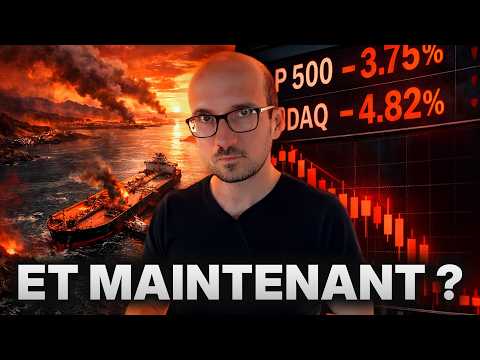
Choc énergétique, tech en chute libre, crypto qui lâche : debrief complet
AI Summary
The past week has been exceptionally intense for global markets, with central banks facing a looming crisis, persistent pressure on oil prices, and significant inflation risks impacting even major tech companies. The situation is complicated, requiring a step back to understand the underlying issues.
The primary factor influencing market conditions is the commercial closure of the D3 in Ormous. Insurance companies are refusing to cover vessels passing through the strait, with war bonuses having quadrupled or quintupled. This has made it financially unfeasible for ships to navigate the area, effectively blocking 20% of global oil production. Even Iran's allies, like China, are reportedly being denied entry for some of their ships. This differs significantly from the 2022 Ukraine war scenario, where Russia continued to sell oil indirectly. Currently, a physical bottleneck exists, forcing Gulf producing countries to reduce output as storage capacity is full, preventing exports. The International Energy Agency has termed this the "biggest energy security disruption in history."
Oil prices have surged, with Brent crude surpassing $103, reaching levels not seen since 2022. Despite announcements from figures like Trump about ongoing negotiations, upward pressure on oil prices persists, leading to increased inflation expectations across various sectors. Goldman Sachs estimates that markets are currently pricing in a $14 oil risk premium compared to pre-conflict levels, an amount corresponding to the economic impact of a complete four-week closure of the D3 of Ormous. The ripple effect extends beyond oil to other critical raw materials. Gulf countries account for 45% of global sulfur production, and helium, vital for semiconductors, is also affected. Fertilizer prices have exploded by 40% since the conflict began, indicating future impacts on industrial costs and production, though the most visible effect for now is rising pump prices.
This uncertainty has significantly altered inflation outlooks. The OECD has considerably revised its inflation projections upwards, now forecasting over 4% inflation in the United States by 2026 under current circumstances, a substantial increase from previous projections of under 3%. Central banks, including the Federal Reserve, are struggling to anticipate the full impact, leading to uncertainty about future rate decisions. Market expectations for a rate cut have shifted further out, now anticipated for September, rather than earlier. In the Eurozone, the OECD projects 2.6% inflation and economic growth around 0.8%, a disappointing outlook for an economy expected to recover, with growth optimistically predicted to pick up only by mid-2026.
The situation raises concerns about stagflation—a scenario characterized by slowing growth and rising prices, creating a "double scissors effect" that is a "mess." While the Fed's forecasts for an easing of monetary policy by late 2026 are seen as overly optimistic, the European Central Bank is already considering raising rates as early as this summer. This environment has pushed the 10-year US Treasury rate dangerously close to 4.5%, marking the highest levels since April when tariffs were initially implemented. This signifies a tightening of financial conditions, which mechanically weighs on the long-term valuations of companies, particularly in the tech sector.
Consequently, upward pressure on oil prices and rising US dollar interest rates have led to downward pressure on risky assets and major indices this week. The speaker noted selling American indices like the SP500 through daily plans, though with varying success due to volatility spikes. Market polarities are predominantly negative, with the VIX, a measure of implied volatility for SP500 options, increasing by 10% while other indicators show declines. Support zones on US indices are giving way on daily and weekly charts, pushing below previous range bottoms for the SP500 and Nasdaq. European indices, like the CAC and DAX, had already fallen significantly more than their American counterparts, losing 12% compared to the SP500's 6% loss, highlighting Europe's underperformance. Towards the end of the week, investors tended to retrieve cash when overexposed, contributing to generally weaker Friday sessions.
Beyond broad market trends, specific tech companies faced challenges. Meta (MTA) saw a nearly 10% drop, losing $120 billion in valuation, following two court verdicts condemning the company for designing platforms that promote addiction among minors. This impacted the broader tech sector, including Reddit and Snap. Micron was also affected after Google announced a new algorithm requiring significantly less memory, potentially reducing revenue for memory-related businesses.
Traditional safe havens have not performed their role effectively. Gold, instead of rising during market uncertainty, has continued to decline. This is attributed to the rising US dollar and potential unwinding of positions by investors compensating for losses in other assets. Bitcoin, which had shown resilience in recent weeks and attempted to surpass $70,000 or even $75,000, has also retreated, falling below $70,000 and displaying negative polarities, failing to act as a safe haven.
In summary, the market is experiencing a significant energy supply shock and multiple other shocks driving inflation upwards. Interest rates and debt costs are increasing, limiting central banks' ability to lower rates. This will likely lead to falling growth forecasts and an inevitable decline in equity markets. A sustained closure of the D3 of Ormous for a quarter, according to the Dallas party, could lead to a three-point deduction in global growth, an enormous impact.
Given these conditions, all support zones on US indices are breaking on daily and weekly charts, indicating a challenging week ahead with downside risk outweighing upside risk. The speaker stresses the importance of preparing long-term entry zones in stages, focusing on quality assets for pullbacks. This proactive approach is crucial because during moments of panic, psychology will be extremely negative, presenting opportunities to buy cheaply while maintaining cash reserves. The speaker intends to continue working with the "flow of the moment," maintaining discipline and a 360-degree market vision.