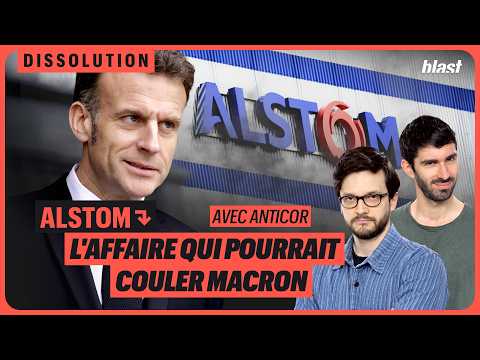
ALSTOM : L'AFFAIRE QUI POURRAIT COULER MACRON
AI Summary
This summary provides an overview of the key political and industrial issues discussed in the transcript, focusing on the Alstom-General Electric affair and the dynamics of the 2026 French municipal elections.
### The Alstom-General Electric Scandal: A Question of Sovereignty
The program opens with a deep dive into the Alstom affair, a case that continues to haunt the French executive branch. The controversy began between 2002 and 2009 when Alstom, a French industrial giant, used bribes to secure contracts in Indonesia. Due to the extraterritorial reach of American law—specifically because the transactions were made in U.S. dollars—the United States Department of Justice imposed a staggering $792 million fine on the company.
This massive financial penalty destabilized Alstom, creating the conditions for the 2014 sale of its energy branch to the American conglomerate General Electric (GE) for 12 billion euros. Eric Halt, Vice-President of the anti-corruption association Anticor, explains that while the company paid the fine, the individuals responsible for the corruption—high-level executives—largely escaped accountability. Anticor has challenged the legal dismissal of these cases, arguing that the act of corruption is characterized by the attempt itself, regardless of whether it ultimately proved profitable for the company.
The second "volley" of this scandal concerns the sale's strategic and political implications. Emmanuel Macron, who was the Minister of Economy at the time, supervised and authorized the sale. Critics, including MP Olivier Marlex, have signaled a troubling correlation between the financiers of Macron’s 2017 presidential campaign and the banks and consultancy firms that profited from the Alstom-GE deal.
Beyond potential corruption or "trafficking of influence," the sale represents a major blow to French industrial sovereignty. Alstom Energy produced the "Arabelle" turbines, which are essential components for France’s nuclear submarines and power plants. By allowing an American company to take over this production, France effectively lost control over its own strategic assets. Because these turbines now incorporate American components, the United States has the legal authority to block their export. Despite warnings about this loss of sovereignty, the government's response at the time—famously summarized by Macron’s dismissive remark that "France is not Venezuela"—showed a lack of a coherent industrial strategy to protect the public interest.
### The Ethics of Political Financing
The Alstom case highlights the porous border between public interest and private gain. The transcript emphasizes that while many aspects of campaign financing and corporate consulting are technically legal, the "entre-soi" (the tight-knit circle of elites) creates a permanent suspicion that erodes public trust.
In France, campaign donation limits are set at 7,500 euros for parties and 4,600 euros for candidates. While these may seem modest to some, they represent significant sums for the average citizen. Furthermore, the system allows for tax rebates that effectively mean the state subsidizes the political preferences of the wealthy. In Macron’s case, a mere 950 individuals funded more than half of his campaign. To combat this "plutocratic" tilt, the program references Julia Cagé’s proposal for "democratic interest vouchers," which would allow every citizen to allocate a small portion of their tax money to the party of their choice, thereby leveling the playing field.
### The 2026 Municipal Elections: Security vs. Reality
The second half of the program shifts focus to the upcoming municipal elections. The debates captured in the transcript reveal a political landscape characterized by aggressive rhetoric and a narrow focus on security. Across various cities—including Paris, Lille, Nice, and Pau—candidates are increasingly fixated on "law and order" issues, often at the expense of other vital local concerns.
A recurring theme in these debates is the expansion of the municipal police and the installation of video surveillance (CCTV). In Nice, for instance, candidates clash over the efficacy of the city’s 2,500 cameras. Critics point out that despite this massive surveillance network, crime and drug trafficking have not decreased; they argue that cameras are a "demagogic" and costly tool that helps solve crimes after the fact but does nothing to prevent them or address the underlying social causes of insecurity, such as poverty and precariousness.
The transcript also highlights a troubling trend in political media: the marginalization of female voices and left-wing perspectives. Debates are frequently dominated by male candidates who interrupt or "mansplain" to their female counterparts, particularly when discussing police tactics or urban management. This "security bias" is often framed by journalists as the primary concern of the French people, a narrative that reinforces the rhetoric of the far-right.
### The Real Stakes: Climate and Social Services
While security dominates the headlines, the transcript argues that the real power of a mayor lies in urban planning and social solidarity. Municipalities and inter-communal bodies determine how cities are built and how they will adapt to the climate crisis. For example, in the city of Pau, temperatures are projected to match those of Seville by 2040. Preparing for this shift requires a focus on ecological transition and public services—areas that are often sidelined in favor of "security theater."
Ultimately, the municipal elections are about the allocation of significant resources. Local governments in France manage a budget of approximately 160 billion euros—about one-third of the state’s total budget. Voters are faced with a fundamental choice: should these hundreds of millions be spent on surveillance cameras and arming police, or should they be directed toward schools, hospitals, crèches, and aid for the elderly? The program concludes by urging citizens to look past the "security obsession" and recognize the vital role of local government in ensuring a sustainable and equitable future.