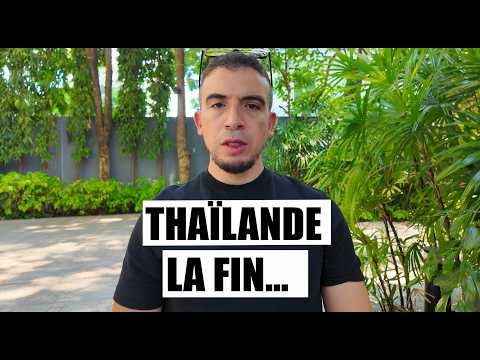
je quitte la Thaïlande si le pays ressemble à la France.
AI Summary
The speaker, having lived in Thailand for 10 years, discusses reasons why he might consider leaving the country, despite having built a stable life there with work and family. He emphasizes that while Thailand offers a sense of freedom compared to France, this doesn't mean disregard for laws or customs. He aims to provide an honest perspective, beyond the typical tourist attractions of sun, beaches, and street food.
One primary concern is disrespectful mass tourism. The influx of tourists often disregards local temples, modesty, traditions, and customs. This behavior can lead locals to mistakenly associate long-term residents and expatriates with the same disrespectful conduct, even if they have lived in Thailand for many years. The speaker, who lives in Bangkok, chose the city for its stability and productive energy, avoiding the constant "vacation" feeling associated with tourist-heavy areas like Koh Samui or Phuket. Bangkok, with its 12 million inhabitants, offers a conducive environment for business and networking, where most foreigners are settled residents rather than transient tourists. It also allows for quick travel to other parts of Thailand.
Another significant reason for potentially leaving is the increasing pollution across Thailand. While he appreciates Bangkok, the noise pollution from tuk-tuks and motorbikes, whose exhaust pipes are often modified to be excessively loud, has become bothersome over time. This, combined with atmospheric pollution, creates an unpleasant environment that makes long-term settlement difficult. He regularly checks daily pollution levels, which are often in the red or orange zones, sometimes necessitating staying indoors with air purifiers. As a father, he questions the long-term health implications for his child. He considered Chiang Mai, but it suffers from a severe "burning season" for several months each year, during which it ranks among the most polluted cities globally. This period often forces residents to leave the city to avoid the extreme pollution, much of which also originates from neighboring Laos and Myanmar, making it a regional issue beyond Thailand's control.
The rising cost of healthcare is another critical factor. Many expatriates have insurance only for hospitalizations, not for outpatient consultations. This means that routine doctor visits or emergency room visits that don't result in an overnight stay are paid out-of-pocket, which can accumulate into significant expenses, especially for families. Furthermore, for individuals with pre-existing medical conditions, insurance often excludes coverage for those specific pathologies, complicating their ability to settle in Thailand. Some individuals pay substantial monthly premiums, up to 600 euros, as insurance costs increase with age and medical conditions. The speaker acknowledges that he initially lived without insurance, minimizing risks, but eventually realized the necessity of protection.
He reiterates his preference for cities like Bangkok and Chiang Mai over purely coastal tourist destinations, as he seeks a routine and stability rather than a perpetual vacation atmosphere. He suggests that prospective expatriates visualize their ideal daily life in Thailand and consider visiting different regions to find the best fit. For him, a simple routine of coffee, work, and family time is ideal. He emphasizes the importance of understanding one's "why" for expatriating – whether seeking stimulation or stability. While he is happy in Thailand and doesn't currently imagine living elsewhere, he has other countries in mind as alternatives. He stresses the importance of respecting local rules, culture, and learning the Thai language, viewing it as an obligation for those who choose to live there. Paying taxes for those with business activities is also crucial to avoid legal issues like being blacklisted.
Road safety is another concern that could lead him to leave. Thailand experiences a high number of accidents, particularly during festive periods like the Thai New Year (Songkran), when alcohol consumption and motorbike use increase. While Bangkok offers reliable public transport like the Skytrain and subway, providing independence from taxis, this convenience is not available in other provinces, where reliance on taxis and their pricing can be an issue. The idea of daily long commutes in an unsafe environment would make him reconsider living there. He believes a smooth daily life, free from constant mental burden, is essential for a long-term stay. The "sweetness of life" in Thailand makes time pass quickly, contrasting with the slower perception of time during difficulties or suffering.
Political instability is a significant, long-term concern. Thailand has a history of economic and political instability. The possibility of events like a coup d'état or widespread protests could directly impact residents and prompt him to seek an alternative destination like Malaysia, Cambodia, or Vietnam, either temporarily or permanently. He advises against being solely committed to Thailand, emphasizing the importance of agility and financial preparedness to relocate if necessary. He also highlights that political instability primarily affects investors with substantial assets, as liquidating and transferring investments would be a complex process.
Finally, the inability to provide a decent education for his child is a critical consideration. He discusses the dilemma of choosing between international and Thai schools. International schools, often English-speaking, foster open-mindedness and public speaking, but can disconnect children from local culture. Thai schools, on the other hand, immerse children in the local culture, potentially leading them to be perceived as full Thais rather than mixed-race foreigners, which can open up local business opportunities. He reflects on the differences between English and French education, noting that French education emphasizes discipline and rules, and he would prefer his son learn French early, as English can be acquired later. He also criticizes parents who choose expensive international schools for ego reasons, suggesting that money could be better invested for the child's future.
He concludes by emphasizing the importance of not feeling like an "eternal guest" or unwelcome. Thailand is a welcoming country, but guests must respect its rules and culture, avoiding a colonial attitude. Learning Thai, respecting elders, and understanding cultural nuances are paramount. He acknowledges that he is a guest and strives to be an exemplary ambassador for his home country, hoping that locals perceive him positively. He believes everyone is an ambassador on their own scale.