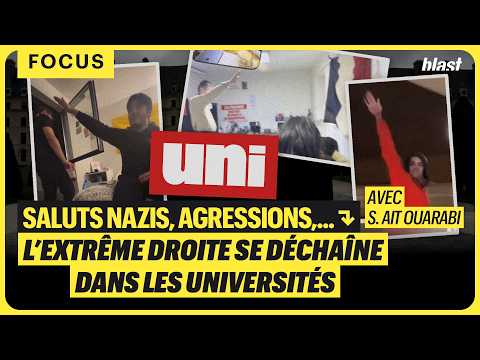
SALUTS NAZIS, AGRESSIONS, ETC. : L’EXTRÊME DROITE SE DÉCHAÎNE DANS LES UNIVERSITÉS
AI Summary
Recent months have seen a sharp rise in tension across French universities, marked by reports of racist and antisemitic messages, intimidation, and even physical aggression. At the center of these controversies are far-right militants associated with the student organization UNI (Union Nationale Interuniversitaire). To understand the nature of these groups and the hardening climate on campuses, we hear from Safia Awarabi, a 24-year-old doctoral student and activist with the left-wing student organization "Le Poing Levé."
Awarabi provides a historical perspective on UNI, noting it was established in 1969 in the wake of the May 1968 protests. Its founding mission was explicitly to combat what it termed "Marxist gangrene" within the university system. From its inception, UNI has pursued a strategy known as the "Union of the Rights." This aims to organize the children of the bourgeoisie to ensure that right-wing and elitist ideas can compete with and suppress the spread of leftist and Marxist ideologies. Awarabi explains that UNI operates with two distinct faces. One is institutional: clean-cut students who run for faculty council seats and present themselves as "well-behaved" representatives. The other is far more radical and often overlaps with neo-Nazi circles. She cites historical examples, such as a joint list between UNI and the neo-Nazi group GUD in the 1980s, and notes that today the organization acts as a bridge for militants ranging from the traditional Republicans to the supporters of Éric Zemmour and Marine Le Pen.
The core project of UNI, according to Awarabi, is to transform the university into an ultra-elitist space. This involves a deliberate effort to exclude the children of workers, those from immigrant backgrounds, and international students. Their platform often mirrors far-right political tropes, such as "national preference" and the "Great Replacement" theory. They specifically target foreign students, advocating for restricted rights and higher fees while accusing them of being part of an "expansionist" strategy to impose a rigorous form of Islam on campuses. Awarabi points out that UNI has simply updated its old anti-Marxist rhetoric for the modern era, now focusing on "anti-wokism" and "anti-Islamogauchisme" (Islamo-leftism).
She argues that this shift was made easier by the current French government. By using terms like "Islamogauchisme" to describe academic research on racism or post-colonial studies, government figures have effectively legitimized UNI’s aggressive ideological stance. Awarabi is highly critical of the "Macronie" (President Macron’s administration), asserting that UNI is essentially surfing on a wave of government-led stigmatization. She mentions the "Bienvenue en France" plan, which increased tuition fees for non-EU students, and recent budget cuts that restricted housing benefits (APL) for foreign students. For Awarabi, these policies are a gift to the far-right, providing them with a framework to be more offensive both ideologically and on the ground. She notes that high-ranking right-wing politicians have even attended UNI national conferences to show support, further blurring the lines between mainstream politics and far-right student activism.
Despite UNI's attempts to present a respectable image—often characterized by students in polo shirts—Awarabi highlights recent videos that have surfaced on social media. These clips show UNI members performing Nazi salutes and singing songs nostalgic for French colonial rule in Algeria. Awarabi believes it is crucial for the public to see these images because they reveal the organization's true nature: a group deeply rooted in colonial nostalgia and racism, with active links to local neo-Nazi groups in cities like Aix-en-Provence.
However, the climate on campus is not solely defined by far-right aggression. Awarabi points to a significant counter-movement among students. In the recent "Crous" elections—which focus on social issues like housing and food—UNI suffered major defeats, losing all their seats in several major academic hubs like Bordeaux, Toulouse, and Aix-en-Provence. This electoral decline reflects a broader resistance on the ground. Awarabi describes instances where hundreds of students have walked out of lectures to confront far-right militants and prevent them from spreading their ideas. She shares a specific victory in Aix-en-Provence, where a massive student mobilization forced members of the far-right group "Frontière" and UNI to flee a campus event.
Ultimately, Awarabi contrasts the "youth" represented by UNI—the children of the bourgeoisie—with the students she represents: the children of the working class whose parents work in construction or cleaning. This latter group, she argues, is the truly engaged majority. These students are fighting against student poverty, protesting for Palestine, and resisting fee hikes. For Awarabi, the goal is clear: students must rely on their own collective strength to push back against far-right ideas. She concludes that universities must remain bastions of progressive thought, where the diverse majority of students can study without fear of intimidation.