Iran: l'escalade inévitable?
AI Summary
The speaker begins by drawing a parallel between the current situation with Iran and past conflicts, recalling Donald Rumsfeld's prediction of a short war in Iraq that ultimately lasted over 20 years, causing a massive humanitarian catastrophe and an embargo that killed 500,000 children. This is contrasted with claims of 30,000 deaths by the Iranian regime during foreign-influenced protests, emphasizing that geopolitics isn't driven by good sentiments but by seeking the best, or least bad, outcome. The consequences of past interventions are highlighted: over 3 million displaced in Iraq, the rise of ISIS (allegedly funded by the CIA), and the slave markets in Benghazi following the overthrow of Gaddafi in Libya. The speaker dismisses those who appeal to good sentiments as either "useful idiots" repeating media scripts or "true villains" like BHL, who was reportedly sentenced to 33 years in prison in Tunisia for conspiracy against the state.
The desire for war with Iran is presented as a long-standing objective, tracing back to Benjamin Netanyahu's 1995 claim that Iran was weeks away from possessing nuclear weapons. The speaker then critiques the perceived ineffectiveness of political leaders, citing Barack Obama's failure to close Guantanamo and Donald Trump's unfulfilled promise to end the war in Ukraine in 24 hours. The continued operation of Guantanamo, the ongoing war in Ukraine, the lack of prosecution for figures like Fauci, Bill Gates, Hillary Clinton, and Jeffrey Epstein's associates, are all presented as evidence that "patriots" are not in control, and that a deeper power structure, a "deep state," is at play. This deep state, according to Putin, cannot be overcome by hypothetical patriots but only by "we the people." Even serious figures like Jayvans are compelled to follow the narrative, such as claiming Iranians are preparing "nuclear vests," a tactic more associated with Israeli deterrence.
The speaker details Israel's "Samson Option" strategy, where figures like Martin Van Creveld explicitly state Rome as a target, and former Mossad chief Yossi Cohen boasts of infiltrating "all the countries you can imagine." This nuclear deterrence is deemed more plausible than claims of Iranian diesel submarines or easily interceptable intercontinental ballistic missiles. The "deep state" is further illustrated by Putin's assertion that Obama was informed by "men in black suits" that closing Guantanamo was impossible. Trump is now seen as fully embracing the war in Iran, a classic escalation scenario, despite having previously managed to de-escalate conflicts. Netanyahu, however, learned from past experiences and, with the backing of unseen forces, ensured the US would fully commit to war with Iran.
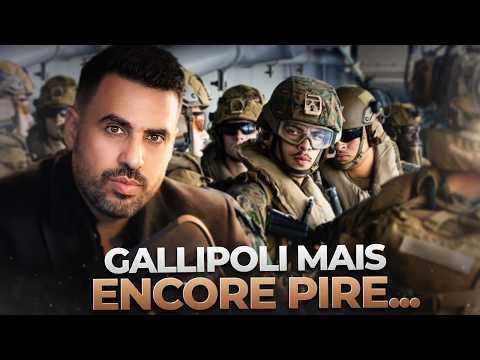
Current US military deployments include marines, airborne troops, and two aircraft carriers. The Abraham Lincoln is hidden behind Omani mountains, while the USS Gerald Ford returned to Crete and then Norfolk, officially due to a "dryer lint fire"—a claim the speaker finds incredulous, given the carrier's cost and importance.
Iran's defensive capabilities are highlighted: underground missile cities buried 500 meters deep in granite, capable of producing and storing hypersonic missiles. Bunker busters, effective against 60 meters of concrete, would be insufficient against 500 meters of granite. Iran has at least 30 such missile cities and a decentralized, autonomous electricity grid. Trump's threat to attack Iran's desalination capabilities is dismissed, as Iran depends on desalination for only 2% of its water, while US allies in the region (Qatar, Kuwait, UAE, Israel) depend on it for 40-90%. Iran can target all these desalination centers and has already "exploded" Dubai's economy.
The speaker notes that 66% of Bahrain's population is Shiite, and they are launching a "small revolution" due to Iran's strengthened position, a similar situation unfolding in Iraq. This explains why "true American patriots" like Ron Paul and Rand Paul opposed war with Iran, a country that has prepared for 40 years and possesses Chinese and Russian intelligence and technology. Iran's ability to shoot down F35s, once touted as "undetectable," is cited, demonstrating that thermal signatures of jet engines are detectable by integrated sensor systems, including Chinese and Russian satellites. This effectively neutralizes stealth bombers and F35s, preventing them from striking Iran.
The US has already exhausted several years' worth of Tomahawk missile stock in a matter of days (over 400 fired, while normal production is 100 per year). Iran retains the capacity to strike Israel, the UAE, and Saudi Arabia. The Houthis, allied with Iran, can close the Bab-el-Mandeb strait at will, a move that could generate an additional $50 billion annually for Iran by taxing the Strait of Hormuz. This conflict also benefits Iran by driving up oil prices and weakening the petrodollar, an arrangement established by Roosevelt and the Saudi king on the USS Quincy. The petrodollar system, where all raw materials are bought in dollars, is collapsing, with Iran now allowing yuan-denominated cargo through the Strait of Hormuz, as China's Xi Jinping advocates for the yuan as a reserve currency.
The speaker questions the rationality of this war, given that it humiliates US allies like Japan (accused of not warning about Pearl Harbor, despite Hiroshima and Nagasaki) and Gulf Cooperation Council countries, forcing them to sell their gold reserves. This irrationality is attributed to "messianism," the belief that a war is necessary to bring about the Messiah. American officers and even a close Trump advisor (who performs exorcisms) are cited as holding such beliefs, to the point where the Pope has condemned these actions as "satanic." The speaker contrasts this with Iranian ayatollahs, questioning which side is more "theocratic." Israeli media itself reportedly criticizes Netanyahu's entourage for a "complete theocratic drift."
The concept of Gog and Magog is explored: for some Muslims, it represents the current Western powers, while for certain messianic extremists, it signifies Iran and Russia or Russia and China. Iran is often demonized as Amalek or Gog/Magog, forces that can only be stopped by the return of Jesus Christ. The speaker notes that anti-Zionist rabbis, who consider the State of Israel and the attempt to force the Messiah's arrival as "Hilul Hashem" (an insult to God), are gaining increasing traction. In the US, unlike France, there is a significant movement of left-wing Jews who are openly critical of Netanyahu and have contributed to exposing damaging information. Even former Trump supporters like Tucker Carlson, Joe Rogan, and Candace Owens feel betrayed by Trump's shift towards war with Iran, given his previous stance against such conflicts.
The core of this messianism is the belief that a major war, potentially nuclear, that could kill 4/5ths of humanity, is required to hasten the coming of the Messiah. This is seen as a forced divine will. In contrast, Muslim (especially Shiite) and Catholic/Orthodox Christian perspectives view such a "forced Messiah" as the Antichrist, who will be destroyed by Jesus Christ after another devastating war.
The speaker emphasizes that, according to scriptures, God can contradict prophecies if individuals are virtuous and deserving. Therefore, even for believers, a nuclear detonation and mass casualties are not predetermined. Individual virtue can change the course of events. The audience is urged not to lose hope, regardless of their beliefs, and to believe that peace is still possible, and that "lunatics" can be prevented from causing a nuclear or world war.
The world is described as a mixture of good and evil, like black and white oil on water, making it impossible to separate them cleanly. This means that even in perceived enemy camps, there are individuals who can contribute to achieving excellent goals for humanity. Therefore, one should never hate enemies or love friends too much, as each side contains potential for peace.
Finally, the speaker asserts that the war in Iran cannot be understood solely from a Marxist or materialist perspective; a crucial spiritual and anthropological dimension of belief is at play. Christian fundamentalists, for example, believe that Jews are wrong and that Jesus needs to return to "kick their butts," which requires bringing about the Antichrist first. This, in turn, necessitates destroying Iran and rebuilding the Third Temple (which they envision as a "Disney-style" temple). The speaker mentions a fundamentalist suggesting that attributing the destruction of the Al-Aqsa Mosque to Iranians would facilitate this temple's construction. This is contrasted with actual events where US strikes caused civilian casualties, including children, while Iranian strikes did not. The Vatican's L'Osservatore Romano is noted as one of the few Western outlets to report on such incidents, understanding the eschatological implications.
The speaker concludes by stressing the importance of individual virtue, purity of heart and mind, and the capacity to maintain hope. Despite being a citizen journalist reporting on these complex and violent realities, the duty is to convey that maintaining a calm, pure, fraternal spirit, seeing the good in adversaries, and understanding the mixed nature of humanity can still influence events. In the face of global crises, remaining calm, exemplary, and spreading hope is crucial, as individuals possess more power than they realize.