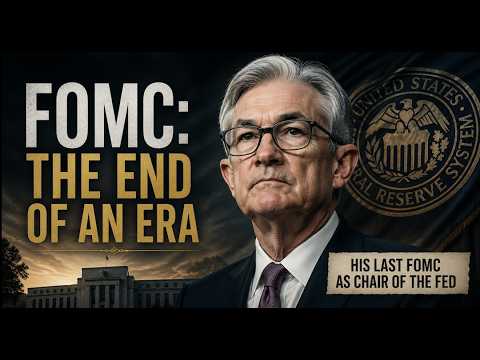
FOMC: The End of an Era
AI Summary
This video discusses the upcoming FOMC meeting, potentially Jerome Powell's last as Chair of the Federal Reserve, marking the end of an era. While Powell may remain a governor until 2028, this meeting signifies a transition. The speaker anticipates Powell will push back against immediate rate cuts, citing rising inflation likely driven by geopolitical conflicts, particularly in the Middle East. Market expectations for rate cuts have already shifted significantly, with projections now extending to late 2027, a stark contrast to earlier forecasts for 2026.
Despite the stock market reaching all-time highs and Bitcoin performing well off its lows, the speaker warns against mistaking this for overall strength, especially within the broader crypto market. A historical correlation is drawn between the Energy Select Sector ETF (XLE) and Bitcoin's performance. During Bitcoin's bear market lows in 2022, XLE was experiencing significant upward movements. This suggests that Bitcoin, and cryptocurrencies in general, thrive under loose monetary policy. As oil prices rise due to geopolitical tensions, inflation increases, preventing the Fed from cutting rates as previously anticipated. This dynamic leads to higher-risk assets bleeding into lower-risk assets, a trend observed when XLE started to rise and rate cut expectations diminished.
The speaker argues that mistaking strength against the US dollar for strength across the crypto market is a misinterpretation. The current trend shows higher-risk assets, including altcoins against Bitcoin, are still underperforming. Bitcoin's testing of its resistance band against gold mirrors its struggle against the US dollar, with historical rejections observed in similar market conditions.
Powell is expected to highlight inflationary pressures and the rationale against immediate rate cuts. While a new Fed chair might be expected to lower rates, the speaker cautions that doing so prematurely could ignite further inflation, leading to a market downturn. A historical precedent in the 1990s is mentioned where rate cuts reignited economic activity, necessitating subsequent rate hikes.
The speaker believes that without geopolitical conflicts, there would be a stronger case for rate cuts due to underlying weakness in the labor market, evidenced by low hiring, falling job openings, and a rising unemployment rate. However, initial claims for unemployment remain low, suggesting the US is not yet in a recession. The uncertainty surrounding a new Fed chair is likely to exacerbate the trend of higher-risk assets underperforming.
Powell is anticipated to discuss progress made and the inflationary impact of Middle Eastern conflicts. The supply-driven shock of increased energy prices may cause the Fed to act too late, eventually leading to rate cuts to chase falling yields. The speaker doubts imminent rate cuts, considering them a potentially huge mistake given the current inflationary environment.
The speaker posits that while rate cuts may eventually occur, they might be for the wrong reasons – a consequence of the Fed being too late to act when needed. Unlike previous preemptive rate cuts, future cuts could be reactive due to delayed action. This scenario, where the Fed is unable to cut rates when necessary due to inflationary pressures, is seen as a likely conclusion to the current business cycle.
Historically, energy prices and XLE tend to top out well after the broader stock market, often coinciding with or even preceding recessions. Examples from 2008 and the dot-com crash illustrate this lag. Given the stock market's recent new all-time highs, energy prices are expected to remain elevated until a recession materializes.
Powell's tenure is acknowledged as having engineered a soft landing so far, with the stock market and gold reaching new highs. However, the plane hasn't fully landed, and the introduction of a new Fed chair adds uncertainty. The combination of tariffs, geopolitical conflicts, and artificially inflated energy prices raises concerns about the ultimate outcome. Despite this, the speaker believes there is still some runway before the business cycle concludes, likely within the next couple of years.
The speaker expresses curiosity about Powell's remarks and his future role. While acknowledging Powell's past missteps, such as the "inflation is transitory" comment, the speaker defends him, stating that common sense dictates not cutting rates when energy prices are soaring. The video concludes with a reminder to subscribe and check out premium content.