Who Was Baal? (and why he sounds a lot like Yahweh)
AI Summary
The story of Elijah on Mount Carmel, where he challenges the prophets of Baal to a contest to determine whose god is real, is one of the most dramatic narratives in the Bible. Both sides prepare a sacrifice without fire, believing the true God will respond with fire from heaven. The prophets of Baal call out, dance, shout, and even cut themselves for hours, but nothing happens. Elijah mocks them before praying once, and fire immediately consumes his sacrifice, wood, and even water, demonstrating the powerlessness of Baal and the omnipotence of the God of Israel.
Baal was a significant storm god, warrior, and king in the ancient Near East, associated with rain and crop growth. While the biblical narrative presents Baal as a rival to the God of Israel, a closer look at the Hebrew Bible reveals that the God of Israel is sometimes described with characteristics similar to Baal, such as thundering from the heavens, riding on clouds, and defeating the sea and its monsters. This raises questions about the relationship between these two traditions.
The word "Baal" in ancient Semitic languages means "lord," "master," "owner," or "husband." It could refer to a landowner, head of a household, or even a god. In some ancient texts, it functions as a title rather than a specific divine name, similar to how "the Lord" refers to the Christian God. The book of Hosea, for instance, suggests that "Baal" could have been a title for the God of Israel, which the prophet later rejects due to its associations. The Hebrew Bible often uses "the Baal" and "the Baals" in plural, implying it could be a category for various local deities rather than a single god, potentially collapsing diverse local deities into a shorthand for foreign gods, especially in contexts where the God of Israel is elevated as supreme.
However, outside the Bible, evidence suggests "Baal" also functioned as a proper divine name for a specific storm god in the Canaanite pantheon. The Canaanites were ancient peoples in a region corresponding to modern-day Israel, Palestine, Jordan, Lebanon, and Syria, sharing related languages and religions. The most crucial text for understanding Canaanite Baal is the Baal Cycle, a Ugaritic literary work from the late Bronze Age (1200s-1100s BCE).
The Baal Cycle, a three-act mythic drama, begins with Baal battling Yam, the sea god. El, the high god, initially favors Yam, but Baal, armed by the craftsman god Kothar-wa-Khasis, slays Yam, establishing his kingship through combat and bringing order by destroying the chaos of the sea. The second act focuses on the construction of Baal's palace on Mount Sapon, which signifies his kingship. This palace building reflects a ritual logic connecting Baal's mountain and his temple in Ugarit. Mount Sapon was a real mountain, and Ugarit's acropolis featured two massive temples, one dedicated to Baal, which were central to the city's layout and rituals. Texts from Ugarit frequently refer to him as "Baal of Sapon," suggesting a ritual merging of the mountain and the elevated temple. The temple's multi-level architecture reinforced this, allowing priests to ascend towards more sacred areas, mirroring Baal's divine ascent.
The third act of the Baal Cycle depicts Baal's conflict with Mot, the god of death. Despite Baal's previous victories, Mot represents a different kind of threat, one that devours rather than fights with weapons. Mot devours Baal, leading to a cessation of rain, drought, and a collapse of fertility, highlighting Baal's identity as a storm and fertility god. Baal is eventually restored, not by directly defeating Mot, but through the intervention of the goddess Anat, who violently subjects Mot to an agricultural death, threshing, grinding, and planting him. This act restores Baal, rain, and fertility, solidifying his kingship and connecting him to storms, agriculture, and fertility. Baal is described as "beneficial for the land" and "rider of the clouds," with clouds imagined as his chariot bringing rain.
This storm warrior god, later known as Baal, had an older history under the name Hadad or Adad, meaning "thunderer." This deity, attested as early as the third millennium BCE in Syria and Mesopotamia, was a divine warrior wielding thunder, defeating the sea, and central to royal ideology. By the late Bronze Age in Ugarit, "Baal" (Lord) became the primary name for Hadad in Canaanite contexts, leading scholars to use "Baal-Hadad" to refer to this specific manifestation. Traces of the older name persisted, with Baal and Hadad sometimes used in parallel, suggesting that Baal evolved from earlier Hadad traditions.
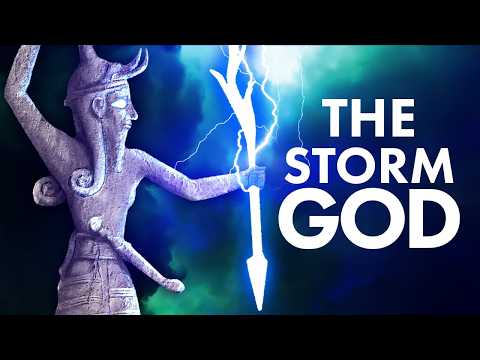
In art, Baal is often depicted as a striding warrior, arm raised, gripping a weapon, usually a lightning bolt or spear. The Baal Stele from Ugarit shows him with a stylized lightning bolt and a raised club, with jagged lines beneath his feet possibly representing mountains or his defeat of the sea. He wears a crown with bull horns, symbolizing strength and fertility. Small bronze bull figurines found throughout the ancient Near East are widely interpreted as symbolic representations of gods like Hadad or Baal. Iconography also shows Baal's connection to agriculture, with weapons sometimes transforming into plants, symbolizing both lightning and vegetation. While usually depicted as a warrior, some scholars argue that Baal could also appear seated in a royal form, challenging the common association of enthroned figures with El, given the Baal Cycle's emphasis on Baal's kingship and enthronement.
The God of Israel is frequently described using language and imagery strikingly similar to Baal. Psalm 29, for example, is thought to be a Baal hymn appropriated for the God of Israel, portraying him as a divine warrior and king with storm god imagery—thunder, lightning, and power over waters. The psalm's geographical setting in the northern Levant, a region closely linked with Baal worship, further strengthens this connection. The climax, with God "enthroned over the flood," mirrors Baal's victory over the sea. This appropriation of Baal-like imagery by Israelite authors may have served as anti-Baal propaganda, asserting that these powers belong to the God of Israel.
Similar patterns appear in Psalm 97, which describes the God of Israel surrounded by storm god imagery, and in the use of Baal's epithet "cloud rider" for the God of Israel in Psalms 68 and 104. The Baal Cycle's plot point of Baal battling the sea and a monstrous serpent (Yam and Lotan) also finds parallels in the Hebrew Bible, where the God of Israel battles the sea or sea monsters like Leviathan, whose description aligns closely with Ugaritic Lotan. The linguistic similarities, such as the word "yam" for sea in both Hebrew and Ugaritic, and the etymological link between Leviathan and Lotan, suggest a direct Canaanite background rather than Mesopotamian influence.
Many scholars now argue that the ancient Israelites emerged from indigenous Canaanite populations, sharing a Canaanite language (Hebrew), material culture, and religious traditions, including not only Baal but also El and Asherah. Thus, the use of Baal-like imagery in biblical texts might be seen as drawing from a shared cultural heritage rather than borrowing from a foreign religion.
The story on Mount Carmel, depicting Baal worship as alien and opposed to Israel's true identity, is a strong example of religious polemic. However, scholarship suggests this portrayal might be a "later partisan construction." Archaeological evidence, such as theophoric names (names incorporating a god's name) like Ishbal and Gerubal (Gideon), indicates that names invoking Baal were not foreign to early Israelites and coexisted alongside names invoking Yahweh within the same administrative systems in ancient Israel. This suggests that Baal worship was a normal part of the religious landscape for centuries without overt conflict. Later Judahite scribes, pushing for the exclusive worship of the God of Israel, became uncomfortable with names containing "Baal" and altered them, replacing "Baal" with words like "shame." This suggests a time when invoking Baal in personal names was acceptable, only later becoming something to be avoided. Hosea 2:16, where God says, "You will call me my husband and no longer call me my baal," implies that people were indeed calling Yahweh "Baal."
Scholars like Michael J. Stahl argue that the God of Israel likely adopted storm god characteristics under Baal's influence, particularly during the Iron Age 2 period when the Kingdom of Israel consolidated its political power. King Omri's dynasty in the northern kingdom may have modeled the God of Israel on Baal, elevating him to the role of a royal storm god. From this perspective, the Mount Carmel story is not merely about proving the God of Israel's superiority but about drawing a boundary, a later attempt to distinguish the God of Israel from a cultural context where Baal was not a foreign rival but an integral part of the same religious world.