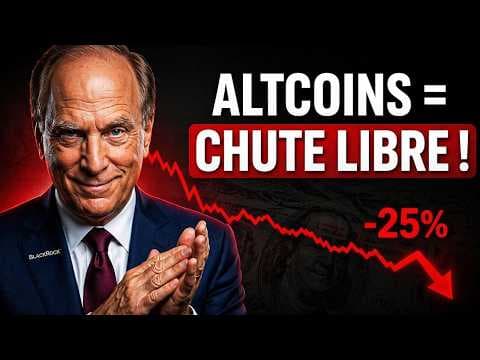
LES ALTCOINS en CHUTE LIBRE ! (ne te fais pas avoir)
Audio Summary
AI Summary
The current altcoin market is experiencing significant weakness compared to Bitcoin, primarily due to a lack of breakout on altcoin-specific indices. When looking at the broader altcoin market excluding top 10 cryptocurrencies, the weekly charts show a failure to break established structures, with price action remaining within a range and experiencing rejections. Daily charts indicate that previous breakouts have been invalidated, leading to re-entry into the consolidation phase. This scenario could potentially push the altcoin market capitalization below 150 billion dollars, implying further declines for assets like Solana, which might revisit lows below $66.
The speaker emphasizes that as long as Bitcoin's momentum remains unchanged, there's a glimmer of hope that this bearish altcoin scenario might be averted. However, a sustained downturn in Bitcoin's performance would signal a much more dire situation for altcoins. Currently, the relationship between altcoins and Bitcoin clearly shows periods of significant altcoin weakness. Despite capital flowing back into the crypto market, it is primarily being absorbed by Bitcoin.
This trend is further illustrated by the performance of Ethereum against Bitcoin (ETH/BTC). The ETH/BTC pair is exhibiting bearish characteristics, suggesting a potential decline to around 270-280,000 satoshis. This indicates that Bitcoin is expected to continue outperforming Ethereum. The dynamic on ETH/BTC has been bearish since its previous peak, with a stair-step upward movement that lacks strength, pointing towards a continuation of the bearish trend. The formation of a market structure shift further suggests that Ethereum's rebound may have concluded, and a downward movement is likely. This doesn't necessarily mean ETH against the US dollar will fall, but rather that Bitcoin will likely gain strength relative to Ethereum, contributing to the overall weakness of the altcoin market.
Examining large-cap altcoins against Bitcoin reinforces this observation. Solana against Bitcoin, for instance, shows continued weakness, indicating a bear market for Solana relative to Bitcoin, even after periods of strong performance. Similarly, BNB, despite a previous surge, has returned to a bearish movement against Bitcoin, with potential retracements towards 7300 satoshis. XRP against Bitcoin also displays a similar bearish trend, revisiting previous support zones.
The strength of Bitcoin is further evidenced by its dominance, which is currently breaking out of its range to the upside. As long as Bitcoin dominance remains elevated, it signifies a stronger Bitcoin and a weaker altcoin market. For investors, this implies that the bottom for altcoins is likely not yet in.
Looking at total market capitalization indices for altcoins (Total 3), they remain in contact with their trendlines, indicating a bearish flow. While the end of the altcoin bear market against Bitcoin might be approaching, it is still very much a bear market. This is attributed to high global interest rates and the ongoing contraction of global liquidity, which are unfavorable for altcoin performance.
Despite these challenges, there is a noticeable capitulation among investors in the altcoin market, with a declining belief in altcoins. While this psychological pressure can be seen as a positive sign for the eventual end of the current five-year altcoin bear market, it doesn't guarantee an "altcoin season" similar to 2021. The market is expected to become more selective, favoring assets that offer genuine utility or generate value. The current market conditions suggest a lack of broad interest in altcoins, especially considering Bitcoin's recent pump.
A subtle shift is being observed: even when Bitcoin experiences slight dips, altcoins are still struggling. While not a significant trend yet, it hints at a potential change in arbitrage. Money is slowly returning to the crypto market, with inflows noted since April, but this capital is not benefiting altcoins, which continue to form new bearish structures. When Bitcoin rises, altcoins tend to follow but to a lesser extent. Conversely, when Bitcoin begins to decline, altcoins are likely to experience more significant drops, as seen with Bitcoin down 0.42% and some altcoins down 1-6%. While exceptions like Starknet exist, which might be driven by market-making activities, the overall environment remains bearish for altcoins.
Against the US dollar, altcoins are failing to break out and are underperforming significantly, despite the inflow of capital. Bitcoin continues to be the preferred asset, with Ethereum also showing weakness against Bitcoin. Other previously performing assets like Tao have also seen significant retracements. Hyperliquid is highlighted as an exception, demonstrating resilience during this bear market and potentially positioning itself for strong performance in the next bull run. This bear market is seen as an opportunity to identify solid assets for the future.
The current underperformance of altcoins is attributed to several factors: insufficient capital, contracting global liquidity, high interest rates, and broader economic pressures like oil prices and inflation. Altcoins are not acting as a safe haven. However, investor psychology is reaching a low point, which could be a precursor to a positive shift. The speaker believes a next cycle is probable from a speculative standpoint, but significant widespread adoption of altcoins is unlikely, with the market remaining largely speculative.
Future "altcoin seasons" are expected to be shorter, less aggressive, and more selective, favoring fundamentally strong assets over speculative ones. This is compared to the dot-com bubble, where after the crash, only companies with long-term growth potential survived. The challenge in crypto is the limited number of assets with real utility or value generation. Institutions are aware of this, and while they may engage in speculative phases, significant long-term growth for most altcoins is not anticipated. Instead, short, intensive movements lasting a few weeks are expected, which will require strategic timing to benefit from.
The speaker suggests that a true altcoin season is unlikely to materialize for at least another year, possibly two, unless a recession accelerates market changes. The current environment is not conducive to a broad altcoin rally. The video concludes with a reminder about free access to resources and encourages viewers to engage with the content.