Quadratic Equations - Shortcuts & Tricks for 2026 - 2027 Placement Tests, Job Interviews & Exams
Audio Summary
AI Summary
This video provides a comprehensive guide to quadratic equations, a crucial topic for numerical ability and quantitative aptitude sections in various entrance exams and placement tests. The discussion begins with the fundamental concept of a polynomial.
A polynomial is defined as an expression composed of constants and variables, connected by mathematical operators such as addition or subtraction. A key characteristic is that the variable must have a positive whole number degree. Whole numbers include 0, 1, 2, and so on, excluding negative numbers and fractions. Examples illustrate this: `ax + c` (degree 1), `ax² + bx + c` (degree 2), `ax³ + bx² + cx + d` (degree 3), and `7` (a constant polynomial, `7x⁰`, degree 0). Expressions like `1/x` (x⁻¹) or `√x` (x^(1/2)) are not polynomials because their degrees are not positive whole numbers. Understanding how to identify polynomials is essential as it is a common test question.
Each polynomial has a degree, which is the highest power of the variable in the expression. For `ax + c`, the degree is 1. For `ax² + bx + c`, the degree is 2. A constant like `7` has a degree of 0.
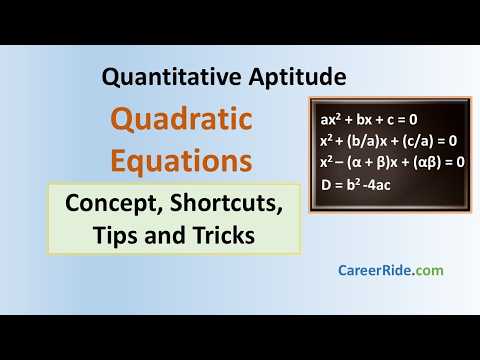
A quadratic equation is a specific type of polynomial equation where the highest degree of the variable is exactly two. The general form is `ax² + bx + c = 0`. Here, `a`, `b`, and `c` are constants, and `x` is the variable. A critical condition for a quadratic equation is that `a` cannot be zero. If `a` were zero, the `ax²` term would vanish, reducing the equation to `bx + c = 0`, which is a linear equation with a degree of 1, not a quadratic one.
A quadratic equation always has exactly two values of `x` that satisfy it, making the equation equal to zero. These values are called the roots of the quadratic equation, often denoted as alpha (α) and beta (β). If α and β are the roots, the quadratic equation can be factored as `(x - α)(x - β) = 0`. This means a quadratic equation can be split into two factors. When finding the roots from factors, the sign of the constant in the factor is reversed (e.g., from `x - α` to `x = α`).
The general quadratic equation `ax² + bx + c = 0` can be divided by `a` (since `a ≠ 0`) to get `x² + (b/a)x + (c/a) = 0`. If α and β are the roots, the equation can also be written as `x² - (α + β)x + αβ = 0`. By comparing these two forms, we derive two fundamental relationships:
1. Sum of the roots (α + β) = `-b/a`
2. Product of the roots (αβ) = `c/a`
These relationships are extremely useful for quickly solving problems.
Several examples illustrate finding roots:
- For `x² + 17x + 72 = 0`, we need two numbers whose sum is 17 and product is 72. These are 8 and 9. So, `(x + 8)(x + 9) = 0`, and the roots are `x = -8` and `x = -9`.
- For `x² + 2x - 15 = 0`, we need two numbers whose sum is 2 and product is -15. These are 5 and -3. So, `(x + 5)(x - 3) = 0`, and the roots are `x = -5` and `x = 3`.
- For `x² - 20x + 75 = 0`, we need two numbers whose sum is -20 and product is 75. These are -15 and -5. So, `(x - 15)(x - 5) = 0`, and the roots are `x = 15` and `x = 5`.
When the `x²` term has a coefficient other than 1, say `3x² + 14x + 15 = 0`:
Multiply the coefficient of `x²` by the constant term (`3 * 15 = 45`). Now find two numbers whose product is 45 and sum is 14. These are 9 and 5. The equation becomes `3x² + 9x + 5x + 15 = 0`. Factoring yields `3x(x + 3) + 5(x + 3) = 0`, which simplifies to `(3x + 5)(x + 3) = 0`. The roots are `x = -5/3` and `x = -3`.
A unique scenario is when a quadratic equation becomes an "identity." While a standard quadratic equation has at most two roots, an identity holds true for *all* values of `x`, meaning it has more than two roots. For an equation `Ax² + Bx + C = 0` to be an identity, all its coefficients must be zero: `A = 0`, `B = 0`, and `C = 0`.
Example: For what value of `P` is `(P-1)x² + (2P²+P-3)x + (P²-1) = 0` an identity?
- `P - 1 = 0` implies `P = 1`.
- `2P² + P - 3 = 0` implies `(2P - 3)(P + 1) = 0`, so `P = 3/2` or `P = -1`.
- `P² - 1 = 0` implies `P = 1` or `P = -1`.
The common value of `P` that makes all coefficients zero is `P = 1`.
The graph of any quadratic equation `ax² + bx + c = 0` is always a parabola.
- Parabolas are symmetrical about an axis called the axis of symmetry, which is always parallel to the y-axis.
- If `a > 0`, the parabola opens upwards.
- If `a < 0`, the parabola opens downwards.
- The lowest (or highest) point of the parabola is called its vertex. The x-coordinate of the vertex and the axis of symmetry is given by `-b/(2a)`.
- The roots of the quadratic equation are the points where the parabola intersects the x-axis.
- If the parabola cuts the x-axis at two distinct points, there are two distinct real roots.
- If the parabola just touches the x-axis at one point, there is one repeated real root.
- If the parabola does not touch the x-axis at all, there are no real roots.
The discriminant (D) of a quadratic equation `ax² + bx + c = 0` is given by `D = b² - 4ac`. The sign of the discriminant determines the nature of the roots:
- If `D > 0`: Two distinct real roots. The parabola cuts the x-axis at two distinct points.
- If `D = 0`: One distinct real root (a repeated root). The parabola touches the x-axis at exactly one point.
- If `D < 0`: No real roots (complex or imaginary roots). The parabola does not touch the x-axis.
The quadratic formula, also known as the Shriharachara formula, is used to find the roots when factoring is difficult or impossible: `x = (-b ± √(b² - 4ac)) / (2a)`.
Notice that `b² - 4ac` is the discriminant (D). So, `x = (-b ± √D) / (2a)`.
- If `D = 0`, then `x = -b / (2a)`. This confirms there is only one distinct real root (which is repeated).
- If `D > 0`:
- If `D` is a perfect square (e.g., `D = 1`), the roots are rational and distinct real roots.
- If `D` is not a perfect square (e.g., `D = 65`), the roots are irrational and occur in conjugate pairs (e.g., `m + √n` and `m - √n`). They are real, unequal, but irrational.
- If `D < 0`: Then `√D` involves the square root of a negative number, which is an imaginary number (represented by `i`, where `i = √-1`). The roots are complex and non-real, always occurring in conjugate pairs (e.g., `m + i√n` and `m - i√n`).
Practice questions:
1. Given sum of roots = -7 and product = 21, the equation is `x² - (-7)x + 21 = 0`, or `x² + 7x + 21 = 0`.
2. Given roots -7/2 and -5/7. Sum = -59/14, product = 5/2. The equation is `x² + (59/14)x + 5/2 = 0`. Multiplying by 14 gives `14x² + 59x + 35 = 0`. Note that multiplying the entire equation by a constant (e.g., by 2 to get `28x² + 118x + 70 = 0`) does not change its roots.
3. If a quadratic equation is multiplied by 3, the roots remain the same. The roots of the new equation will be 1 time the roots of the original equation.
4. For `√3x² - 7x + 3√3 = 0`, sum of roots = `-b/a = -(-7)/√3 = 7/√3 = 7√3/3`. This is not the correct answer given in the video. The video provides `√21` by mistakenly calculating `(-(-7)/√3)` as `√3 * √7`, which is incorrect. The calculation should be `7/√3 = 7√3/3`. However, the example calculation for `sum = -b/a = -(-3√7)/3 = √7` and `alpha*beta = √21` (this refers to a different problem).
5. If roots are `√5` and `-√5`, an infinite number of such equations are possible because multiplying by a constant `K` does not change the roots.
6. If roots are unequal: `D > 0` (two distinct real roots) or `D < 0` (two distinct unreal roots). `D = 0` implies equal roots, so `D` cannot be zero.
7. Non-real complex roots always occur in conjugate pairs.
8. If one root is zero, then the product of roots `c/a = 0`, implying `c = 0`. The equation will be of the form `ax² + bx = 0`.
9. If roots are equal in magnitude but opposite in sign (e.g., α and -α), their sum `(-b/a)` will be zero, implying `b = 0`. The equation will be of the form `ax² + c = 0`.
10. If one root is the reciprocal of the other (α and 1/α), their product `(c/a)` will be 1, implying `c = a`. The equation will be of the form `ax² + bx + a = 0`.
11. If both roots are coincident (equal), then `D = 0`. The product of roots is not necessarily zero.
12. Find the difference between roots of `x² + 6x - 91 = 0`. Roots are 7 and -13. Difference = `7 - (-13) = 20`.
13. For `7x² + 18x + 8 = 0`, sum of roots = -18/7, product = 8/7. By checking options, roots -4/7 and -