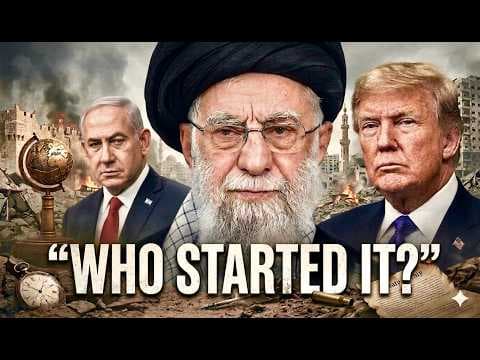
Iran vs USA: From Allies to Enemies | Full History Explained!!
Audio Summary
AI Summary
Two countries, Iran and the United States, once close allies, are now engaged in a 70-year cold war that impacts global security and oil prices. This rivalry, marked by sanctions, cyber attacks, proxy conflicts, and nuclear standoffs, stands in stark contrast to the 1950s when American advisors were present in Iran, Iranian students studied in the US, and the Shah of Iran interacted with American presidents. The aim is to understand how these allies became adversaries and why this rivalry remains significant today, focusing on the real history, turning points, and human stories without bias or fluff.
The relationship between Iran and the United States is a complex narrative shaped by shifting alliances, deep mistrust, and global consequences. It has reshaped the Middle East, influenced global markets, and affected millions of lives. This is not a simple tale of good versus evil but is influenced by geopolitics, domestic politics, historical trauma, missed opportunities, and the desire for stability among ordinary people. Perspectives vary widely within both countries.
To understand the current situation, one must look back to the early 1950s. In 1953, Iran's democratically elected Prime Minister, Muhammad Mosaddegh, nationalized the country's oil industry, which had been under British control. The British sought help from Washington, leading to Operation Ajax, a covert operation by the US and Britain that overthrew Mosaddegh and reinstated the Shah, Muhammad Reza Pahlavi. For the next two decades, the Shah aligned Iran with the West, pursuing modernization, education, and infrastructure development, positioning Iran as a regional stabilizer during the Cold War. However, his rule became increasingly authoritarian, with the secret police (Savak) suppressing dissent, while wealth inequality, cultural shifts, and foreign influence fueled public anger.
By the late 1970s, widespread protests and anti-monarchy sentiment culminated in the Shah fleeing the country in 1979. Ayatollah Ruhollah Khomeini returned from exile, transforming Iran into an Islamic Republic with a strong anti-Western stance. This revolution, seen by many Iranians as a fight for sovereignty and independence, meant the US lost a key Cold War ally in a vital strategic region, planting a deep seed of distrust.
Months after the revolution, on November 4, 1979, Iranian students seized the US embassy in Tehran, holding 52 American diplomats and citizens hostage for 444 days. This crisis completely severed diplomatic ties, which have never been fully restored. The reasons included revolutionary fervor, fear of another American-backed coup, and demands for the Shah's extradition. This event became a defining trauma for both nations: in America, it fueled a narrative of Iranian hostility, while in Iran, it cemented the US as an imperialist threat.
The Iran-Iraq War (1980-1988) further complicated matters. The US, fearing the spread of Iran's revolutionary ideology, supported Iraq, providing intelligence and economic aid, and at times ignoring Iraq's use of chemical weapons. In 1988, the US Navy shot down Iran Air Flight 655, killing all 290 people on board. The US called it a tragic mistake, while Iran saw it as a deliberate act of war, deepening resentment. Decades of economic sanctions followed, isolating Iran's economy and embedding a cycle of suspicion.
Throughout the 1990s and 2000s, the relationship fluctuated between confrontation and cautious outreach. Iran's nuclear program, initially for civilian energy, raised international concerns after hidden facilities were exposed in 2002. In 2003, the US labeled Iran part of an "axis of evil." However, secret back-channel talks and economic pressure eventually led to negotiations. In 2015, the Joint Comprehensive Plan of Action (JCPOA), or Iran nuclear deal, was signed. Iran agreed to limit its nuclear program and allow international inspections in exchange for the lifting of sanctions. This deal, while praised by many, faced criticism from hardliners in Iran who felt it didn't bring enough economic relief, and from opponents in the US who argued it didn't address Iran's ballistic missile program or regional influence. Despite criticisms, the agreement worked for several years, with Iran's nuclear program constrained and regional tensions cooling.
Stability changed in 2018 when the US withdrew from the nuclear deal and reinstated "maximum pressure" sanctions. Iran responded by gradually exceeding the deal's nuclear limits, arguing it had no reason to comply without economic benefits. Diplomatic talks stalled repeatedly. Since then, the relationship has been shaped by regional conflicts, maritime incidents, cyber operations, and shifting global alliances. Iran has strengthened ties with Russia and China, while the US has reinforced partnerships with Gulf allies and Israel. Despite this, indirect negotiations, prisoner exchanges, and de-escalation efforts have continued, often mediated by countries like Oman, Qatar, and Switzerland.
Economically, sanctions have severely impacted Iran's middle class, leading to inflation and limited imports, while globally, supply chains and American businesses have felt the ripple effects from restricted energy markets. Militarily, both sides have avoided direct full-scale conflict due to the catastrophic human and economic costs. Politically, leadership transitions in both countries continue to shape the path between confrontation and engagement. The current relationship is defined by "strategic limbo," managed hostility, and a constant search for leverage, with both sides testing boundaries and calculating that total confrontation would be more damaging than uneasy coexistence.
Beyond the political headlines, millions of Iranians and Americans do not fit the official narrative. Over a million Iranian-Americans live and work in the US, bridging cultures in various fields. Academic collaborations, diaspora communities, humanitarian initiatives, and cultural festivals continue to operate beneath the surface of political tension. History suggests that progress is possible when diplomacy aligns with public interest, and people-to-people relationships keep channels open. The Iran-United States relationship is a complex web of historical memory, strategic interests, economic reality, and human resilience. Rebuilding trust requires verified agreements, consistent diplomacy, regional de-escalation, and sustained cultural and academic exchange, as the alternative is perpetual uncertainty.