They can fly 200 miles with no fuel. Here's how.
Audio Summary
AI Summary
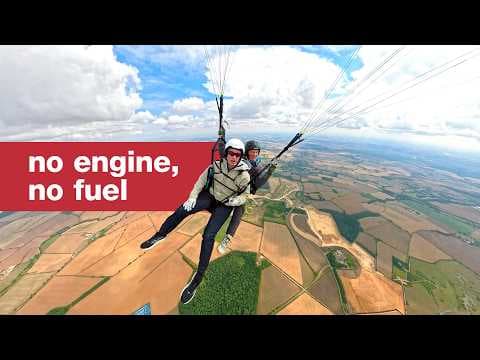
The video chronicles a paragliding experience in Rutland, England, the country's smallest historic county. The host aimed to capture the entire county in one camera shot and learn how paragliders fly. This endeavor led him to a former Royal Air Force base, where he met Mick, a former RAF pilot and member of the Hang Gliding and Paragliding Association. Mick was to take the host on a tandem flight.
Before the flight, Mick provided a safety briefing and explained the concept of "going XC" or cross-country flying, which involves traveling hundreds of kilometers without an engine or fuel. While XC flying wasn't planned for the host, he was briefed on how paragliders gain lift. Lift primarily comes from thermals, which are bubbles of warm air rising from the ground. The sun heats surfaces like harvested fields or straw bales, causing the air above them to warm up. This warm air, being lighter, eventually rises, often triggered by structures like buildings or tree lines, forming a thermal. This rising air can then condense to form cumulus clouds, indicating good paragliding conditions. A paraglider pilot's skill lies in reading the sky and clouds to locate these thermals and gain altitude.
The host noted the minimal equipment required for paragliding compared to other air sports. A paraglider, essentially a large nylon wing (about 42 square meters for a tandem), and harnesses fit into a single backpack. Mick clarified the distinction between a parachute, designed for safe descent, and a paraglider, designed for maximum lift, with a much greater aspect ratio. The paraglider's structure is maintained by air ramming into its leading edge. A collapse can occur if the wing encounters poor air, but tandem gliders are designed to reinflate automatically within three seconds. Mick also demonstrated how the wing is steered by pulling brake handles, which deflect the trailing edge and increase drag on one side, slowing it down and causing a turn. He emphasized the danger of turning too low, a leading cause of air sport injuries.
Initial take-offs were assisted by a mechanical winch due to light winds. The winch pulls the paraglider forward, providing the initial altitude and speed, typically reaching 700 to 800 feet before the pilot releases from the cable. Mick, with over 300 tandem flights and a thousand personal launches over 25 years, shared his experience. He also revealed his nickname, "Cockroach," a play on his surname, Roche.
The weather gradually improved, with more blue sky appearing, creating better conditions for thermals. The host spoke with Josh, another pilot attempting a cross-country flight, aiming for possibly 100 kilometers. Josh explained that pilots follow the wind direction and thermals, with the return journey often involving hitchhiking or public transport, adding to the adventure.
After a break, the host prepared for his flight, donning safety equipment and several layers of clothing. He was positioned in front of Mick in the tandem harness. His responsibilities included adjusting his arms and camera after take-off and before landing, and pulling the cable to detach from the winch. The take-off involved walking forward with purpose as the winch line came under tension.
Once airborne, the experience was described as "staggering." Mick immediately sought a thermal, guided by a variometer, which emits high-pitched beeps for ascent and low-pitched beeps for descent. The host was instructed to shift his leg and lean to alter drag and the center of gravity, aiding in faster turns within the thermal. The paraglider ascended at speeds of up to 1.8 meters per second, reaching over 1,200 feet above ground. Other paragliders joined them in the thermal, all turning in the same direction to avoid collisions.
The flight continued to climb at up to three meters per second, reaching over 3,000 feet. The host noted the "incredible" quietness of paragliding, with only the rush of air and the variometer's beeps. At one point, they experienced a partial collapse as they moved to the edge of a thermal, but the wing quickly reinflated. From this altitude, the host could see all of Rutland in one shot.
To descend, they flew out of the thermal into sinking air, which caused a drop of three meters per second. Mick demonstrated spiral dives for rapid descent, which involved high G-forces. The host expressed a newfound interest in paragliding, finding it more accessible and less expensive than other air sports due to the minimal equipment, free "fuel" from natural thermals, and the extended flight times possible.
For landing, Mick advised being ready to run upon ground contact to avoid tripping. The landing was smooth, with the paraglider gradually slowing down and the wing collapsing to the side. The host expressed immense gratitude and joy for the experience, which reached an altitude of 3,000 feet.