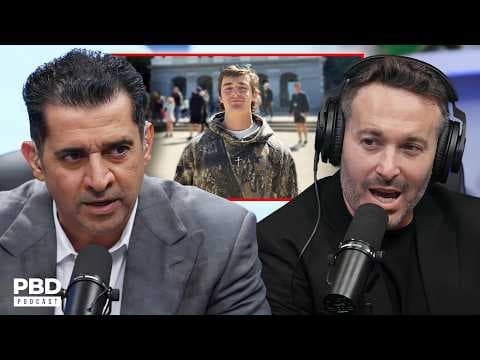
“COVERING UP Their Crimes” - California's 'STOP Nick Shirley Act' PROTECTS Migrant Fraud
Audio Summary
AI Summary
The discussion centers on California's proposed "Privacy for Immigration Support Service Providers Act," also known as AB2624, which critics are calling the "Stop Nick Shirley Act." Nick Shirley is a citizen journalist known for exposing potential government fraud, particularly in immigrant communities. The bill aims to make it harder for individuals like Shirley to investigate and report on suspicious activities by imposing a $10,000 fine or imprisonment for those attempting to uncover the truth about certain locations.
The speakers highlight that the bill seeks to protect individuals and organizations committing fraud in states like Minnesota and California, where instances of fraud involving Somalians in Minnesota and Armenians in California have been reported. These fraudulent activities are alleged to involve millions of dollars, leading to questions about the donors of politicians who support such legislation. It is suggested that a financial forensic audit should be conducted to trace donations and uncover a "circle of life for the fraud," where ill-gotten gains are funneled back into political campaigns.
A significant point of concern is that the bill was sponsored by Mia Bonta, a California State Assemblywoman and the wife of California's Attorney General, the very person responsible for investigating fraud. The bill's official title, "Privacy for Immigration Support Service Providers Act," is seen as a deceptive way to conceal its true intent, which appears to be to keep residential addresses of "support service providers" confidential, even if they are engaging in fraudulent activities. This secrecy would prevent the public from accessing information about places that should ideally be open and known, such as hospices for low-income individuals.
The speakers argue that California, being a larger state than Minnesota, likely has an even greater scale of fraud, potentially involving billions of dollars. They question why the government would discourage citizens, journalists, and independent thinkers from exposing waste, fraud, and abuse, which are universally considered negative. Instead of encouraging transparency and accountability, the bill seems to be designed to protect those who benefit from these illicit activities. The irony is noted that while government officials celebrate tax day and increased revenue, there is little accountability for where this revenue goes, suggesting widespread waste, fraud, and abuse.
Nick Shirley, by attempting to locate "lost money" through his investigations, is seen as trying to help reallocate funds that are being misused. The proposed $10,000 fine or imprisonment is viewed as an attempt to scare off citizen journalists. However, supporters of Nick Shirley express willingness to cover any fines he might incur, emphasizing their commitment to his work.
The discussion also addresses potential misidentification of legitimate businesses by investigative journalists. While acknowledging that not all businesses investigated by Shirley might be fraudulent, the speakers stress the importance of businesses operating transparently and professionally if they claim to be legitimate. They emphasize that Nick Shirley is a citizen journalist, not a judge or executioner, and that his role is to ask questions. Any accusations he makes can be challenged in a court of law to determine the truth.
A major concern raised is that the bill essentially makes the person exposing fraud the problem, rather than the fraud itself. Nick Shirley's investigations, which have uncovered hundreds of millions of dollars in potential fraud, are seen as a significant threat to powerful individuals. The speakers express hope that Shirley is taking his security seriously, given the dangerous nature of his work. They note a trend in "blue states" where authorities focus on suppressing exposure rather than addressing the abuse itself.
The speakers lament the lack of accountability for high-profile cases of alleged government misconduct, contrasting it with the swift actions taken against those on the "other side" of the political spectrum. They recall the investigative journalism of shows like "60 Minutes," where reporters would surprise businesses to uncover wrongdoing and were celebrated with numerous awards. Now, they argue, individuals doing similar work face fines and legal repercussions.
It is suggested that Nick Shirley needs "cover" or "a shield" from a reputable organization, such as a major news outlet, to legitimize his work as an investigative journalist and protect him from legal attacks. This would allow him to continue his investigations with the backing of a recognized media entity.
The segment concludes with an introduction of a new product: a "Faith Over Fear" hat with a cross and a Bible verse. This product is presented as a way for people to express their faith in Jesus Christ and their lack of fear, reflecting a perceived shift in public sentiment towards religion, particularly among younger men.