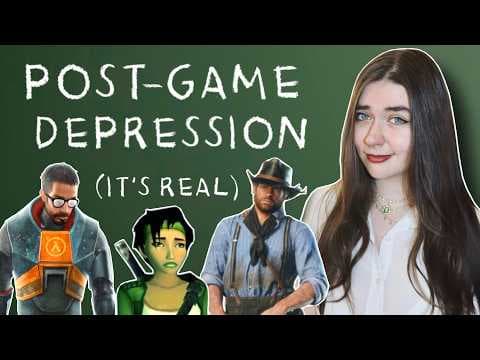
The Science behind Post-Game Depression
AI Summary
In January 2026, the University of Social Sciences and Humanities in Warsaw, Poland, published a study on post-game depression, exploring the feelings of emptiness and grief experienced by gamers after completing a game. This research introduced the first quantitative measure of this phenomenon, the Post-Game Depression Scale (P-D). The study's findings and broader implications for gamer psychology, the scarcity of such research, and potential areas for deeper exploration are discussed.
The research is considered long overdue, given that discussions about depressive symptoms after consuming other forms of media, like books or TV series, are common and well-researched. However, the concept of post-game depression in video games has only recently gained attention, despite video games being arguably the most likely medium to evoke such strong emotional connections. Games allow players to deeply immerse themselves, either by stepping into a protagonist's shoes, making decisions, and experiencing their story firsthand, or by creating their own character, fostering an even deeper bond with the game world.
Historically, studies on gamer psychology have often focused on the benefits of gaming, such as improved hand-eye coordination or problem-solving skills, or on the controversial correlation between video games and aggression. While these topics are not entirely useless, they seem shallow when considering the profound impact games have on individuals' daily lives and emotional well-being. The new study on post-game depression is a refreshing acknowledgment of this deeper psychological impact.
The research involved two studies with 373 participants, structured into four subscales: game-related ruminations (deep, philosophical thoughts), challenging end of experience, necessity of repeating the game, and media anhedonia (the inability to find enjoyment in other media after finishing a game). Psychologist Camille Yanovich recognized that games are evolving beyond mere entertainment, having significant emotional effects on gamers, which this study aimed to understand. Despite frequent discussions among gamers about post-completion sadness, adequate research had been lacking.
One unsurprising main finding was the observation of lower mood, depressive symptoms, and a sense of grief after finishing games. This includes deep thoughts and a significant focus on media anhedonia, which contributes to increased sadness. If other media cannot fill the void left by a highly immersive game, players may simply feel sad. This can also complicate feelings towards the completed game, contrasting with the initial euphoria of playing it for the first time.
The study acknowledged that individual differences play a role in these feelings. While some may experience relief after finishing a game, especially given the current abundance of new releases, others, particularly those prone to intrusive thoughts or dwelling on past events, are at higher risk for intense post-game depression.
Another key finding, also not surprising, is that players of Role-Playing Games (RPGs) are most at risk. The deep immersion and character connection inherent in RPGs, whether creating a character or playing a predefined one like Arthur Morgan in Red Dead Redemption 2, make them particularly difficult to disengage from emotionally. However, the term "RPG" might be too broad in this context. For example, open-world RPGs like Oblivion, which allow continuous play beyond the main story, might lead to less intense grief compared to more linear, story-driven games.
The study also considered grief over characters who die in games, illustrating the immediate emotional impact of certain narrative choices. For instance, experiencing a "bad ending" in a game like Resident Evil Requiem, even if reversible, can trigger an immediate low, demonstrating the powerful emotional effect of well-crafted games. While Resident Evil is not an RPG, such story-driven games could be considered a close second in terms of their potential to induce post-game depression.
However, the research, to the presenter's knowledge, did not fully explore the difference between finishing a currently relevant game with a likely continuation and games with no follow-up. The example of Half-Life 2 Episode 2, where players waited years for a continuation that never came, highlights a more profound and prolonged form of post-game depression. This involves the initial realization of no continuation, followed by a "dreadful acceptance" that even if a sequel were to appear, it might not be good, given the current trend of companies mishandling beloved IPs.
The case of Beyond Good and Evil, a game from the presenter's childhood, further illustrates this. A sequel was announced in 2008, then re-announced differently in 2017, but the original creator has since left the industry, diminishing hopes for a worthy continuation. Even a 2024 remaster, ending on a cliffhanger, only intensified the pain due to the lack of promise for a new installment. The lack of closure and associated frustration is a significant, unexplored aspect.
Similarly, while games like Skyrim offer continuous play and modding, prolonged waiting for a sequel like Elder Scrolls 6, coupled with doubts about its quality, can lead to a delayed and lingering form of post-game depression. This isn't immediate sadness but a series of events spanning years, eroding hope and trust.
Future research could delve into these long-lasting impacts of media on mental health, exploring how they linger and alter attitudes towards media in general. Another suggested area for gamer psychology research is in-game romances, particularly in RPGs like Baldur's Gate 3. As these in-game relationships become increasingly deep and immersive, their effect on mental health and real-life relationships, including perceptions of "cheating," warrants investigation. Studies on couples where one or both partners are gamers could provide fascinating insights into this relatively new and evolving aspect of gaming.