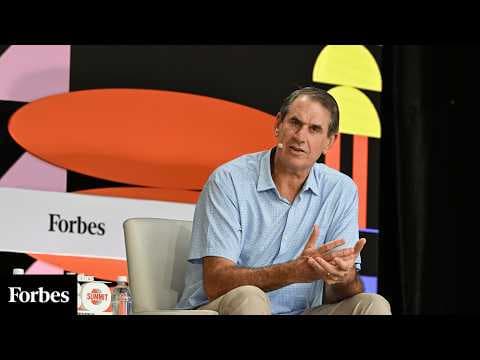
A Fireside Chat With A Venture Capital Legend
Audio Summary
AI Summary
Bill Gurley, a renowned investor, shared insights from his new book, "Running Down a Dream," which advocates for individuals to pursue careers aligned with their fascinations rather than solely chasing perceived smart choices or grinding for achievement. He believes that people fascinated by their work learn faster, achieve more, and are more likely to succeed, a trend amplified by AI. Gurley differentiates "fascination" from "passion," explaining that fascination implies an endless curiosity and a willingness to put in the work to understand nuances, which is crucial for innovation and disruption. He contrasts this with Scott Galloway's advice to chase what you're good at, arguing that genuine fascination provides an intrinsic drive and spirit that mere aptitude does not.
When making investments, Gurley looks for an "unbridled determinism" in founders, a deep engagement with their field, and a continuous pursuit of the cutting edge of technology. He cited Bret Taylor as an example, who consistently adapted to new technological waves, from Google Maps to social media, and now AI customer service. Gurley also shared his personal career journey, which involved changing paths twice – from computer engineering to Wall Street – before finding his calling in venture capitalism. He emphasizes that it's okay to make multi-step changes to find what truly resonates, encouraging young people to ask themselves if they can envision doing their current work 30 years later.
Gurley advises founders to consider whether they would still be happy working on their current venture 15 years from now, especially given the long-term commitment often required. He believes that if someone is genuinely fascinated and willing to learn, they can make a mark in almost any field, even those dominated by raw talent like Olympic sports or Hollywood, by exploring the numerous support roles that surround these individual talents. He highlighted the story of a woman in his book who, despite not seeing herself as an actress, found immense success as a Hollywood agent by understanding the ecosystem around the talent.
For the 30-under-30 community, Gurley stressed the importance of creating peer circles for co-learning and sharing. He cited the example of Jimmy Donaldson (Mr. Beast) who, at 17, formed a group of like-minded YouTube enthusiasts. They spent 16 hours a day on Skype for four years, independently learning and sharing, which according to Donaldson, effectively multiplied Malcolm Gladwell's 10,000-hour rule to 40,000 hours of collective learning. Gurley advocates for full transparency and sharing of ideas, believing that "ideas are a dime a dozen" and sharing only leads to more ideas coming back.
Reflecting on his biggest career mistake, Gurley recounted failing to invest in Google at an $80 million pre-money valuation. His favorite investment was OpenTable, due to its intellectual appeal and the successful execution of the anticipated network effect, growing from three restaurants to 20,000.
During the Q&A, Gurley offered practical advice:
- For someone at a career crossroads, he suggests an "AB test": spend a week immersing yourself in one option, then another week in the other, to see which truly pulls at your curiosity.
- On the future of health tech, he agrees it's the "next trillion-dollar industry," acknowledging the recent breakthroughs in areas like pancreatic cancer research.
- Regarding consumer demographic trends with AI, he notes efforts to use AI to custom-package choices, addressing the paradox of choice. He also observed a trend of targeting the high-end market due to greater disposable income and the unfortunate reality that pre-AI, drug companies often focused on symptom support rather than cures due to profitability.
- On the "free vs. charge" debate for products, Gurley explained that it depends on the target market and the potential for massive scale. He noted his firm's support for open-source companies where the product itself serves as a top-of-funnel for user acquisition. He also mentioned the growing trend of consumer apps being eligible for insurance reimbursement.
- For investing in founders, he looks for determinism, strong sales ability, and an "unfair go-to-market advantage" that avoids traditional advertising or sales.
- On defensibility in software, Gurley believes that while AI can commoditize certain tasks, software requiring deterministic data, like financial ledgers, remains safer. He emphasizes that founders must be deeply curious about what AI can do in their field to avoid being outpaced.
- For building network effects, he advises founders to design their product so that the value to each customer increases significantly with greater market penetration.
- For entrepreneurs in geographically isolated markets like New Zealand, he recommends leveraging virtual communities and digital connectivity to the fullest, building strong peer groups online.
- When assessing founder quality versus market fit, Gurley leans towards founder quality, noting that great founders can pivot from failed products, citing Discord and Slack as examples.
- For those with "side hustles," he views it as a valuable way to AB test and discover what truly fascinates them, though he suggests ultimately focusing on a single lane to make a significant impact.
- For women founders seeking venture capital, he acknowledges the progress made but stresses the need for continued effort. He advises plugging into female founder and VC community groups for support and visibility, advocating for a focus on both the problem of underrepresentation and celebrating success stories to inspire more participation.
- For VCs balancing active investing with non-ROI activities like mentoring and writing, he emphasizes that VC is a "hustle job" requiring deep fascination and constant differentiation.
- On AI governance and security in due diligence, Gurley notes that in early-stage investing, it's not a primary concern, but could become a "hard gate" if incidents involving hot startups spike.
- For investment opportunities in an AI-commoditized software landscape, he would chase markets where human touch or judgment remains valued, or where AI can dramatically enhance customer experience and delight, rather than just cost reduction.
- Regarding components that attract VCs to new apps, Gurley highlights early success (often seen on leaderboards), personal experience of being "wowed" by the product, and the ability to connect with a VC's personal interests, as VCs have limited investment capacity and want to "fall in love with a project."
- For VCs raising a second fund, he notes that early liquidity events are most valuable, followed by markups and the quality of co-investors attracted.
- Sharing a favorite Uber story, Gurley recalled an intellectual battle with an NYU professor about the market size, which he countered with a detailed retort explaining a common TAM analysis mistake.
- Finally, Gurley strongly advises against taking venture capital unless absolutely certain of a "really big outcome." He warns that successive funding rounds can quickly dilute founder equity, making it harder to achieve a profitable exit in the more common $20-100 million M&A range compared to billion-dollar exits. He advocates for using "hustle and sweat equity" to build a business, citing the example of Tito's Handmade Vodka, where the founder retained 100% ownership.