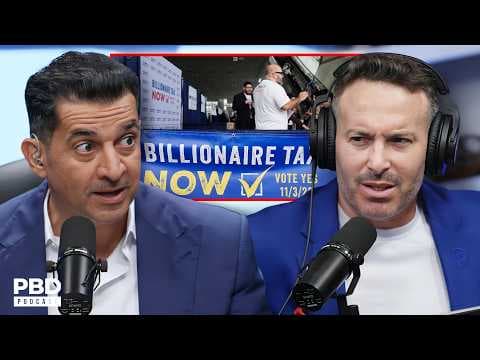
“California’s EVERYONE Tax” - ‘Billionaire’ Tax EXPOSED As Scam On ALL Californians
Audio Summary
AI Summary
The discussion revolves around a proposed "billionaire tax" in California, which is presented as a tax on billionaires but, according to a tweet by Chamath Palihapitiya, the "devil is in the details" and it's actually an "everyone tax." This tax protocol, reportedly written by four professors who "don't believe in the American dream," is said to apply to every Californian resident who currently has assets or ever will. The creators allegedly named it the "billionaire tax" to garner public support without close scrutiny of its true implications.
The fine print of the 34-page document supposedly reveals how the government can convert it into an "everyone tax" without voter approval. It also suggests the tax could be adjusted to be a yearly tax, not just a one-time imposition, again, without voter approval. As a voter, approving this tax would require individuals to list all their assets and their values, submit them to the California Franchise Tax Board, and authorize the board to appraise and confirm these values. Furthermore, individuals could face a penalty of up to 40% of their tax bill if the board determines their reported value was too low. The tax board would also be allowed to subpoena financial records from all financial institutions for auditing purposes. The length of the document, 34 pages, is highlighted as evidence that it creates mechanisms to "steal from all of you," whereas a true billionaire tax would only be a few pages long.
The sentiment that "if you only vote on headlines you deserve the fine print" is expressed, urging people to be informed voters and "ambassadors of truth" in their communities. This situation is likened to Nancy Pelosi's statement about a healthcare bill, where she famously said, "we'll know what's in it after we pass it." This is seen as a recurring government tactic to use emotional headlines, like "taxing the rich," to gain approval, only to later expand the scope to include more people. The speaker notes that this is exactly what was predicted, following a shift in rhetoric from Bernie Sanders, who initially targeted "millionaires" but later focused solely on "billionaires" after becoming a millionaire himself. The importance of checking the "ingredients" of bills, similar to how consumers check food labels, is emphasized, as government is seen as aiming to "impugn and control all of us," not just a select few.
The conversation then shifts to the broader issue of "villainizing rich people," describing it as "the easiest thing to do." The concept of "victim olympics" is brought up, criticizing the tendency to blame "the rich people" or "capitalists" for societal problems. A call for a new national conversation about capitalism versus socialism is made, referencing a previous debate that garnered significant interest. It is suggested that capitalists and business owners need to educate their workers on how salaries and taxes truly work. An example is given of an employer who, after Trump's tax cuts, directly distributed benefits to employees based on their tenure, demonstrating the tangible impact of tax policies.
The speaker argues that the proposed tax is not genuinely targeting billionaires, but rather aligns with a desire to eliminate billionaires altogether, potentially leaning towards a communist ideology. The issue of affordability is identified as a critical factor in winning elections. A unique policy from Poland is introduced: individuals aged 26 or younger pay no federal income tax. This idea is then expanded to propose a similar policy for those under 30 in the US, or for families with four or more children, where parents would pay no federal income taxes until their children turn 18. These proposals are framed as incentives for youth to work hard and for families to have more children, addressing real societal issues.
Bill Maher is cited as having called out Bernie Sanders on taxes, noting that the "super rich" with their "army of accountants" find loopholes, while "regular rich people" pay a significant amount in taxes. Statistics are presented: the top 10% of Americans pay 72% of all taxes, while the bottom 50% (earning less than $40,000) pay only 3%. The concern is raised that "taxing the rich" federally could lead them to leave the country, while state-level taxes could prompt an exodus from states like California and New York. The phrase "more is caught than taught" is used to highlight how people only truly understand issues when they personally affect them.
Finally, the transcript transitions to a promotional segment for a shoe line called "The Future Looks Bright collection." The speaker enthusiastically shares personal anecdotes about the demand for size 14 shoes and the positive feedback received about the product's comfort and quality. The shoes are described as handmade in Tuscany, Italy, with "super foam technology," blending comfort, function, and luxury. The creation process is highlighted as patient and focused on quality, taking two years to perfect. The shoes are available in white, black, brown, or navy blue, with new colors planned for August. The segment concludes with a call to action to purchase the shoes from vtmerge.com.