Thailand’s Property Collapse… The Cracks Are Starting to Show
AI Summary
There are growing concerns about Thailand's property market, with reports of developers facing financial difficulties, unfinished condo projects, and buildings with high vacancy rates. Despite these issues, property prices in many areas remain high. This report investigates the situation in Pattaya, a major Thai property market, by speaking with local estate agents.
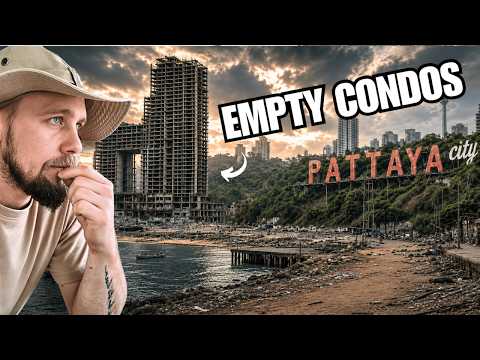
Pattaya appears busy on the surface, with tourists, open businesses, and ongoing construction. However, signs of a struggling market are evident, including unfinished developments and half-empty buildings, some of which seem frozen in time. The key question is whether these are isolated incidents or indicators of a broader market downturn.
Estate agents in Pattaya describe a market that experienced significant expansion before COVID-19, particularly in areas like Jomtien, leading to an oversupply of condos. The pandemic severely impacted less established companies, exacerbating this issue. However, demand has been steadily increasing since then, partly due to the Eastern Economic Corridor (EEC) initiative, which is bringing substantial infrastructure projects to the region over the next decade, suggesting future market potential.
One notable unfinished development near the Pattaya Hollywood sign is explained as being built on crown land without proper permits. This project was halted by the new mayor and is likely to be demolished, though legal proceedings are ongoing.
The demographic of buyers has shifted. Previously, the market was dominated by Russian and Chinese buyers, but these groups have largely departed. Currently, buyers are coming from a wider range of countries, including America, England, Canada, and other parts of Europe. There's a noticeable increase in Western European and North American clients, including expats, retirees, and lifestyle buyers, rather than just investors. This shift is attributed to Pattaya's evolving image as a more family-friendly destination with potential future attractions like Disneyland and casinos.
The influx of Indian buyers is also a recent trend, spurred by relaxed visa policies and promotional efforts. This has led to a significant increase in Indian restaurants and large clubs in areas like Walking Street, with some speculation about potential money laundering activities, though this is not confirmed.
Regarding unsold properties, agents state that it largely depends on the quality of the development. Buyers are now more discerning and seek quality projects. Older developments with outdated decor or materials are harder to sell, especially since the pre-COVID era saw rapid construction with varying quality standards. The resulting oversupply after COVID-19 has made buyers more selective.
The high number of closed estate agent offices is attributed to the industry's unregulated nature. Anyone can become an agent, leading to many businesses failing to establish a strategic market presence. Pattaya's entrepreneurial environment sees many businesses open and close for various reasons.
The perception of a property market collapse online is linked to the statistical oversupply of condominiums, a consequence of the pre-COVID building boom. However, agents differentiate between a large quantity of stock and a lack of desirable, high-quality products. New high-rise developments are still being built, and developers report high sales rates, particularly to foreign buyers.
A significant issue discussed is the use of nominee companies for property ownership, primarily by foreigners who cannot own land directly in Thailand. While this was a common loophole, Thai authorities are cracking down on it, making it illegal and introducing stricter regulations, such as requiring Thai nominees to show proof of funds. This crackdown is making it more difficult to find Thai nominees and poses a risk to those using this structure. Some are selling properties or restructuring companies to comply with the law.
For foreigners to legally purchase property in their name, funds must be transferred from overseas directly to Thailand, with clear documentation indicating the purpose of buying property.
The biggest risk identified is the company ownership scheme, but compliance with laws or using a Thai spouse can mitigate this. Agents remain optimistic about Pattaya's market due to the EEC, which promises significant infrastructure development, including airport and port expansion, high-speed rail, and highway upgrades. They believe this will boost the market and increase prices within the next decade, especially if attractions like casinos and Disneyland materialize.
Despite current cost of living and fuel price concerns, foreign buyers, often cash buyers, continue to show interest. The stabilization of the Thai Baht is a positive factor, and the Thai government's quick response to economic changes, such as offering interest rate cuts and subsidies, is seen as beneficial.
In conclusion, while some areas face challenges and there's a clear oversupply of certain properties, the overall market outlook for Pattaya, driven by infrastructural development and a diversifying buyer base, remains cautiously optimistic. The long-term impact of ongoing developments and potential new attractions will determine the market's future trajectory.